
Cloud engineering has changed significantly over the past few years, but one challenge remains the same: organizations need reliable ways to build, release, monitor, secure, and recover applications running in the cloud. That is where experienced DevOps professionals continue to play an important role.
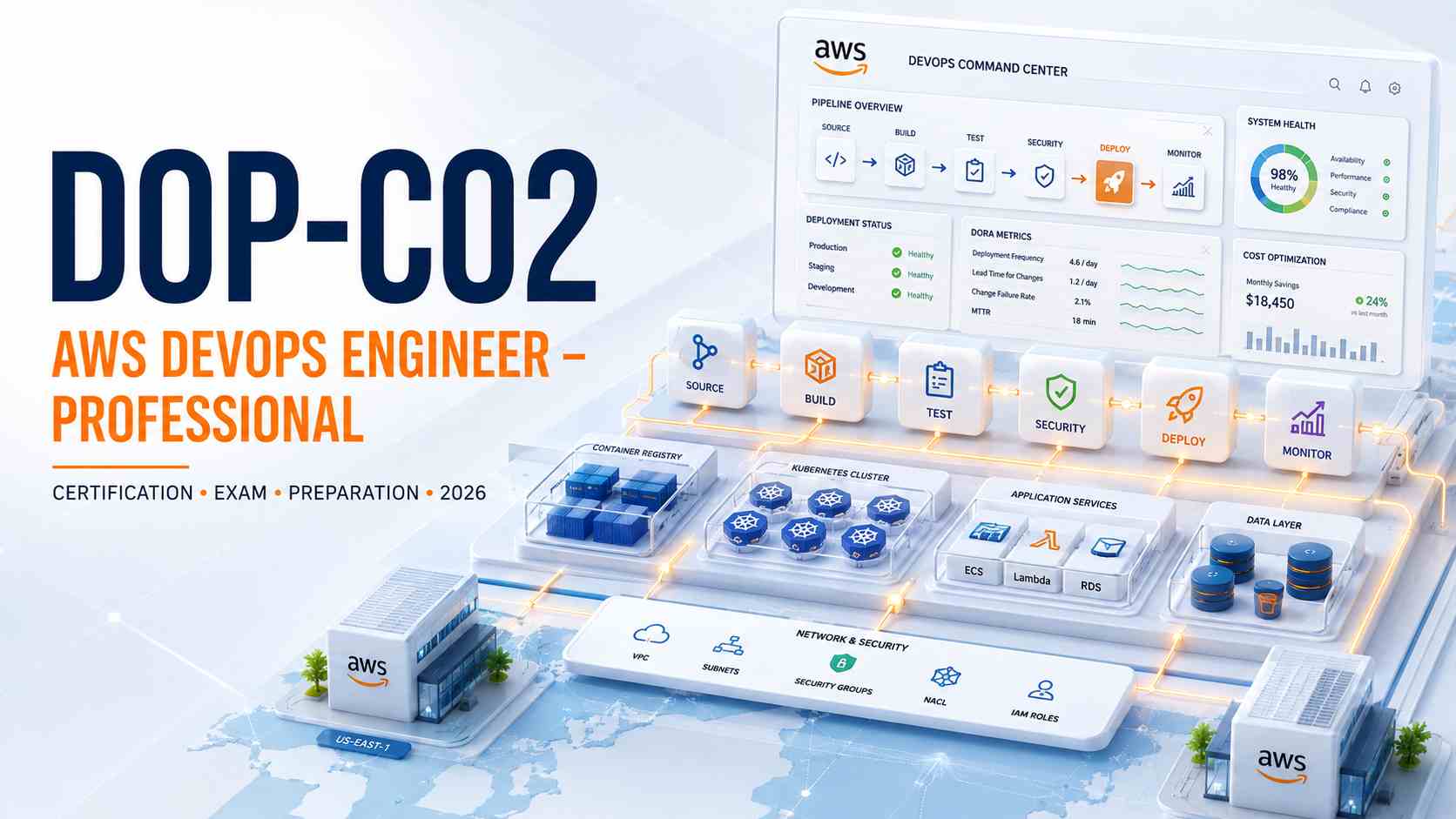
For AWS professionals, the DOP-C02 Certification 2026 remains one of the advanced credentials designed to demonstrate practical knowledge of running modern workloads on Amazon Web Services.Officially known as the AWS Certified DevOps Engineer – Professional, the certification focuses on areas such as continuous delivery, infrastructure as code, monitoring, resilient architecture, security, and incident management.
But professional-level certifications require a meaningful investment of time and effort. That raises an important question: Is the AWS DevOps Engineer Professional certification still worth pursuing in 2026?
This guide explains what the DOP-C02 exam covers, who should consider it, its potential career value, the difficulty involved, and how to approach DOP-C02 exam preparation effectively.
What Is the DOP-C02 Certification?
The DOP-C02 is the exam associated with the AWS Certified DevOps Engineer Professional certification.
It is intended primarily for experienced cloud and DevOps professionals who work with AWS environments and understand both software delivery and infrastructure operations.
Rather than testing only whether candidates recognize individual AWS services, the exam focuses heavily on how those services should work together in realistic situations.
Candidates may need to determine how to:
- Build reliable software delivery pipelines
- Manage infrastructure through code
- Design highly available AWS environments
- Monitor applications and infrastructure
- Respond to operational incidents
- Implement scalable security controls
- Manage configuration across multiple environments
- Improve deployment reliability
- Handle backup, recovery, and business continuity requirements
This makes the certification considerably more advanced than entry-level or associate-level AWS credentials.
DOP-C02 Exam Overview for 2026
The DOP-C02 exam is a professional-level AWS certification examination. Candidates can also review the official DOP-C02 exam guide for the current exam structure, content domains, question types, and scoring information.
The current exam format includes:
- Exam: AWS Certified DevOps Engineer – Professional
- Exam code: DOP-C02
- Level: Professional
- Duration: 180 minutes
- Questions: 75
- Question types: Multiple choice and multiple response
- Passing score: 750 on a scale of 100 – 1,000
- Recommended experience: At least two years working with AWS environments
The exam contains both scored and unscored questions. Candidates cannot identify which questions are unscored while taking the test, so every question should be treated seriously.
Professional-level AWS questions are commonly scenario-based. Instead of simply asking what a particular service does, questions may describe a business or technical problem and ask candidates to choose the most appropriate solution.
What Does the DOP-C02 Exam Cover?
The current DOP-C02 Certification 2026 syllabus is divided into six major knowledge areas. The official DOP-C02 exam guide provides the detailed tasks and requirements covered within each domain.
1. SDLC
This area focuses on managing the software development lifecycle in AWS environments.
Candidates should understand areas such as:
- Continuous integration and continuous delivery
- Deployment strategies
- Source control workflows
- Build and release processes
- Testing within deployment pipelines
- Multi-environment application delivery
You may encounter scenarios involving development, testing, staging, and production environments where applications need to move safely between different stages.
2. Configuration Management and Infrastructure as Code
Infrastructure as code is one of the most important topics for the AWS DevOps Engineer Professional exam.
Candidates should understand how cloud infrastructure can be defined, deployed, updated, and controlled consistently.
Important concepts include:
- AWS CloudFormation
- Infrastructure templates
- Configuration management
- Environment consistency
- Stack management
- Change management
- Multi-account deployments
For example, a company may operate dozens of AWS accounts and need a consistent method for deploying networking, logging, IAM, and security configurations across them.
The exam may ask you to determine the most scalable and manageable approach.
3. Resilient Cloud Solutions
Modern production systems must continue operating when individual components fail.
The DOP-C02 exam therefore tests your understanding of resilience, availability, scalability, and recovery.
Key areas include:
- Multi-AZ architectures
- Multi-Region strategies
- Scaling
- Backup and restoration
- Disaster recovery
- Recovery Time Objective (RTO)
- Recovery Point Objective (RPO)
- Failover strategies
- Self-healing infrastructure
Understanding the differences between high availability and disaster recovery is particularly important.
A highly available system attempts to remain operational during individual component failures, while a disaster recovery strategy focuses on restoring operations after a larger disruption.
4. Monitoring and Logging
DevOps engineers need visibility into what is happening across applications and infrastructure.
Candidates preparing for the DOP-C02 exam should understand how AWS monitoring and logging services can help identify performance problems, security events, infrastructure failures, and unusual behavior.
Important topics may include:
- Amazon CloudWatch
- AWS CloudTrail
- Application logs
- Metrics
- Alarms
- Dashboards
- Distributed monitoring
- Log aggregation
- Operational visibility
Questions often require more than recognizing the correct service.
You may need to determine which metrics should be monitored, where logs should be stored, when alerts should be triggered, and how teams should respond when thresholds are exceeded.
5. Incident and Event Response
Production incidents are inevitable, so engineers need reliable procedures for identifying and resolving them.
This section examines areas such as:
- Event-driven responses
- Incident investigation
- Operational troubleshooting
- Failed deployments
- Infrastructure failures
- Recovery procedures
- Root-cause analysis
For example, imagine that a new application release causes increased error rates immediately after deployment.
A DevOps engineer should be able to identify the problem through monitoring, determine what changed, limit the impact, restore a stable version, and collect enough information to investigate the underlying cause.
Understanding this complete lifecycle is more valuable than memorizing isolated AWS features.
6. Security and Compliance
Security is closely connected with modern DevOps practices.
Candidates should understand how security controls can be integrated into infrastructure and application delivery processes.
Areas worth studying include:
- AWS Identity and Access Management
- Role-based permissions
- Least privilege
- Secrets management
- Encryption
- Security monitoring
- Audit logging
- Policy enforcement
- Multi-account governance
- Compliance controls
Expect scenarios involving both technical security requirements and operational practicality.
The most restrictive solution is not necessarily always the best answer. The goal is often to identify an approach that satisfies security requirements while remaining scalable and manageable.
How Difficult Is the DOP-C02 Exam?
The DOP-C02 exam is challenging because it expects candidates to understand how AWS services interact in complex production environments.
The difficulty usually comes from three areas.
Long Scenario-Based Questions
Professional-level questions may contain significant context.
A scenario might describe:
- An organization’s current infrastructure
- Security requirements
- Business constraints
- Availability requirements
- Deployment processes
- Several AWS services
Candidates must separate important requirements from unnecessary information before choosing an answer.
Several Technically Possible Answers
In many questions, more than one solution may technically work.
The challenge is selecting the solution that best satisfies requirements such as:
- Operational efficiency
- Scalability
- Reliability
- Security
- Cost awareness
- Minimal administrative effort
This requires architectural judgment rather than simple memorization.
Broad AWS Knowledge
DevOps responsibilities touch many parts of AWS.
Candidates may need familiarity with compute, storage, networking, security, monitoring, deployment, containers, identity management, serverless services, databases, and infrastructure management.
You do not necessarily need specialist-level knowledge of every AWS service, but you should understand how major services fit into production architectures.
Who Should Take AWS DevOps Engineer Professional?
The AWS DevOps Engineer Professional certification is most appropriate for professionals who already work with AWS and want to validate advanced DevOps skills.
AWS describes the target candidate as someone with two or more years of experience provisioning, operating, and managing AWS environments, along with experience in software development life cycle practices and programming or scripting.
It may be suitable for:
- DevOps engineers
- Cloud engineers
- Cloud operations professionals
- Site reliability engineers
- Platform engineers
- Systems engineers
- Experienced developers working extensively with AWS
- Cloud infrastructure professionals
It can also be useful for professionals who are moving from general cloud operations into more specialized DevOps responsibilities.
Is the DOP-C02 Certification Worth It in 2026?
For the right professional, yes, the DOP-C02 Certification 2026 can still be worthwhile.
However, its value depends heavily on your experience and career direction.
It Can Be Worth It for AWS-Focused DevOps Engineers
If your current role already involves AWS infrastructure, deployment pipelines, monitoring, containers, infrastructure as code, or production operations, the certification aligns closely with practical responsibilities.
Preparing for the exam can also expose gaps in areas that may not appear regularly in your current environment.
For example, someone working mainly with single-Region applications may gain deeper knowledge of multi-Region recovery and enterprise governance while preparing.
It Can Be Valuable for Platform and Cloud Engineers
The certification is not limited to people with the exact title “DevOps Engineer.”
It may also be relevant to:
- Cloud engineers
- Platform engineers
- Site reliability engineers
- Infrastructure engineers
- Cloud consultants
- Systems engineers
- Senior backend engineers with infrastructure responsibilities
- Technical leads managing AWS environments
The common factor is responsibility for operating and delivering production workloads on AWS.
It Can Help Validate Advanced AWS Knowledge
Professional certifications can provide a structured way to demonstrate that your AWS knowledge extends beyond introductory concepts.
This may be useful when applying for roles where employers expect strong AWS experience.
However, certification should complement real experience rather than replace it.
Being able to explain how you designed a deployment system, investigated production failures, reduced downtime, improved monitoring, or managed infrastructure through code will generally demonstrate more practical depth than certification alone.
DOP-C02 Certification vs Real-World Experience
One of the most important considerations in 2026 is understanding the relationship between certification and experience.
They serve different purposes.
Certification demonstrates structured knowledge across a defined AWS syllabus.
Experience demonstrates that you can apply that knowledge when real production systems behave unexpectedly.
For example, knowing different deployment strategies is useful.
But production experience teaches additional lessons such as:
- How to investigate failed releases
- How to communicate during incidents
- How to decide when to roll back
- How to reduce deployment risk
- How to monitor application health
- How to balance reliability against cost
- How to troubleshoot unexpected dependencies
The strongest professional profile normally combines both.
Effective DOP-C02 Exam Preparation
A structured DOP-C02 exam preparation strategy is more effective than studying AWS services randomly.
If you are looking for structured DOP-C02 exam preparation, you can also explore the CertsGate preparation resources for this certification.
Start With the Exam Domains
Use the six exam domains as your study framework.
Identify which areas you already understand and which require additional work.
Someone experienced with CI/CD, for example, might need more study around compliance or disaster recovery.
Build Practical AWS Environments
Hands-on practice is particularly important for professional-level exams.
Try building environments that involve:
- Infrastructure as code
- Deployment pipelines
- Monitoring and logging
- IAM roles and policies
- High availability
- Backup and recovery
- Application scaling
- Container deployments
The objective should be understanding why one architecture is preferable to another.
Practice Architecture Scenarios
Do not restrict your preparation to questions such as:
“What does this AWS service do?”
Instead, ask:
“Under what circumstances would I select this service over another?”
That distinction reflects the type of reasoning professional-level questions often require.
Study Trade-Offs
Many AWS architecture decisions involve trade-offs.
During DOP-C02 exam preparation, compare solutions according to:
- Reliability
- Cost
- Security
- Performance
- Scalability
- Management effort
- Recovery requirements
Understanding trade-offs helps when multiple answers appear technically correct.
Use Practice Questions Carefully
Practice questions can help you become comfortable with the structure of the exam.
However, focus on understanding why an answer is correct rather than memorizing responses.
After answering a practice question incorrectly, investigate:
- Which requirement you missed
- Why your selected option was weaker
- Why the correct solution better satisfied the scenario
- Which AWS concept requires further study
This turns each mistake into a learning opportunity.
Common DOP-C02 Preparation Mistakes
Candidates can make professional-level certification preparation harder by following the wrong approach.
Common mistakes include:
- Memorizing AWS service descriptions without understanding architecture
- Ignoring infrastructure as code
- Spending too little time on security
- Studying individual services without understanding integrations
- Avoiding hands-on practice
- Ignoring RTO and RPO concepts
- Focusing only on deployment and overlooking operations
- Memorizing practice questions
- Failing to practice time management
A better approach combines conceptual study, practical experience, architecture scenarios, and exam-style questions.
Who Should Take the DOP-C02 Exam in 2026?
The DOP-C02 Certification 2026 is best suited to professionals who already have meaningful exposure to AWS.
It is particularly relevant if you:
- Manage production workloads on AWS
- Build or maintain delivery pipelines
- Work extensively with infrastructure as code
- Manage monitoring and logging
- Handle production incidents
- Design resilient cloud architectures
- Manage cloud security and permissions
- Work across development and operations teams
If several of these activities are already part of your job, DOP-C02 can be a logical next step.
Final thought: Is AWS DevOps Engineer Professional Still Worth It?
The AWS DevOps Engineer Professional certification remains relevant in 2026 for experienced professionals working extensively with AWS infrastructure and software delivery.
Its value comes from the breadth and depth of the skills it covers. Candidates need to understand not only deployment processes but also resilience, infrastructure as code, monitoring, security, incident response, and large-scale AWS operations.
However, DOP-C02 should not be viewed as a shortcut into a DevOps career.
For beginners, developing hands-on AWS experience should generally come first. For experienced engineers, the certification can provide a structured way to strengthen existing knowledge and demonstrate professional-level AWS expertise.
Ultimately, the DOP-C02 Certification 2026 is most worthwhile when it supports an existing career direction. If AWS is central to your work and you regularly deal with production systems, infrastructure, reliability, and software delivery, preparing for DOP-C02 can be a useful professional development goal.
Frequently Asked Questions
Is DOP-C02 still valid in 2026?
Yes. DOP-C02 is the current exam code for the AWS Certified DevOps Engineer – Professional certification in 2026.
Is the DOP-C02 exam difficult?
Yes, it is considered an advanced professional-level AWS exam. It requires broad AWS knowledge and the ability to solve complex scenario-based problems rather than recall service definitions.
How much AWS experience should I have before taking DOP-C02?
AWS recommends at least two years of experience provisioning, operating, and managing AWS environments. Practical experience with software development processes and scripting is also useful.
Is AWS DevOps Engineer Professional good for beginners?
Generally, no. Beginners will usually benefit from first developing strong AWS fundamentals and gaining practical cloud experience before attempting a professional-level certification.
Is DOP-C02 worth getting for a DevOps career?
It can be valuable for professionals whose work involves AWS, cloud infrastructure, deployment pipelines, monitoring, infrastructure as code, security, and production operations. However, certification provides the most value when combined with practical experience.