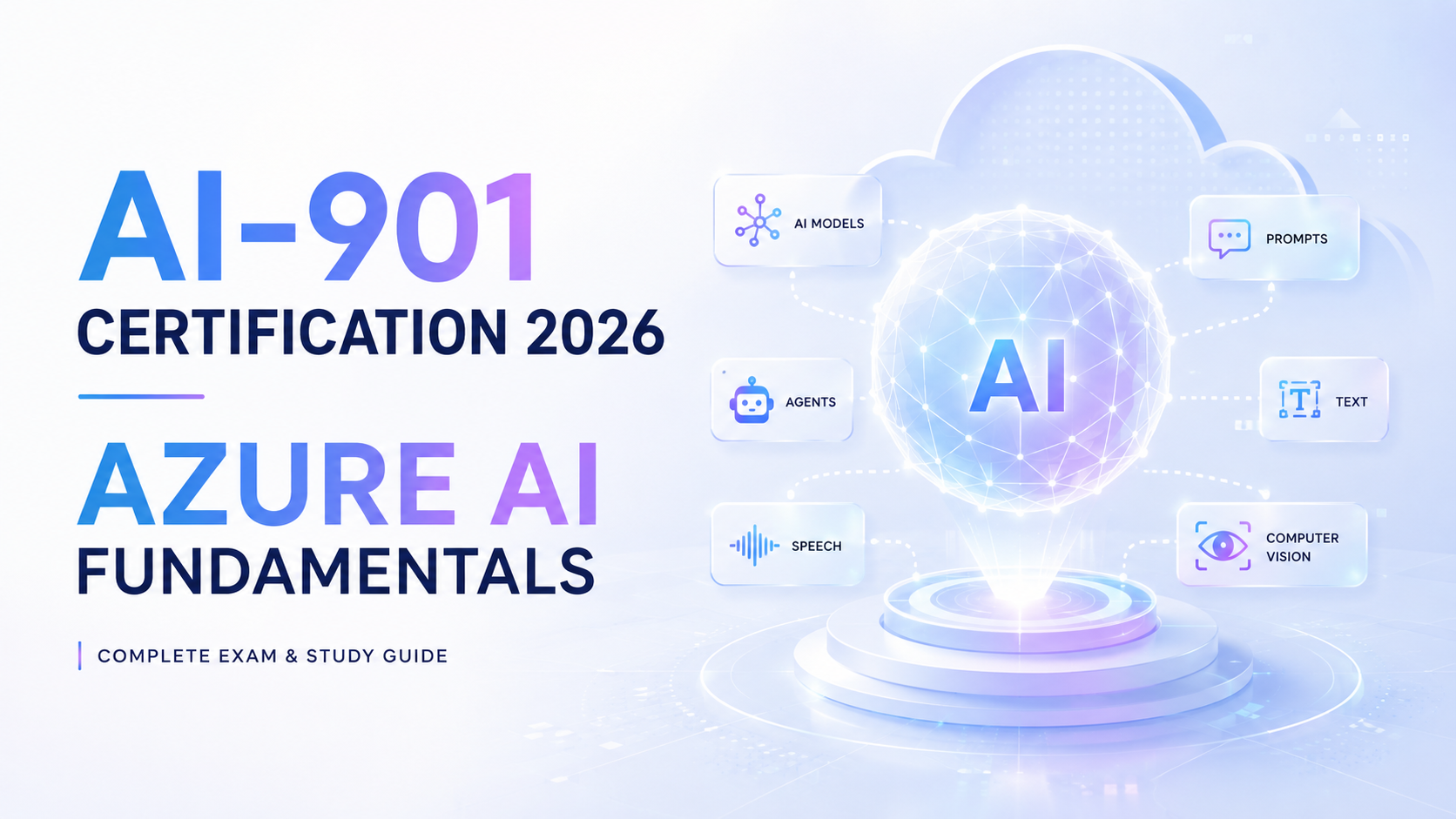
Microsoft has updated its entry-level Azure artificial intelligence certification path for 2026, making the AI-901 Certification an important starting point for professionals who want to understand modern AI solutions on Microsoft Azure.
The AI-901 Exam replaces the retired AI-900 exam while continuing to support the Microsoft Certified: Azure AI Fundamentals credential. AI-900 retired on June 30, 2026, and candidates can now earn the Azure AI Fundamentals certification by passing AI-901.
Unlike a purely conceptual fundamentals exam, AI-901 introduces candidates to both core concepts and practical implementation skills. It covers responsible AI, generative models, different AI workloads, Microsoft Foundry, text and speech solutions, computer vision, agents, and information extraction.
This AI-901 Study Guide explains what the certification covers, who should consider it, the major exam domains, important technical concepts, and a practical AI-901 Exam Preparation roadmap for 2026.
Candidates looking for structured AI-901 exam preparation can also explore the AI-901 preparation resources available through CertsGate.
What Is the AI-901 Certification?
The AI-901 Certification refers to the Microsoft Azure AI Fundamentals certification path based on the AI-901 exam.
It is designed primarily for people who are beginning their journey with AI solution development on Azure. Candidates are expected to understand fundamental AI concepts as well as basic technical skills required to interact with Azure-based AI services.
Microsoft states that candidates should have conceptual knowledge of Azure AI solutions, familiarity with Azure resources, and an understanding of basic Python syntax and programming techniques. Familiarity with REST APIs, SDKAs, and command-line interfaces can also help with preparation.
The certification can therefore be relevant for:
- Students entering cloud or technology careers
- Junior developers
- Cloud professionals exploring AI services
- Software developers working with Azure
- Technical consultants
- Solution architects building foundational AI knowledge
- Professionals preparing for more advanced Microsoft certifications
The exam is positioned at the fundamentals level, but the updated AI-901 objectives include more hands-on concepts than candidates may expect from an introductory certification.
AI-901 vs. AI-900: What Changed in 2026?
One of the most important things candidates should understand is the transition from AI-900 to AI-901.
The AI-900 Microsoft Azure AI Fundamentals exam was retired on June 30, 2026, and AI-901 became its replacement. The underlying certification remains Microsoft Certified: Azure AI Fundamentals.
AI-901 places stronger emphasis on current Azure AI development workflows.
Instead of focusing mainly on identifying services and explaining basic concepts, candidates are now expected to understand how AI solutions can be implemented through Microsoft Foundry and related Azure capabilities.
This means preparation should include both theoretical understanding and practical familiarity with the services mentioned in the current exam objectives.
Who Should Take the AI-901 Exam?
The AI-901 Exam is suitable for people who want foundational knowledge before moving into more specialized cloud or development roles.
You do not need to be an experienced machine learning engineer to begin studying for the exam. However, basic technical knowledge will make preparation easier.
The Certification May Be Suitable If You:
- Are new to Azure AI services
- Want to understand how modern AI workloads operate
- Need foundational knowledge before studying advanced Azure technologies
- Work with developers, architects, or data teams
- Want to understand Microsoft Foundry
- Are beginning to work with generative applications or AI agents
- Need basic knowledge of computer vision, speech, and language solutions
For example, a junior developer who has previously created standard web applications may use AI-901 preparation to understand how an application can interact with deployed models, analyze documents, interpret images, or process speech.
AI-901 Exam Skills Measured
According to the current exam outline, the Microsoft Azure AI Fundamentals AI-901 exam is divided into two major domains:
- Identify AI concepts and capabilities (40% to 45%)
- Implement AI solutions by using Microsoft Foundry (55% to 60%)
This weighting is important because more than half of the assessment focuses on implementing solutions through Microsoft Foundry.
1. Identify AI Concepts and Capabilities
This section represents approximately 40% to 45% of the examination.
Candidates need to understand responsible AI principles, model concepts, and common workload types.
Responsible AI Principles
Responsible systems should be designed with technical and ethical considerations in mind.
Candidates should understand concepts such as:
- Fairness
- Reliability
- Safety
- Privacy
- Security
- Inclusiveness
- Transparency
- Accountability
A practical example would be a financial application that evaluates customer information. Developers must consider whether the system treats different groups fairly, protects sensitive information, produces reliable results, and allows decisions to be explained appropriately.
AI Models and Configuration
Candidates should also understand how generative models work at a foundational level.
Important topics include:
- Model capabilities
- Choosing an appropriate model
- Model deployment options
- Configuration parameters
- Differences between workloads and model types
You do not necessarily need advanced mathematical knowledge, but you should understand why different models may be suitable for different tasks.
For example, a model designed primarily for text generation may serve a different purpose from one designed to interpret both images and text.
Common AI Workloads
The AI-901 Study Guide should also cover common workload categories.
These include:
- Generative AI
- Agent-based solutions
- Text analysis
- Speech processing
- Computer vision
- Information extraction
Microsoft’s current objectives also include concepts such as sentiment analysis, entity detection, keyword extraction, summarization, speech recognition, speech synthesis, im
summarization, speech recognition, speech synthesis, image interpretation, and extracting information from multiple content formats.
2. Implement AI Solutions Using Microsoft Foundry
This is the largest part of the AI-901 Exam, representing approximately 55% to 60% of the assessment.
Candidates should therefore spend a significant portion of their study time becoming familiar with Microsoft Foundry and its development workflow.
Generative Applications and Agents
Candidates should understand how generative applications can be created and tested.
Topics include:
- Creating system prompts
- Creating user prompts
- Deploying models
- Interacting with deployed models
- Using the Foundry portal
- Working with the Foundry SDK
- Creating basic chat applications
- Creating and testing single-agent solutions
Real-World Example
Imagine a company wants an internal assistant that answers employee questions about company policies.
A model could be deployed in Microsoft Foundry, instructions could define how it should respond, and a lightweight application could send user questions to the deployed model.
AI-901 does not require candidates to become advanced application architects, but they should understand the fundamental components involved in this type of solution.
Text and Speech Solutions
Another important area of AI-901 Exam Preparation involves text and speech capabilities.
Candidates should understand how Azure services can be used for tasks such as:
- Analyzing text
- Processing spoken input
- Converting speech into usable information
- Producing spoken responses
- Building applications that incorporate speech capabilities
For example, a customer service application might accept a spoken question, process the user’s request, and return an appropriate response.
Understanding the purpose of each component is more important than memorizing isolated product names.
Computer Vision and Image Capabilities
Computer vision allows applications to interpret information contained in images and other visual input.
For AI-901, candidates should understand areas such as:
- Interpreting visual prompts
- Working with multimodal models
- Creating visual outputs
- Integrating vision capabilities into lightweight applications
A practical example would be an application that receives a photograph of a product and extracts useful information from the image.
Another example could involve inspecting an uploaded image and answering questions about what appears inside it.
Information Extraction
Information extraction is another major part of the current exam objectives.
Candidates should understand how information can be extracted from:
- Documents
- Forms
- Images
- Audio
- Video
The current objectives specifically include Azure Content Understanding within Foundry Tools.
Consider an organization receiving hundreds of invoices.
Instead of requiring employees to manually locate supplier names, invoice numbers, dates, and totals, an information extraction solution could identify structured information from each document.
For the exam, focus on understanding what these services accomplish and when they are appropriate.
Basic Python Knowledge for AI-901
One significant difference candidates should recognize is that AI-901 assumes some familiarity with Python syntax and programming techniques. Microsoft lists Python knowledge among the expected skills for candidates.
You do not need to become an advanced Python developer before attempting the exam.
However, you should understand basic concepts such as:
- Variables
- Strings
- Lists
- Functions
- Function arguments
- Conditional statements
- Basic code structure
- Calling libraries or SDK methods
- Reading simple Python examples
The goal is to understand lightweight application examples rather than develop complex software from memory.
Understanding Azure Resources
Candidates should also be comfortable with basic Azure terminology.
Review concepts such as:
- Azure subscriptions
- Resource groups
- Azure resources
- Service endpoints
- Authentication
- Access permissions
- Deployment
- Cloud storage
- Cloud compute
If you have never worked with Azure before, spending some time exploring basic Azure concepts can make the technical sections of the AI-901 exam easier to understand.
AI-901 Exam Preparation Roadmap
A structured approach can make AI-901 Exam Preparation more manageable.
Step 1: Understand the Exam Objectives
Begin with the current AI-901 skills outline.
Create two major study categories:
- AI concepts and capabilities
- Microsoft Foundry implementation
Because the Foundry section carries the greater exam weighting, allocate more preparation time to it.
Step 2: Learn the Core Concepts
Build a strong understanding of:
- Responsible AI
- Model fundamentals
- Generative models
- Text processing
- Speech
- Computer vision
- Information extraction
- Agent concepts
Avoid memorizing definitions without understanding when each concept would be used.
Step 3: Learn Microsoft Foundry
Spend time understanding the basic Foundry workflow.
Focus on:
- Finding and selecting models
- Deploying a model
- Interacting with models
- Working with prompts
- Understanding SDK-based applications
- Building basic agent solutions
- Using Foundry Tools
Hands-on familiarity can make scenario-based questions easier to interpret.
Step 4: Review Basic Python
Practice reading short Python examples.
You should be comfortable identifying what a simple piece of code does, particularly when it interacts with an Azure service or SDK.
Step 5: Study Through Scenarios
Scenario-based learning is often more useful than memorizing large lists.
For example:
Scenario: A company needs to determine whether customer reviews are positive or negative.
Relevant concept: Sentiment analysis.
Scenario: A business wants to extract values from scanned forms.
Relevant concept: Information extraction.
Scenario: An application needs to understand an uploaded photograph.
Relevant concept: Computer vision or a multimodal model.
This approach helps connect technologies with business requirements.
Step 6: Practice Exam-Style Questions
Practice questions can help identify weak areas.
For additional exam-focused practice, candidates can also explore CertsGate’s AI-901 exam preparation resources.
After completing a set of questions, review why each incorrect answer was wrong instead of simply memorizing the correct option.
Keep a list of topics that repeatedly cause difficulty and revisit them before the exam.
Common AI-901 Preparation Mistakes
Avoiding common mistakes can improve the efficiency of your study plan.
Studying Old AI-900 Material Only
Some AI-900 concepts remain relevant, but AI-901 has a different structure and stronger implementation focus.
Use study material aligned specifically with the current AI-901 objectives.
Ignoring Microsoft Foundry
Foundry-related implementation skills account for the majority of the exam.
Candidates who study only general concepts may leave a significant part of the syllabus uncovered.
Memorizing Without Understanding
Knowing that a service exists is not always enough.
Try to understand:
- What problem it solves
- What input it accepts
- What output it produces
- When it should be used
Avoiding Hands-On Practice
Even basic experimentation can make technical terminology easier to remember.
Practical exposure helps connect concepts that may otherwise seem unrelated.
Ignoring Python Completely
AI-901 is still a fundamentals certification, but basic Python familiarity is part of the expected candidate profile.
Learning simple syntax early can prevent unnecessary difficulty later.
What Is the AI-901 Passing Score?
Microsoft currently lists the passing score for the AI-901 Exam as 700.
The number does not necessarily mean that candidates must answer exactly 70% of questions correctly because certification exam scoring can use scaled scoring.
Instead of focusing on a specific percentage, candidates should aim for consistent understanding across every objective.
Is AI-901 Difficult for Beginners?
AI-901 is intended for people near the beginning of their technical journey, but “fundamentals” should not be interpreted as requiring no preparation.
The exam combines conceptual knowledge with practical Azure topics.
Candidates with previous experience in Azure, Python, cloud computing, or software development may find certain sections easier.
Complete beginners may need additional time for:
- Azure terminology
- Python basics
- Microsoft Foundry
- Model deployment concepts
- SDK terminology
A structured study plan can make these areas manageable.
Is the AI-901 Certification Worth Considering in 2026?
The value of any certification depends on a person’s role, experience, and career direction.
The AI-901 Certification can be useful as a foundational credential for people who need structured knowledge of Microsoft Azure AI technologies.
It can help candidates understand terminology and concepts that appear in more advanced development, cloud, and architecture environments.
However, certification alone does not replace practical experience.
Someone planning to work professionally with Azure solutions should combine exam preparation with hands-on projects, programming practice, and broader cloud knowledge.
Final Thoughts
The AI-901 Certification represents Microsoft’s updated fundamentals-level route for candidates learning about modern AI solutions in Azure.
The exam goes beyond basic definitions. Candidates need to understand responsible AI concepts, model capabilities, common workloads, Microsoft Foundry, generative applications, agents, text and speech processing, computer vision, information extraction, Azure resources, and basic Python.
A strong AI-901 Exam Preparation strategy should therefore combine conceptual study with practical exploration.
Start with the official exam domains, spend additional time on Microsoft Foundry because of its greater weighting, practice basic Python, work through realistic scenarios, and regularly test your understanding.
With a structured AI-901 Study Guide and consistent preparation, beginners can build the foundation needed to approach the Microsoft Azure AI Fundamentals exam with a clearer understanding of both the concepts and their practical applications.
Frequently Asked Questions
1. What is the AI-901 Certification?
The AI-901 Certification is the current exam route for earning the Microsoft Certified: Azure AI Fundamentals credential. It covers foundational concepts and practical implementation skills related to Microsoft Azure AI services.
2. Did AI-901 replace AI-900?
Yes. Microsoft retired the AI-900 exam on June 30, 2026, and AI-901 replaced it as the exam for the Azure AI Fundamentals certification.
3. Do I need programming experience for the AI-901 Exam?
Advanced programming experience is not required, but candidates should understand basic Python syntax and programming techniques. Familiarity with Azure resources is also recommended.
4. What topics should I focus on for AI-901 Exam Preparation?
Focus on responsible AI, model concepts, common workloads, Microsoft Foundry, generative applications, agents, text and speech solutions, computer vision, information extraction, Azure fundamentals, and basic Python.
5. What is the passing score for AI-901?
The current passing score for the AI-901 exam is 700. Candidates should prepare across all exam objectives rather than relying on one strong topic area.