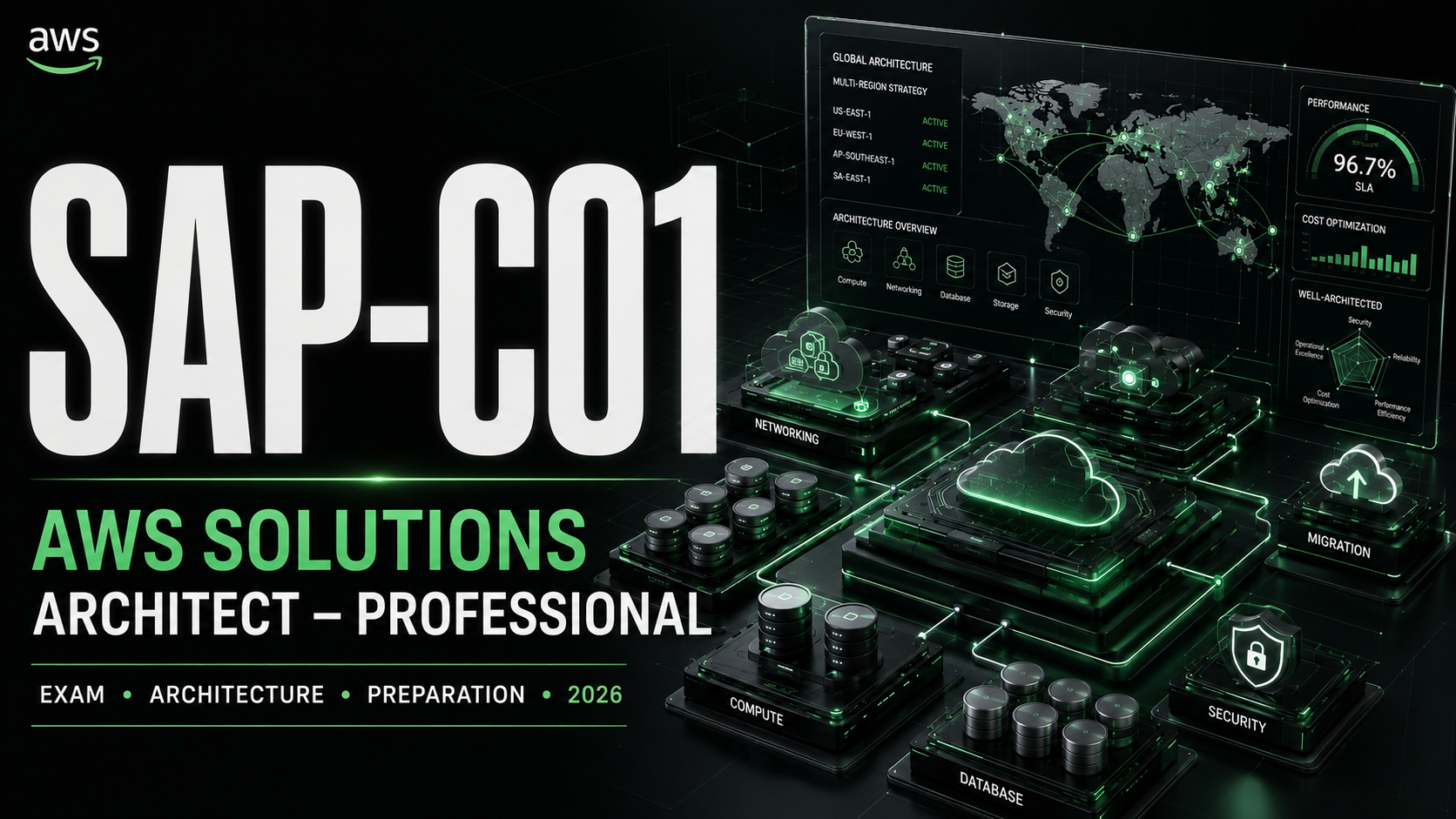

AWS architecture becomes significantly more challenging when systems grow beyond a few services, regions, or workloads. Architects must think about security, availability, networking, migration, performance, cost, and business requirements at the same time.
That is why the AWS Solutions Architect Professional SAP-C01 exam became known as one of the more demanding AWS certification exams. It tested whether candidates could move beyond individual AWS services and make architectural decisions for complex environments.
There is one important point for candidates researching the certification in 2026: SAP-C01 is the previous version of the AWS Certified Solutions Architect – Professional exam. The current exam is SAP-C02.
However, people still search for terms such as SAP-C01 study guide 2026, AWS SAP-C01 practice questions, and SAP-C01 certification guide. Many of the architectural principles associated with SAP-C01 remain useful when building the deeper knowledge required for today’s Solutions Architect Professional certification.
This guide explains what SAP-C01 covered, the skills candidates should develop, important AWS architecture areas, preparation strategies, practice-question techniques, and practical AWS Solutions Architect Professional exam tips.
What Is AWS Solutions Architect Professional SAP-C01?
The AWS Solutions Architect Professional SAP-C01 was an earlier exam version associated with the AWS Certified Solutions Architect – Professional certification.
It focused on advanced cloud architecture rather than simple service definitions. Candidates were expected to understand how AWS technologies could be combined to solve complex technical and business problems.
The certification path is designed for professionals working with large or complicated AWS environments. Typical responsibilities can include:
- Designing scalable cloud architectures
- Creating highly available applications
- Planning disaster recovery
- Building secure networking architectures
- Managing multiple AWS accounts
- Migrating workloads to AWS
- Selecting suitable storage and database services
- Improving application performance
- Controlling infrastructure costs
- Evaluating architectural trade-offs
In 2026, candidates pursuing the certification should prepare for SAP-C02, the current AWS Certified Solutions Architect – Professional exam. AWS describes the current certification as validating advanced skills in designing optimized AWS solutions based on the AWS Well-Architected Framework.
SAP-C01 vs. SAP-C02: What Candidates Should Know in 2026
Anyone finding an older SAP-C01 certification guide should first understand the distinction between the two exam codes.
SAP-C01 represents the previous exam version, while SAP-C02 is the current version of AWS Certified Solutions Architect – Professional.
This does not make every SAP-C01 learning resource useless. Fundamental architecture principles such as high availability, scalability, network design, security, migration, and cost optimization continue to matter.
However, candidates should not depend entirely on old SAP-C01 material.
AWS services change over time. Features are introduced, architectures evolve, and certification objectives are updated. Older study material should therefore be treated as supplementary learning rather than the primary source of exam preparation.
A practical SAP-C01 study guide 2026 should help candidates understand foundational Professional-level concepts while directing actual certification preparation toward the current SAP-C02 objectives.
What Does the Current SAP-C02 Exam Cover?
The current SAP-C02 exam organizes its objectives into four broad content domains:
- Design Solutions for Organizational Complexity
- Design for New Solutions
- Continuous Improvement for Existing Solutions
- Accelerate Workload Migration and Modernization
These domains reflect the responsibilities of architects working with complex AWS environments. Candidates should also understand the principles of the AWS Well-Architected Framework, which provides guidance for designing secure, reliable, efficient, and cost-effective cloud architectures.
Rather than memorizing hundreds of AWS features, candidates need to understand how architecture decisions affect business and technical outcomes.
Organizational Complexity
Enterprise AWS environments often contain multiple accounts, departments, workloads, development teams, and security requirements.
Candidates should understand concepts involving:
- AWS Organizations
- Multi-account architecture
- Organizational units
- Identity and access management
- Centralized security controls
- Resource sharing
- Governance
- Hybrid connectivity
- Centralized logging
Consider a company with separate development, testing, production, finance, and security teams.
Putting everything into one AWS account may create unnecessary security and operational complexity. A better architecture could use separate AWS accounts with centralized governance and clearly defined access policies.
Questions at the Professional level often require candidates to recognize architectural patterns like this rather than identify an AWS service.
Designing Reliable AWS Architectures
Reliability is one of the most important areas for a Solutions Architect.
A reliable application should continue operating when individual infrastructure components fail.
Candidates should understand:
- Multiple Availability Zone architectures
- Application Load Balancers
- Auto Scaling
- Route 53 routing strategies
- Amazon RDS Multi-AZ configurations
- Amazon Aurora
- Amazon S3 durability concepts
- Backup strategies
- Cross-Region architectures
- Recovery objectives
Understanding RTO and RPO
Two important disaster recovery concepts are:
Recovery Time Objective (RTO): How quickly a workload must return to operation following a disruption.
Recovery Point Objective (RPO): How much data loss the organization can tolerate.
For example, an internal reporting application might tolerate several hours of downtime.
A payment-processing application may require much shorter recovery times and minimal data loss.
The architect must select a disaster recovery strategy that matches those requirements rather than simply choosing the most expensive option.
Networking Knowledge for SAP-C01 and Professional-Level Preparation
Networking is another area where candidates often struggle.
You should be comfortable with:
- Amazon VPC
- Public and private subnets
- Route tables
- Internet gateways
- NAT gateways
- Security groups
- Network ACLs
- VPC peering
- AWS Transit Gateway
- AWS Direct Connect
- Site-to-Site VPN
- Private connectivity
- DNS architecture
- Hybrid networking
Professional-level questions may describe a company with dozens or hundreds of VPCs across several AWS accounts.
Creating individual VPC peering connections between every network could become difficult to manage. A centralized networking architecture may therefore provide a more scalable solution.
The important skill is not memorizing which AWS networking services exist. It is understanding when one architecture becomes more suitable than another.
Security and Identity Management
Security should be considered throughout the architecture rather than added after deployment.
Important areas include:
- AWS Identity and Access Management
- IAM roles
- IAM policies
- AWS Organizations
- Service control policies
- AWS Key Management Service
- AWS Secrets Manager
- AWS Certificate Manager
- AWS WAF
- AWS Shield
- Amazon GuardDuty
- AWS CloudTrail
- AWS Config
- Encryption at rest
- Encryption in transit
- Least-privilege access
Candidates should understand the difference between authentication, authorization, encryption, monitoring, and governance.
Real-World Security Example
Imagine that an application running on Amazon EC2 needs access to an S3 bucket.
Storing permanent access keys directly on the server would create unnecessary security risk.
A better architecture normally uses an IAM role that provides the EC2 workload with only the permissions it requires.
Professional-level questions often include several technically possible options. The task is to identify the option that offers the best combination of security, scalability, maintainability, and operational simplicity.
Storage and Database Architecture
Different applications require different storage and database technologies.
Candidates should understand when to consider services such as:
- Amazon S3
- Amazon EBS
- Amazon EFS
- Amazon FSx
- Amazon RDS
- Amazon Aurora
- Amazon DynamoDB
- Amazon ElastiCache
- Amazon Redshift
Do not simply memorize definitions.
Instead, compare services according to factors such as:
- Data structure
- Access patterns
- Performance
- Availability
- Scalability
- Consistency requirements
- Backup requirements
- Geographic distribution
- Cost
- Management overhead
For example, a traditional transactional application may require a relational database, while a workload handling extremely large numbers of key-value requests may have different database requirements.
Architecture begins with the workload, not the service name.
Migration and Modernization
Migration plays an important role in Professional-level AWS architecture.
AWS includes migration and modernization within the current SAP-C02 objectives.
Candidates should understand general migration approaches such as:
- Rehosting
- Replatforming
- Refactoring
- Retiring unnecessary systems
- Retaining workloads temporarily
- Moving data between environments
- Migrating databases
- Creating hybrid environments
A company might initially move an application to AWS with minimal changes because of a strict deadline.
Later, the organization may redesign parts of the application to take greater advantage of managed AWS services.
Both decisions can be reasonable depending on business requirements.
Professional-level architecture questions frequently test this ability to balance ideal architecture against real-world constraints.
Cost Optimization
The cheapest architecture is not automatically the best architecture.
Cost optimization means meeting business requirements without unnecessary spending.
Candidates should understand areas including:
- EC2 purchasing options
- Savings Plans
- Storage classes
- Data-transfer costs
- Right-sizing
- Scaling strategies
- Managed services
- Serverless architectures
- Reserved capacity
- Monitoring resource utilization
For example, continuously running oversized compute instances may waste money if workload demand changes substantially throughout the day.
However, reducing infrastructure too aggressively could affect performance and availability.
Architects must balance cost with reliability, security, performance, and operational requirements.
How to Build a SAP-C01 Study Guide for 2026
Because SAP-C01 is an older exam version, your preparation plan should focus on current Professional-level skills rather than trying to reproduce an outdated exam.
For current exam objectives, candidates should review the official AWS Certification Exam Guides and focus on the SAP-C02 requirements.
A practical study strategy can be divided into several stages.
Step 1: Strengthen AWS Fundamentals
Before studying complex architectures, make sure you understand core services.
Review:
- EC2
- S3
- VPC
- Route 53
- IAM
- RDS
- DynamoDB
- Lambda
- CloudFront
- CloudWatch
- CloudFormation
You should know what these services do and how they interact.
Step 2: Move From Services to Architecture
Instead of studying Amazon RDS by itself, ask questions such as:
- How would I make this database highly available?
- How would I recover it after a regional disruption?
- How would applications connect securely?
- How would I scale read traffic?
- How would I migrate an existing database?
- What would influence cost?
This type of thinking is much closer to Professional-level architecture.
Step 3: Study Architecture Trade-Offs
Create comparison notes for technologies that solve similar problems.
Examples include:
- Site-to-Site VPN vs. Direct Connect
- NAT Gateway vs. VPC endpoints
- RDS vs. DynamoDB
- EBS vs. EFS vs. S3
- CloudFront vs. Global Accelerator
- Multi-AZ vs. Multi-Region
- VPC peering vs. Transit Gateway
Focus on understanding the reason behind each choice.
Step 4: Build Practical Architectures
Hands-on practice helps turn theoretical knowledge into architectural understanding.
Try designing environments involving:
- A three-tier web application
- A multi-account organization
- A hybrid corporate network
- A highly available database
- A disaster recovery environment
- A globally distributed web application
Even simple labs can reveal relationships that are difficult to understand through reading alone.
Step 5: Practice Scenario-Based Questions
Once the major concepts are clear, begin working through realistic architecture scenarios.
For additional preparation resources, candidates can explore CertsGate’s for practice and exam readiness.
Do not focus only on getting the correct answer.
After every question, determine:
- What was the actual business requirement?
- Which technical requirement mattered most?
- Which services were relevant?
- Why was the correct option stronger?
- Why were the other options weaker?
This approach makes practice questions far more valuable.
AWS Solutions Architect Professional Exam Tips
Professional-level questions can contain long scenarios with several technical details.
The following AWS Solutions Architect Professional exam tips can make them easier to approach.
Identify the Main Requirement First
Look for phrases indicating priorities such as:
- Lowest operational overhead
- Lowest cost
- Highest availability
- Minimal downtime
- Least administrative effort
- Strongest security
- Fastest migration
- Minimal application changes
Several answers may technically work, but only one may satisfy the stated priority.
Separate Requirements From Background Information
Long questions often include more information than you need.
Identify:
Current environment → Problem → Constraints → Desired result
This makes complicated scenarios easier to process.
Eliminate Clearly Weak Answers
Instead of immediately searching for the perfect answer, remove options that:
- Violate security principles
- Create single points of failure
- Require unnecessary management
- Ignore stated requirements
- Cannot scale appropriately
You may reduce four possible answers to two relatively quickly.
Avoid Choosing Services Based Only on Familiarity
A familiar service is not necessarily the best service.
Choose the architecture based on requirements rather than the AWS products you have used most often.
Watch for Operational Complexity
If two solutions meet the technical requirement, but one requires considerably more manual administration, the managed or simpler architecture may be the stronger choice
when the scenario specifically asks for reduced operational overhead.
How to Use AWS SAP-C01 Practice Questions Effectively
Older AWS SAP-C01 practice questions can still help reinforce fundamental architectural reasoning, but they should not be treated as an exact representation of the current exam.
AWS services and exam objectives evolve.
Use older questions primarily to practice:
- Requirement analysis
- Architecture comparison
- Networking concepts
- Security decisions
- High-availability design
- Migration reasoning
- Cost optimization
For current certification preparation, practice material should align with SAP-C02.
Create an Error Log
Keep a simple record containing:
- Topic
- Question type
- Your answer
- Correct concept
- Why you were wrong
- What you need to review
After several practice sessions, patterns will begin to appear.
If most mistakes involve networking, for example, spending another week answering random questions may be less effective than studying networking deeply.
Common Preparation Mistakes
Memorizing Answers
Memorized answers provide little value when the wording or architecture changes.
Learn the underlying concept instead.
Studying Every AWS Service Equally
AWS offers a very large range of services.
Professional-level preparation should prioritize architectural services and concepts relevant to the exam rather than treating every product with equal importance.
Ignoring Networking
Strong knowledge of compute and storage alone is insufficient.
Complex networking scenarios are an important part of advanced AWS architecture.
Ignoring Business Requirements
Professional architects do not choose technologies in isolation.
Architecture decisions should support cost, performance, compliance, recovery, security, and organizational objectives.
Depending Completely on SAP-C01 Material
This is particularly important in 2026.
SAP-C01 resources may explain valuable architecture concepts, but candidates taking the certification today should align their final preparation with SAP-C02 because AWS currently lists SAP-C02 as the active Solutions Architect – Professional exam.
A Simple 8-Week Study Plan
Weeks 1-2: Core Architecture
Review:
- Compute
- Storage
- Databases
- IAM
- VPC networking
- Load balancing
- Scaling
Weeks 3-4: Advanced Architecture
Focus on:
- Multi-account environments
- Hybrid networking
- Cross-Region architecture
- Security controls
- Disaster recovery
- Governance
Weeks 5-6: Migration and Optimization
Study:
- Migration strategies
- Database migration
- Application modernization
- Performance optimization
- Cost optimization
- Existing architecture improvement
Week 7: Practice Questions
Complete scenario-based questions and review every incorrect answer.
Spend additional time on weak areas rather than repeatedly reviewing topics you already understand.
Week 8: Final Review
Review:
- Architecture comparisons
- Networking
- Security
- Disaster recovery
- Migration
- Multi-account environments
- Cost decisions
- Common mistakes from your practice-question log
The goal during the final week should be consolidation rather than attempting to learn every AWS service from the beginning.
Final Thoughts
The AWS Solutions Architect Professional SAP-C01 exam remains a common search topic because many study guides, training materials, and practice questions were created while that version of the certification was active.
For learners in 2026, however, the distinction between historical and current material matters. SAP-C01 can provide useful background in advanced AWS architecture, but candidates planning to earn AWS Certified Solutions Architect -Professional should prepare for the current SAP-C02 exam.
The strongest preparation strategy is not simply memorizing AWS service features. It is learning how to evaluate requirements, compare architectures, recognize trade-offs, and select solutions that balance security, reliability, performance, cost, and operational complexity.
A well-structured SAP-C01 study guide 2026, combined with current exam objectives and scenario-based practice, can therefore serve as a useful foundation for developing the deeper architecture skills expected from an AWS Solutions Architect Professional.
Frequently Asked Questions
Is SAP-C01 still available in 2026?
No. SAP-C01 is an earlier version of the AWS Solutions Architect – Professional exam. AWS currently lists the certification exam as SAP-C02.
Can I use a SAP-C01 study guide in 2026?
Yes, but only as supplementary material. Older SAP-C01 resources can still help with fundamental architecture concepts, but current candidates should base their main preparation on the SAP-C02 exam objectives.
Are AWS SAP-C01 practice questions still useful?
They can be useful for practicing architecture reasoning, networking, security, migration, and high-availability concepts. However, older questions may not reflect current AWS features or the current exam structure.
What is the best way to prepare for AWS Solutions Architect Professional?
Build strong knowledge of core AWS services first, then focus on architecture scenarios, multi-account environments, networking, security, migration, disaster recovery, performance, and cost optimization. Scenario-based practice is especially useful because Professional-level questions often require candidates to compare several technically valid solutions.
Is AWS Solutions Architect Professional difficult?
It is an advanced certification intended for professionals dealing with complex AWS architecture. AWS states that the current SAP-C02 exam is intended for solutions architects with advanced technical skills and experience designing optimized AWS solutions. Strong practical experience and an understanding of architecture trade-offs are therefore important parts of preparation.