
Building a successful generative application on AWS involves far more than connecting an application to a foundation model. Developers must understand model selection, retrieval systems, data preparation, security, prompt design, application integration, monitoring, performance, cost control, and production troubleshooting.
The AIP-C01 certification is designed around those practical responsibilities.
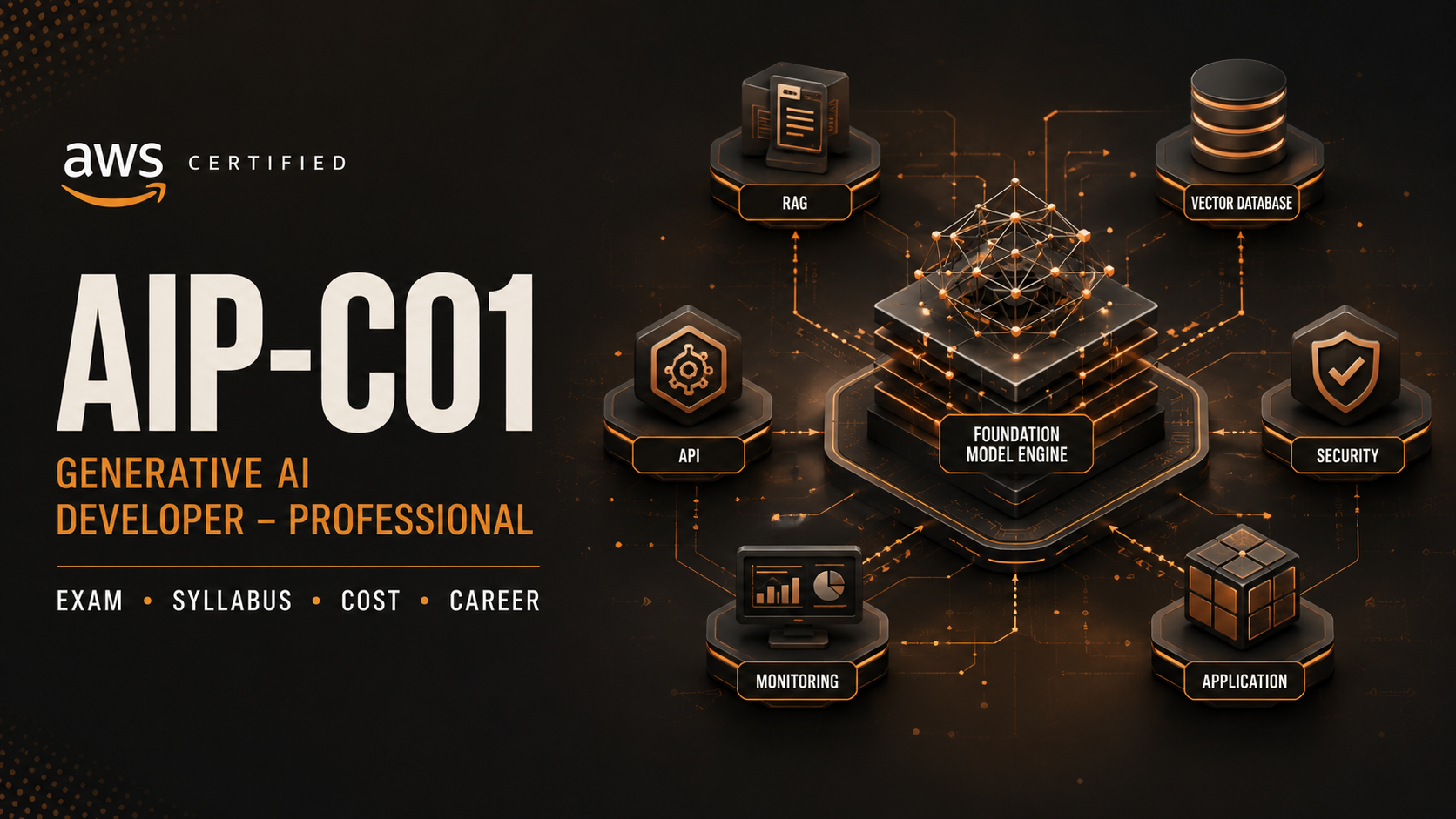
Officially known as the AWS Certified Generative AI Developer – Professional, the certification focuses on the skills required to integrate foundation models into applications and business workflows using AWS technologies. Rather than concentrating on developing foundation models from scratch, the exam evaluates whether candidates can design, implement, secure, operate, evaluate, and troubleshoot production-ready generative solutions.
This AIP-C01 exam guide explains the exam structure, candidate profile, AIP-C01 syllabus, major AWS services and concepts to understand, and a practical approach to preparing for the certification in 2026.
What Is the AIP-C01 Certification?
The AIP-C01 certification is the exam associated with the AWS Certified Generative AI Developer – Professional credential.
It is a Professional-level AWS certification intended primarily for developers who build applications that use foundation models.
The exam focuses heavily on practical implementation. Candidates are expected to understand how different AWS services work together when developing production systems involving:
- Foundation models
- Retrieval Augmented Generation (RAG)
- Vector databases
- Knowledge bases
- Prompt management
- Model APIs
- Agent-based architectures
- Application security
- Data privacy
- Governance
- Monitoring
- Testing and evaluation
- Performance optimization
- Cost management
AWS describes the target candidate as someone with at least two years of experience building production-grade applications using AWS or open-source technologies, together with general machine learning or data engineering experience and approximately one year of hands-on experience implementing generative solutions.
This makes AIP-C01 considerably more technical than an introductory cloud or foundational certification.
AIP-C01 Exam Overview
Before preparing for the certification, it is important to understand the structure of the AIP-C01 exam.
Exam Detail AIP-C01 Information
Certification AWS Certified Generative AI Developer – Professional
Exam Code AIP-C01
Level Professional
Duration 180 minutes
Questions 75 total
Scored Questions 65
Unscored Questions 10
Question Types Multiple choice and multiple response
Passing Score 750 out of 1,000
Exam Cost US$300
Delivery Pearson VUE testing center or online proctored exam
Languages English, Japanese, Korean, Simplified Chinese
AWS currently lists the exam at US$300, although applicable taxes and local-currency pricing can affect the final amount. The exam lasts three hours and contains 75 questions. Of those, 65 contribute to the score, and 10 are unscored questions that AWS uses for evaluation.
The exam uses a scaled scoring system from 100 to 1,000, with 750 as the minimum passing score. AWS uses a compensatory scoring model, meaning candidates do not have to achieve a separate passing score in every domain; the overall exam result determines whether they pass.
Who Should Consider the AWS Certified Generative AI Developer Professional?
The AWS Certified Generative AI Developer Professional is most relevant to developers and technical professionals who already understand application development and want to demonstrate greater skills in implementing generative workloads on AWS.
A suitable candidate may already work as a:
- Cloud developer
- Backend developer
- Full-stack developer
- Machine learning engineer
- Platform engineer
- Solutions engineer
- Cloud engineer
- Software engineer working with foundation models
- Developer responsible for RAG-based applications
- Technical specialist integrating models into existing business systems
The exam assumes candidates understand more than model APIs.
AWS recommends familiarity with compute, storage, networking, security, identity management, deployment practices, infrastructure as code, observability, and cloud cost optimization.
For example, a developer may need to understand not only how an application sends a request to Amazon Bedrock but also how that application authenticates securely, handles failures, retrieves company data, controls model access, monitors token consumption, streams responses, and remains available when an underlying dependency fails.
That broader production perspective is central to AIP-C01.
What Is Not the Main Focus of AIP-C01?
An important part of preparing for the certification is understanding what the examination does not primarily expect candidates to do.
According to the current AIP-C01 exam guide, areas outside the target candidate’s expected responsibilities include:
- Developing and training foundation models from scratch
- Advanced machine learning techniques
- General-purpose data engineering
- Feature engineering
The certification is therefore better understood as an application-development and production-integration credential.
The emphasis is on using existing models effectively, responsibly, securely, and efficiently within real applications.
AIP-C01 Syllabus and Exam Domains
The AIP-C01 syllabus contains five major domains.
Their current weightings are:
- Foundation Model Integration, Data Management, and Compliance – 31%
- Implementation and Integration – 26%
- AI Safety, Security, and Governance – 20%
- Operational Efficiency and Optimization for GenAI Applications – 12%
- Testing, Validation, and Troubleshooting – 11%
The first three domains together represent 77% of the scored exam, making architecture, implementation, integration, security, and governance particularly important preparation areas.
Domain 1: Foundation Model Integration, Data Management, and Compliance – 31%
Domain 1 is the largest section of the AIP-C01 exam.
It covers the architecture surrounding foundation models and the data provided to them.
Candidates should understand how to analyze requirements and choose an architecture based on factors such as business requirements, performance, resilience, cost, and technical constraints.
Foundation Model Selection
Different models are appropriate for different workloads.
Candidates should understand how to compare models based on:
- Capabilities
- Accuracy
- Latency
- Context requirements
- Cost
- Regional availability
- Application requirements
The syllabus also includes designing systems that can change model providers or models without requiring major application changes.
Resilience matters as well. Applications may require fallback models, cross-region inference, graceful degradation, or alternative processing routes when a service becomes unavailable.
Preparing Data for Models
Production applications rarely receive perfectly formatted data.
Developers may need to validate, clean, normalize, transform, or structure information before sending it to a model.
The syllabus covers processing different data types, including:
- Text
- Images
- Audio
- Structured data
- Tabular data
Candidates should also understand model-specific input requirements and how improving input quality can improve output consistency.
Vector Stores and Semantic Retrieval
Vector databases are an important part of the AIP-C01 syllabus.
Candidates should understand concepts such as:
- Embeddings
- Semantic search
- Metadata
- Vector indexes
- Index optimization
- Document synchronization
- Retrieval performance
- Vector database maintenance
Relevant architectures can involve services such as Amazon OpenSearch Service, Amazon Aurora with pgvector, Amazon Bedrock Knowledge Bases, Amazon S3, and supporting AWS services.
Retrieval Augmented Generation
RAG allows an application to retrieve relevant information before asking a foundation model to generate a response.
For example, imagine an internal support application containing thousands of company documents.
Instead of placing every document into a request, the system can:
- Receive the employee’s question.
- Search for relevant document sections.
- Retrieve the best matching information.
- Add that information to the model context.
- Generate a response grounded in company information.
Candidates should understand chunking, embeddings, semantic retrieval, hybrid search, reranking, query transformation, and retrieval quality.
Prompt Engineering and Prompt Governance
AIP-C01 also expects candidates to understand structured prompt management rather than simply writing individual prompts.
Topics can include:
- Prompt templates
- Parameterized prompts
- Version management
- Output formatting
- Context management
- Prompt testing
- Approval processes
- Prompt regression testing
- Multi-step prompt flows
Amazon Bedrock Prompt Management, Prompt Flows, Guardrails, CloudWatch, CloudTrail, Lambda, S3, DynamoDB, and Step Functions may appear in architectures addressing these requirements.
Domain 2: Implementation and Integration – 26%
The second-largest section focuses on turning architecture into functioning applications.
Agentic Applications and Tool Integration
Developers should understand how models interact with tools and external systems.
A system might need to:
- Search a database
- Retrieve an order
- Call an API
- Create a support request
- Perform several steps in sequence
- Request human approval before completing an action
The AIP-C01 exam covers concepts such as state management, tool calling, stopping conditions, error handling, resource boundaries, human review, multi-agent coordination, and Model Context Protocol integrations.
Candidates should understand how to prevent an agent from performing actions outside its intended permissions.
Model Deployment
AIP-C01 also tests decisions involving model deployment.
Candidates should be able to compare approaches involving:
- On-demand invocation
- Provisioned throughput
- Managed APIs
- Hosted endpoints
- Specialized models
- Model cascading
- Container-based workloads
The correct choice may depend on latency, throughput, cost, availability, or workload characteristics.
Enterprise Application Integration
Real businesses rarely build isolated applications.
A generative feature may need to communicate with:
- Existing APIs
- Internal applications
- Databases
- CRM platforms
- Event systems
- Document-processing systems
- On-premises environments
Candidates therefore need to understand common AWS integration patterns using technologies such as API Gateway, Lambda, EventBridge, Step Functions, queues, identity controls, networking, and CI/CD pipelines.
Foundation Model API Integration
Simply making an API request is not enough for a production system.
Candidates should understand:
- Synchronous requests
- Asynchronous processing
- Streaming
- Retries
- Exponential backoff
- Rate limits
- Error handling
- Request validation
- Model routing
- Failure recovery
For example, an interactive application may stream tokens to the user rather than waiting for the complete response. A batch-processing workload, however, may use queues and asynchronous workers because immediate output is unnecessary.
Understanding these trade-offs is important for the AIP-C01 exam.
Domain 3: AI Safety, Security, and Governance – 20%
Security represents one-fifth of the scored examination.
Developers should understand how to protect both the application and the information passing through it.
Input and Output Protection
Applications need controls around what users can submit and what models can return.
Candidates should understand:
- Input validation
- Content filtering
- Output validation
- Prompt injection defenses
- Jailbreak protection
- Structured output enforcement
- Grounding
- Hallucination reduction
- Safety guardrails
Amazon Bedrock Guardrails and supporting services can be used as part of layered protection strategies.
Data Security and Privacy
Applications may process confidential company information, personal data, or regulated records.
The syllabus therefore includes:
- IAM
- Least-privilege access
- Network isolation
- VPC endpoints
- Personally identifiable information detection
- Data masking
- Data retention
- Access monitoring
- Data anonymization
A good architecture should ensure that a model receives only the information required for the current task.
Governance and Compliance
Organizations also need traceability.
Candidates should understand techniques for maintaining:
- Audit logs
- Data lineage
- Source attribution
- Model documentation
- Compliance records
- Policy enforcement
- Usage monitoring
CloudTrail, CloudWatch, AWS Glue Data Catalog, metadata tagging, model cards, and other AWS capabilities can contribute to these controls.
Domain 4: Operational Efficiency and Optimization – 12%
Once an application reaches production, developers must control performance and cost.
Cost Optimization
Foundation model usage can become expensive when applications process large prompts or produce unnecessary output.
Candidates should understand:
- Token tracking
- Context-window optimization
- Prompt compression
- Context pruning
- Response-length controls
- Model selection based on workload complexity
- Caching
- Batch processing
- Provisioned capacity
One application, for example, may use a smaller model for routine classification requests and reserve a more capable model for complex reasoning tasks.
This can reduce cost while maintaining acceptable application quality.
Performance Optimization
The exam can also evaluate how developers improve:
- Response latency
- Retrieval speed
- Throughput
- Concurrent requests
- Vector search performance
- Model configuration
- Resource utilization
Techniques may include parallel requests, response streaming, optimized indexes, batching, caching, capacity planning, and appropriate model parameters.
Monitoring
Production systems require visibility.
Candidates should be familiar with monitoring areas such as:
- Token consumption
- Response latency
- Error rates
- Model invocation behavior
- Retrieval performance
- Response quality
- Cost
- Tool calls
- User interactions
- Application failures
CloudWatch and Amazon Bedrock invocation logging are particularly relevant to operational monitoring.
Domain 5: Testing, Validation, and Troubleshooting – 11%
Traditional application testing alone is insufficient when model outputs can vary between requests.
AIP-C01 therefore includes evaluation techniques designed specifically for foundation-model applications.
Candidates should understand how to evaluate characteristics such as:
- Relevance
- Factual accuracy
- Consistency
- Fluency
- Retrieval quality
- Response quality
- Tool-use effectiveness
- Task completion
- Latency
- Cost
Evaluation strategies can include A/B testing, canary testing, golden datasets, regression testing, human feedback, model comparison, retrieval evaluation, and continuous quality checks.
A practical example would be testing a RAG application with 200 known questions and expected answers before and after changing its embedding model.
If retrieval accuracy drops significantly, the team can detect the regression before deploying the change to all users.
AWS Services to Understand for AIP-C01
AIP-C01 is not simply an Amazon Bedrock examination.
Candidates should understand how Bedrock works within the wider AWS ecosystem.
Services and technologies worth studying include:
- Amazon Bedrock
- Amazon Bedrock Knowledge Bases
- Amazon Bedrock Guardrails
- Amazon Bedrock Prompt Management
- Amazon OpenSearch Service
- Amazon Aurora
- Amazon S3
- AWS Lambda
- Amazon API Gateway
- AWS Step Functions
- Amazon EventBridge
- Amazon SQS
- Amazon DynamoDB
- Amazon CloudWatch
- AWS CloudTrail
- AWS Identity and Access Management
- Amazon SageMaker AI
- AWS Glue
- Amazon Macie
- Amazon Comprehend
- AWS CodePipeline
- AWS CodeBuild
- AWS X-Ray
The goal should not be memorizing every feature. Instead, understand which service solves which architectural problem and why one design may be preferable to another.
How to Prepare for the AIP-C01 Exam
A structured preparation plan is usually more effective than trying to memorize hundreds of isolated facts.
For structured AIP-C01 exam preparation, you can also explore CertsGate’s preparation resources for study materials and practice support.
1. Start With the AIP-C01 Syllabus
Review all five domains and identify your strongest and weakest areas.
Because Domain 1 and Domain 2 account for 57% of scored content combined, they deserve significant attention.
However, ignoring smaller domains is risky because the exam uses compensatory scoring and evaluates overall performance.
2. Build a Real RAG Application
Hands-on practice can make architectural questions easier to understand.
Build a small application that:
- Stores documents
- Generates embeddings
- Uses a vector store
- Retrieves relevant context
- Calls a foundation model
- Returns a grounded response
Then experiment with chunk sizes, metadata filtering, hybrid retrieval, reranking, and different embedding approaches.
3. Add Production Controls
Turn the simple project into something closer to a production architecture.
Add:
- Authentication
- IAM permissions
- Guardrails
- Logging
- Monitoring
- Request validation
- Error handling
- Retry logic
- Caching
- Cost tracking
This exercise connects several exam domains in a single application.
4. Practice Architecture Scenarios
Professional-level AWS questions often require choosing the best architecture rather than identifying something that merely works.
When studying a scenario, ask:
- Which option is most secure?
- Which requires the least operational effort?
- Which meets the latency requirement?
- Which provides better resilience?
- Which reduces cost?
- Which follows least privilege?
- Which design scales appropriately?
The answer may involve trade-offs rather than one universally superior technology.
5. Study Security Carefully
Do not leave security until the end.
Review IAM, network isolation, PII protection, guardrails, audit logging, prompt injection risks, data access controls, and output validation.
Security and governance account for 20% of scored content.
6. Learn Evaluation Techniques
Know the difference between evaluating the model itself and evaluating the complete application.
A model may produce strong responses while the overall RAG application performs poorly because retrieval is returning irrelevant documents.
You should therefore understand separate measurements for:
- Retrieval quality
- Generation quality
- Application latency
- Cost
- Agent performance
- User satisfaction
7. Practice Cost and Performance Decisions
Be prepared for scenarios involving trade-offs between models.
A larger model is not automatically the correct answer.
A smaller or less expensive model may be preferable when it meets the required quality level with lower latency and cost.
Similarly, caching, batching, shorter context, streaming, provisioned throughput, and retrieval optimization can significantly affect application performance.
Is AIP-C01 a Difficult Exam?
The AIP-C01 exam should be considered an advanced certification because it expects candidates to combine cloud architecture knowledge with practical experience developing production applications around foundation models.
The challenge is not simply remembering AWS service names.
Candidates need to understand how services work together.
A single scenario could involve model selection, a vector database, IAM permissions, API Gateway, Lambda, Bedrock, CloudWatch, Guardrails, and a failure-recovery strategy.
Developers with hands-on experience building similar systems will generally find these scenarios easier to reason through than candidates relying primarily on theoretical study.
Is the AIP-C01 Certification Worth Considering in 2026?
The value of the AIP-C01 certification depends on a person’s role and career direction.
It is particularly relevant for developers working with AWS who are responsible for moving generative applications beyond experiments and into production environments.
The certification covers skills that appear repeatedly in real development projects: retrieval architecture, foundation model integration, application security, model APIs, agent-based workflows, monitoring, testing, governance, and cost optimization.
However, it may not be the best starting point for someone who has limited AWS experience.
The recommended candidate profile assumes considerable application-development experience, making practical AWS knowledge important before attempting the Professional-level exam.
Final Thoughts:
The AWS Certified Generative AI Developer – Professional represents a shift toward evaluating complete production systems rather than isolated model knowledge.
The AIP-C01 syllabus covers the full lifecycle of a generative application: selecting foundation models, preparing data, building retrieval systems, integrating applications, implementing security controls, monitoring production workloads, controlling cost, evaluating responses, and troubleshooting failures.
Candidates preparing for the AIP-C01 certification in 2026 should therefore combine exam study with practical development experience.
Understanding Amazon Bedrock is important, but understanding how Bedrock connects with storage, networking, identity, APIs, vector databases, monitoring, deployment systems, and security controls is even more valuable for the exam.
A candidate who can examine a business requirement and design a secure, reliable, cost-conscious production architecture will be much closer to the level of understanding AIP-C01 is designed to evaluate.
Frequently Asked Questions About AIP-C01
What is the AIP-C01 exam?
AIP-C01 is the exam code for the AWS Certified Generative AI Developer – Professional certification. It evaluates the ability to design, implement, secure, operate, evaluate, and troubleshoot production generative applications using AWS technologies.
How many questions are on the AIP-C01 exam?
The exam contains 75 questions. AWS currently identifies 65 as scored questions and 10 as unscored questions used for evaluation purposes.
What is the passing score for AIP-C01?
The minimum passing score is 750 on AWS’s scaled scoring range of 100 to 1,000. Candidates need to pass the examination overall rather than achieve a separate passing score in every domain.
How much does the AIP-C01 exam cost?
The current listed price for the AWS Certified Generative AI Developer – Professional exam is USD $300, although local taxes and currency conversion may affect the final amount paid.
How long should I prepare for the AIP-C01 certification?
There is no single preparation period that applies to everyone. Developers who already work with AWS, foundation models, RAG systems, application security, and production monitoring may need less preparation. Candidates without hands-on experience should spend more time building real AWS projects before relying heavily on practice questions.