
Cybersecurity careers are becoming more specialized, but some certifications continue to stand out because they cover a broad range of security knowledge rather than focusing on just one technical area. The CISSP certification 2026 remains one of the most recognized credentials for experienced cybersecurity professionals who want to demonstrate knowledge across security management, architecture, operations, risk, and governance.
But CISSP is not an entry-level certification, and passing the exam is only one part of the process. Candidates also need relevant professional experience, an endorsement, and ongoing professional development after certification.
So, is CISSP still worth pursuing in 2026? What does the CISSP exam 2026 look like, how much does it cost, and what are the actual requirements?
This guide covers the CISSP exam structure, eligibility requirements, certification cost, eight exam domains, career value, preparation considerations, and who should or should not consider taking the certification.
What Is CISSP Certification?
CISSP stands for Certified Information Systems Security Professional. It is a professional cybersecurity certification administered by ISC2.
For complete information about the certification, eligibility, exam pathway, and available training options, visit the official CISSP certification page from ISC2.
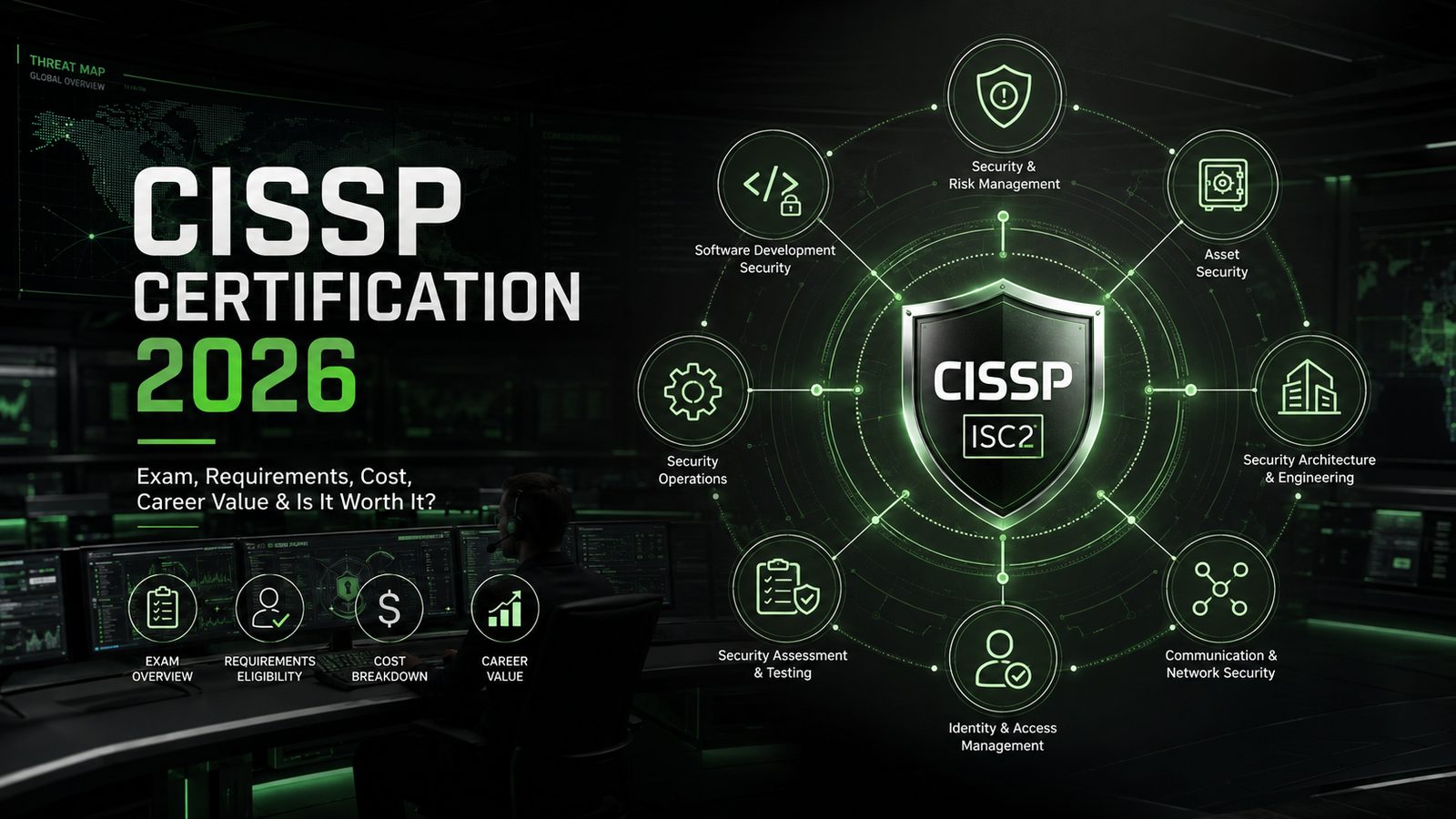
Unlike certifications that concentrate on a single technical skill, CISSP covers a broad cybersecurity knowledge base. Its eight domains include security and risk management, asset security, security architecture, network security, identity and access management, security testing, security operations, and software development security.
The certification is particularly relevant to professionals working in or moving toward roles such as:
- Security Manager
- Security Architect
- Security Engineer
- Security Analyst
- Security Consultant
- Security Auditor
- IT Manager
- Security Director
- Network Architect
- Cybersecurity leadership roles
The certification is designed around both technical and managerial aspects of information security. That makes it more suitable for professionals who already have practical experience than for people just beginning their cybersecurity careers.
CISSP Exam 2026: What to Expect
The CISSP exam 2026 uses Computerized Adaptive Testing (CAT). Instead of giving every candidate the same number of questions, the exam adapts to the candidate’s performance as they progress.
CISSP Exam Format
The current CISSP exam has:
- Exam duration: Up to 3 hours
- Number of items: 100–150
- Passing score: 700 out of 1,000
- Format: Multiple-choice and advanced item types
- Delivery: Computerized Adaptive Testing
- Testing: Pearson VUE testing centers
- Available languages: English, Simplified Chinese, German, Japanese, and Spanish
The exam can include scenario-based and other advanced question formats. This means candidates need more than simple memorization of definitions.
For example, a question may describe a security incident and ask what a security professional should do first. Several answers may appear technically reasonable, but the best answer may depend on risk, business priorities, security policies, or the responsibilities of the security professional.
That is one reason practical experience can be valuable when preparing for CISSP.
CISSP Exam Domains in 2026
The CISSP examination is divided into eight domains. Each domain has a different percentage of the exam.
Before starting your preparation, it is important to review the official CISSP exam outline to understand the current domains and topics covered on the examination.
Domain Weight
Security and Risk Management 16%
Asset Security 10%
Security Architecture and Engineering 13%
Communication and Network Security 13%
Identity and Access Management (IAM) 13%
Security Assessment and Testing 12%
Security Operations 13%
Software Development Security 10%
Total 100%
1. Security and Risk Management
This is the largest CISSP domain, accounting for 16% of the exam.
Topics include:
- Security governance
- Risk management
- Security policies
- Compliance
- Legal and regulatory considerations
- Professional ethics
- Business continuity
- Disaster recovery
- Personnel security
The domain focuses heavily on understanding security in the context of an organization’s overall business objectives.
2. Asset Security
Asset Security represents 10% of the exam.
It covers areas such as:
- Information classification
- Data ownership
- Data security controls
- Data retention
- Data handling
- Data protection requirements
Candidates should understand how organizations identify, classify, protect, and eventually dispose of information assets.
3. Security Architecture and Engineering
This domain represents 13% of the exam.
It covers concepts related to:
- Secure design principles
- Security models
- Cryptography
- Security architecture
- Physical security
- Vulnerability management
- Trusted computing
- Secure engineering practices
Questions may require candidates to choose an appropriate security architecture rather than identify a security technology.
4. Communication and Network Security
Also weighted at 13%, this domain focuses on protecting communication systems and networks.
Important areas include:
- Network architecture
- Secure network design
- Network protocols
- Transmission security
- Wireless security
- Network attacks
- Segmentation
- Secure communication channels
A strong understanding of how different network components interact is useful for this section.
5. Identity and Access Management
IAM represents another 13% of the CISSP exam.
This domain includes:
- Identification and authentication
- Authorization
- Access control
- Account management
- Federation
- Privileged access
- Identity management technologies
The key idea is making sure the right people or systems receive the appropriate level of access to resources.
6. Security Assessment and Testing
This domain accounts for 12% of the examination.
Topics include:
- Security assessments
- Vulnerability assessments
- Penetration testing
- Security audits
- Testing strategies
- Security control assessments
- Reporting
Candidates should understand not only how testing is performed but also how its results are interpreted and communicated.
7. Security Operations
Security Operations represents 13% of the exam.
It covers areas such as:
- Incident management
- Disaster recovery
- Business continuity
- Investigations
- Logging and monitoring
- Security operations processes
- Change management
- Recovery strategies
This domain connects security policies with day-to-day security activities.
8. Software Development Security
The final domain represents 10% of the exam.
It focuses on security throughout the software development lifecycle, including:
- Secure development principles
- Software security
- Development methodologies
- Application security
- Security testing
- Secure coding concepts
- Software acquisition and deployment
Even professionals who do not work directly as software developers can encounter these concepts in security architecture, application security, and risk management roles.
CISSP Exam Requirements 2026
One of the most important things to understand about the CISSP is that passing the exam does not automatically mean you become a CISSP.
The CISSP exam requirements include relevant professional experience.
Candidates generally need:
- Five years of cumulative, full-time professional experience
- Experience in at least two of the eight CISSP domains
- Completion of the required endorsement process after passing the examination
There are also approved pathways that can reduce the required experience by one year.
Can a Degree Reduce the Experience Requirement?
Yes. A relevant four-year college degree or certain approved credentials can satisfy up to one year of the required professional experience.
This means a qualifying candidate may need four years of applicable experience instead of five.
However, only one year of the experience requirement can be waived through education or an approved credential.
What If You Do Not Have Five Years of Experience?
You do not necessarily have to wait several years before taking the examination.
A candidate who passes the CISSP exam but does not yet have the required professional experience can become an Associate of ISC2.
The Associate of ISC2 pathway gives the candidate up to six years to obtain the required five years of experience and then apply for the full CISSP certification.
This can be useful for cybersecurity professionals who are progressing toward the experience requirement but are not eligible for the full credential yet.
Since experience and waiver requirements can change, candidates should check the current CISSP experience requirements published by ISC2 before applying.
CISSP Certification Cost in 2026
The CISSP certification cost is more than just the examination fee because candidates should also consider maintenance and preparation expenses.
As of 2026, the CISSP examination fee is US$749.
Other possible expenses include:
- Study books
- Practice questions
- Training courses
- Travel costs, if applicable
- Retake fees if the exam is unsuccessful
- Annual maintenance fees after certification
Annual Maintenance Fee
Maintaining the certification also involves an Annual Maintenance Fee.
The current CISSP maintenance fee is US$135 per year.
CISSP holders also need to complete continuing professional education requirements during their certification cycle.
The current requirement is 120 CPE credits over a three-year certification cycle.
Therefore, prospective candidates should consider CISSP as an ongoing professional commitment rather than a one-time examination.
How to Become CISSP in 2026
For candidates asking how to become CISSP, the process can be broken into several clear stages.
Step 1: Review Your Professional Experience
First, compare your employment history against the eight CISSP domains.
You normally need five years of qualifying experience involving at least two domains, although an eligible degree or credential may reduce the requirement by one year.
Step 2: Review the Current Exam Outline
Use the latest exam objectives to understand exactly what is covered.
Because CISSP has a broad syllabus, studying without following the official domain structure can lead to spending too much time on narrow technical subjects while ignoring governance, risk, security management, or architecture.
Step 3: Build a Structured Study Plan
A practical study plan should cover all eight domains rather than concentrating only on areas where you already have professional experience.
For candidates who want additional support while following a structured study plan, CISSP exam preparation resources from CertsGate can provide useful study materials and practice resources.
For example, a network security engineer may be comfortable with communication and network security but need considerably more preparation in governance, software development security, or risk management.
Step 4: Practice Scenario-Based Decision Making
CISSP questions often require candidates to think from the perspective of someone responsible for organizational security rather than simply selecting the most technically advanced solution.
When reviewing practice scenarios, consider questions such as:
- What is the business risk?
- Which action should happen first?
- Who owns the decision?
- What policy or control should be considered?
- Which solution addresses the root problem?
- What approach best supports the organization’s security objectives?
This style of reasoning is particularly important for experienced technical professionals who are accustomed to immediately solving infrastructure problems.
Step 5: Take the CISSP Exam
The examination currently lasts up to three hours and contains between 100 and 150 items under the CAT format. Candidates need a scaled score of at least 700 out of 1,000 to pass.
Step 6: Complete the Certification Application and Endorsement
Passing the examination is not the final step.
Candidates seeking certification must complete the certification application process within nine months of passing their exam. An endorser who is an ISC2-certified professional in good standing can verify the candidate’s professional experience. If a candidate does not know an eligible professional, ISC2 can be requested to perform the endorsement process.
Step 7: Maintain the Certification
CISSP is not a lifetime credential that can be earned and forgotten.
Certified professionals are currently expected to complete 120 Continuing Professional Education credits during each three-year certification cycle and maintain the required annual fee.
How Difficult Is the CISSP Exam?
CISSP can be challenging even for experienced cybersecurity professionals because of its breadth.
Someone may have ten years of strong experience in network security but relatively
little exposure to software development security, governance, legal considerations, asset management, or formal risk management.
The challenge is therefore not simply learning difficult technical concepts.
Candidates must develop a broad understanding of how multiple security disciplines connect within an organization.
Another challenge is the style of decision-making required. A technically possible answer is not always the most appropriate organizational answer.
The exam may require candidates to consider risk, policy, business priorities, management responsibilities, and security principles before choosing a technical response.
How Long Does CISSP Preparation Take?
There is no universal preparation period.
For an experienced cybersecurity professional, preparation may take several months. Someone with less exposure to the eight domains may need considerably longer.
A reasonable preparation approach is to divide the process into three phases:
Phase 1: Learn
Study each domain and understand the underlying concepts.
Phase 2: Apply
Use practice questions and scenario-based exercises to determine whether you can apply those concepts.
Phase 3: Review
Focus on weak areas, review mistakes, and practice managing your time under exam conditions.
The goal should not simply be to memorize more information. It should be to understand the reasoning behind security decisions.
What Jobs Can CISSP Support?
CISSP is generally associated with experienced and senior-level cybersecurity positions.
Relevant roles may include:
- Cybersecurity Manager
- Information Security Manager
- Security Architect
- Security Consultant
- Senior Security Analyst
- Security Engineer
- Risk and Compliance Manager
- Cybersecurity Program Manager
- Information Security Officer
- Security Operations Manager
- Senior Governance, Risk and Compliance professional
However, holding CISSP does not automatically qualify someone for a senior position.
Employers normally consider the certification alongside practical experience, technical capability, leadership skills, industry knowledge, communication skills, and previous responsibilities.
CISSP vs. Entry-Level Cybersecurity Certifications
CISSP is not usually the best first certification for someone with no cybersecurity experience.
A beginner may benefit more from an entry-level certification that establishes foundational security knowledge.
CISSP becomes more relevant when a professional has already developed several years of experience and wants to demonstrate broader security knowledge.
For example:
Beginner: Learn networking, operating systems, security fundamentals, and basic security practices.
Early-career professional: Build hands-on experience and develop specialization.
Experienced professional: Consider CISSP to demonstrate broad cybersecurity knowledge and support progression toward senior responsibilities.
This makes the CISSP a career-development certification rather than simply a starting point.
Is CISSP Worth It in 2026?
For the right professional, CISSP can still be a valuable cybersecurity credential in 2026.
It is particularly relevant for professionals who already have meaningful industry experience and want to move toward responsibilities involving architecture, security strategy, risk, consulting, governance, or leadership.
However, it may not be the best immediate choice for everyone.
CISSP may be worth considering if you:
- Already have several years of cybersecurity experience
- Work across multiple security disciplines
- Want to move toward security architecture or management
- Regularly deal with governance, risk, security strategy, or policy
- Want a vendor-neutral certification covering enterprise security
- See CISSP requested or preferred for roles you are targeting
CISSP may be less urgent if you:
- Are completely new to cybersecurity
- Need fundamental technical skills first
- Want to specialize in one specific security technology
- Have limited professional security experience
- Are pursuing a highly hands-on role where another certification better matches the job requirements
The value ultimately depends on how closely CISSP matches your existing experience and future career plans.
Certification should support a career strategy rather than replace one.
Final Thoughts
The CISSP certification 2026 remains a broad professional cybersecurity qualification aimed primarily at experienced practitioners.
The current CISSP exam 2026 covers eight security domains, uses an adaptive testing format, contains 100 to 150 items, allows up to three hours, and requires a scaled score of 700 out of 1,000 to pass.
For full certification, candidates normally need five years of qualifying professional experience across at least two domains, although one year may be waived through eligible education or credentials. Candidates without enough experience can take the exam and work toward the full experience requirement through the Associate pathway.
The main question is therefore not simply whether CISSP is respected.
The more useful question is whether its broad focus matches where you want your cybersecurity career to go.
For professionals aiming toward senior technical, architectural, consulting, governance, risk, or security leadership responsibilities, CISSP can be a logical next step. For beginners or highly specialized practitioners, building experience or pursuing more role-specific skills first may provide greater immediate value.
Frequently Asked Questions
Is CISSP still worth it in 2026?
CISSP can be worthwhile for experienced cybersecurity professionals pursuing senior technical, architectural, consulting, risk, governance, or management responsibilities. Its value depends heavily on your career direction and existing experience.
What is the CISSP certification cost in 2026?
The standard CISSP examination fee is currently US$749 in many regions, with regional pricing of €719.04 in EMEA and £606.69 in the United Kingdom. Certified members also currently pay a US$135 Annual Maintenance Fee.
What are the CISSP exam requirements?
To earn full CISSP certification, candidates normally need five years of cumulative professional experience covering at least two CISSP domains. Up to one year may be waived through qualifying education or an approved credential.
Can I take CISSP without five years of experience?
Yes. You can pass the CISSP examination before completing the experience requirement and follow the Associate of ISC2 pathway while gaining the required professional experience. Candidates using this route have up to six years to complete the experience requirement.
How many questions are on the CISSP exam in 2026?
The current CISSP examination contains between 100 and 150 items and provides up to three hours for completion. A scaled score of at least 700 out of 1,000 is required to pass.