
Cloud computing is no longer something organizations are simply experimenting with. It has become part of everyday business infrastructure.
Companies use cloud platforms to host applications, store sensitive information, run databases, support remote work, and develop and deliver digital services. As this dependence grows, securing cloud environments has become a major responsibility for cybersecurity teams.
That is where the Certified Cloud Security Professional (CCSP) comes in.
Offered by ISC2, CCSP is designed for professionals who want to demonstrate their knowledge of cloud security across architecture, data protection, infrastructure, applications, operations, and compliance.
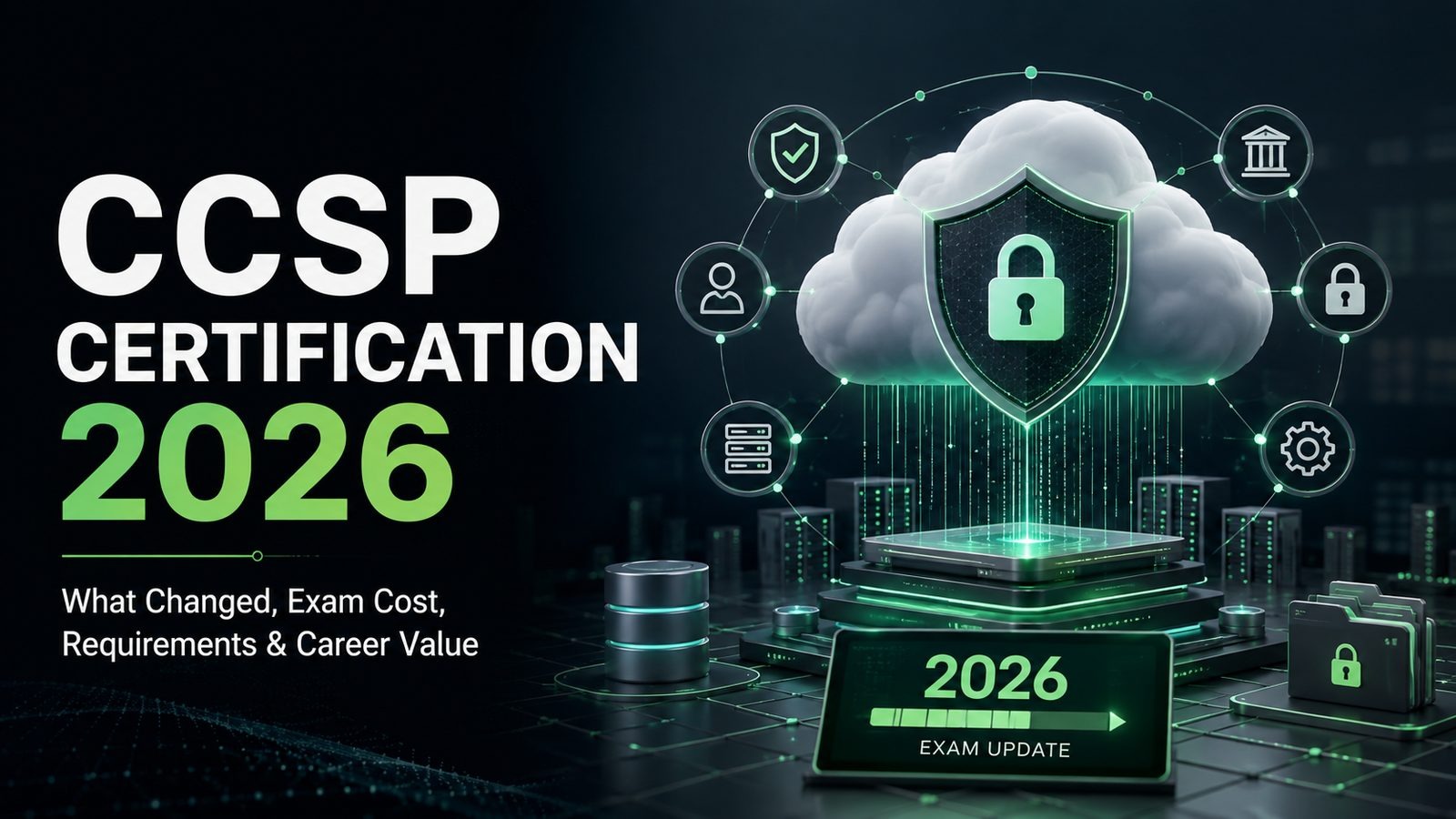
But the certification is particularly interesting in 2026 because the CCSP exam was revised effective August 1, 2026. The updated outline changes the weighting of the domains and refreshes the knowledge areas covered by the exam.
So, what exactly changed? How difficult is the exam? What are the current CCSP certification requirements, and how much does the certification cost?
This guide explains the CCSP exam, the 2026 changes, certification requirements, costs, exam structure, and the situations in which CCSP can be a useful career credential.
What Is the CCSP Certification?
CCSP stands for Certified Cloud Security Professional. It is a professional cybersecurity certification offered by ISC2.
Unlike certifications focused on one specific cloud provider, CCSP is vendor-neutral. Instead of teaching candidates only how to configure a particular platform, it focuses on broader cloud security principles that can apply across public, private, hybrid, and multi-cloud environments.
The certification covers areas such as:
- Cloud architecture and design
- Data protection
- Infrastructure security
- Application security
- Security operations
- Risk management
- Compliance
- Legal considerations
- Cloud governance
This makes CCSP particularly relevant for professionals who work across different cloud environments or need to make security decisions that go beyond individual products and services.
Typical professionals interested in CCSP include cloud security engineers, cloud architects, security consultants, cybersecurity analysts, security managers, auditors, developers, and infrastructure professionals.
What Changed in the CCSP Exam in 2026?
The biggest update to the CCSP exam in 2026 is the introduction of a revised exam outline.
The new outline became effective on August 1, 2026. ISC2 reviewed the domains, domain weights, and underlying topics to keep the certification aligned with current cloud security responsibilities.
The six main domains remain in place, but there has been a small shift in their weighting.
CCSP Exam Domain Changes for 2026
CCSP Domain Previous Weight 2026 Weight
Cloud Concepts, Architecture and Design 17% 17%
Cloud Data Security 20% 20%
Cloud Platform and Infrastructure Security 17% 17%
Cloud Application Security 17% 16%
Cloud Security Operations 16% 17%
Legal, Risk and Compliance 13% 13%
The most visible weighting change is therefore simple:
Cloud Application Security decreased from 17% to 16%, while Cloud Security Operations increased from 16% to 17%.
The change may appear small, but candidates should not assume that only the percentages matter. ISC2 also revised subtopics within the exam outline, so anyone studying for the CCSP certification in 2026 should use materials aligned with the August 2026 outline rather than relying entirely on older study plans.
Current CCSP Exam Format in 2026
The current CCSP exam is delivered using Computerized Adaptive Testing.
Under this approach, the examination adjusts as the candidate progresses through the questions. The purpose is to determine the candidate’s level of knowledge efficiently rather than giving every person the same fixed examination.
It is worth noting that adaptive testing itself is not an August 2026 change. CCSP moved to this examination format on October 1, 2025.
For candidates taking the exam in 2026, the main format is:
- Exam duration: 3 hours
- Number of items: 100 to 150
- Passing score: 700 out of 1,000
- Testing method: Computerized Adaptive Testing
- Available languages: English, Chinese, Japanese, and German
- Testing provider: Pearson VUE
The examination can include multiple-choice questions and other supported item types.
Because the number of questions can vary, candidates should prepare for the possibility of receiving the full question range rather than expecting the exam to finish at the minimum number.
Understanding the Six CCSP Exam Domains
A strong preparation strategy begins with understanding what each domain is trying to test.
1. Cloud Concepts, Architecture and Design – 17%
This domain builds the foundation for the rest of the exam.
Candidates need to understand cloud computing concepts, service models, deployment models, architectural principles, responsibilities between providers and customers, virtualization, cloud design, and security considerations.
For example, you may need to understand how security responsibilities differ between Software as a Service, Platform as a Service, and Infrastructure as a Service.
Knowing definitions alone is usually not enough. Candidates should understand how these concepts affect real security decisions.
2. Cloud Data Security – 20%
Cloud Data Security carries the highest individual weighting on the current exam.
It covers how information should be identified, classified, stored, protected, retained, transferred, and eventually destroyed within cloud environments.
Topics can include:
- Data classification
- Encryption
- Key management
- Data lifecycle management
- Storage security
- Data discovery
- Access controls
- Data loss prevention
- Data retention
Consider a company storing customer financial information across several cloud regions. A security professional may need to determine who can access that information, where it can legally be stored, how it should be encrypted, and how long it should remain available.
Those are the types of practical relationships CCSP candidates need to understand.
3. Cloud Platform and Infrastructure Security – 17%
This section focuses on protecting the technology that supports cloud services.
It includes areas such as:
- Virtual infrastructure
- Networking
- Compute resources
- Storage
- Security controls
- Business continuity
- Disaster recovery
- Infrastructure threats
Candidates should understand both the technical controls and the risks created by poor architecture or configuration.
For example, protecting a cloud workload is not simply about installing security products. Network segmentation, identity controls, resilient architecture, secure configuration, and monitoring all contribute to overall security.
4. Cloud Application Security – 16%
Cloud Application Security focuses on developing and maintaining secure applications in cloud environments.
It covers concepts related to:
- Secure software development
- Application security testing
- Secure development lifecycles
- APIs
- Cloud application architecture
- Software supply-chain risks
- Application vulnerabilities
The weighting has decreased slightly in the CCSP exam changes 2026, but this remains a significant part of the examination.
Candidates with development or application-security experience may find this section familiar, while infrastructure-focused professionals may need additional study here.
5. Cloud Security Operations – 17%
Cloud Security Operations increased from 16% to 17% under the 2026 outline.
This domain focuses on running and protecting cloud environments after they have been deployed.
It can involve:
- Logging and monitoring
- Incident response
- Security operations
- Vulnerability management
- Configuration management
- Change management
- Infrastructure maintenance
- Operational controls
Imagine that suspicious login attempts begin appearing against an organization’s cloud environment.
A cloud security professional needs to know more than how to identify the alert. They may also need to understand logging, escalation, investigation, containment, recovery, documentation, and improvements to prevent similar incidents.
This operational perspective is important throughout the CCSP exam.
6. Legal, Risk and Compliance – 13%
The final domain deals with the business and regulatory side of cloud security.
Topics can include:
- Risk management
- Privacy
- Contracts
- Compliance
- Regulations
- Audit requirements
- Cloud service agreements
- Legal responsibilities
- Vendor risk
- Data location
This domain is particularly important because cloud environments often involve several organizations.
A company may own the data, another organization may provide the cloud infrastructure, and additional providers may manage software or business services.
Determining responsibility requires an understanding of contracts, regulations, risk, and governance.
What Is the CCSP Exam Format in 2026?
According to the current ISC2 exam information, the CCSP exam uses Computerized Adaptive Testing (CAT). The exam has:
- 3 hours of testing time
- 100–150 items
- Multiple-choice and advanced item types
- A passing score of 700 out of 1000
- Testing through Pearson VUE
- Four available exam languages: English, Chinese, Japanese, and German
The adaptive format means candidates should avoid preparing only through memorization.
It is much more useful to understand the reasoning behind cloud-security decisions and practice applying concepts to realistic situations.
CCSP Certification Requirements in 2026
Passing the exam is only one part of becoming fully CCSP certified.
The current CCSP certification requirements include professional work experience.
Candidates generally need at least five years of cumulative full-time IT experience.
Within those five years:
- At least three years must be in cybersecurity.
- At least one year must involve one or more of the six CCSP exam domains.
ISC2 also provides several experience pathways.
A relevant bachelor’s or master’s degree may satisfy up to one year of the required experience. The Cloud Security Alliance’s CCSK certificate can also substitute for one year of experience.
Only one year can normally be waived through these routes.
An active CISSP credential can satisfy the entire CCSP professional experience requirement.
Can You Take the CCSP Exam Without Five Years of Experience?
Yes.
You do not necessarily have to wait until you meet the full professional experience requirement before taking the examination.
A candidate who successfully passes the CCSP exam but does not yet have enough qualifying experience can follow the Associate of ISC2 pathway and complete the necessary experience afterward.
This makes it possible for professionals who are progressing into cloud security to pass the examination earlier and gain the required professional experience over time.
How Much Does the CCSP Certification Cost in 2026?
The CCSP certification cost involves more than simply purchasing an exam voucher.
ISC2 currently lists standard CCSP exam registration at US$599 in regions including the Americas and Asia Pacific, although pricing, currencies, and taxes can vary depending on where the examination is administered.
Candidates should therefore check the current regional registration price before booking.
There may also be additional costs depending on your preparation strategy.
These can include:
- Study books
- Practice exams
- Training courses
- Video courses
- Instructor-led preparation
- Travel to a testing location
These preparation expenses are optional and can vary significantly.
Is the CCSP Certification Worth It in 2026?
Whether CCSP is worth pursuing depends largely on your career direction.
It can provide significant value for professionals whose responsibilities already involve cloud security, architecture, governance, compliance, or security operations.
Its vendor-neutral approach is one of its main advantages.
A professional working only with one cloud platform may benefit from a platform-specific security certification. However, security architects and consultants frequently work across multiple environments.
For them, understanding broader security principles can be especially useful.
CCSP May Be Worth It If You Work In:
- Cloud security engineering
- Cybersecurity architecture
- Cloud architecture
- Security consulting
- Cloud governance
- Risk and compliance
- Cloud infrastructure
- Application security
- Security operations
- Technical security leadership
The certification can also be useful for professionals moving from traditional infrastructure security into cloud-focused positions.
For example, an experienced network security engineer may already understand firewalls, segmentation, identity management, and incident response.
CCSP preparation can help connect that knowledge with cloud architecture, shared responsibilities, data security, cloud applications, and governance.
When CCSP May Not Be the Right Certification
CCSP is not necessarily the best starting point for everyone.
Someone beginning their first cybersecurity role may find the certification too advanced because much of the exam assumes professional familiarity with security concepts and business decision-making.
A beginner may benefit more from first building knowledge in:
- Networking
- Operating systems
- Basic cybersecurity
- Identity and access management
- Cloud fundamentals
- Security monitoring
CCSP is also not intended to replace hands-on cloud experience.
Knowing the correct security principle is useful, but employers may still expect candidates to understand how real cloud environments operate.
The strongest career profile usually combines certification knowledge with practical experience.
CCSP vs Cloud Provider Security Certifications
One common question is whether professionals should choose CCSP or a certification associated with a particular cloud platform.
The answer depends on the job.
Platform-specific certifications normally focus more heavily on how to configure and secure services within one ecosystem.
CCSP takes a broader approach.
For example, rather than concentrating only on the exact steps required to configure encryption within one platform, CCSP may require you to understand:
- Why encryption is necessary
- Which data requires protection
- Key-management responsibilities
- Data lifecycle considerations
- Regulatory requirements
- Risk implications
The two types of certifications can therefore complement each other.
A cloud engineer responsible for one specific environment may prioritize a platform certification first.
A security architect, consultant, or security manager who works across several platforms may find the vendor-neutral CCSP perspective particularly relevant.
How Difficult Is the CCSP Exam?
The CCSP exam is generally designed for experienced professionals rather than beginners.
One reason candidates find it challenging is that questions may require judgment instead of simple memorization.
Several answers may appear technically possible.
The candidate must determine which option best reflects appropriate security practice in the situation described.
For example, a question might describe an organization migrating sensitive customer information to a cloud provider.
Instead of asking only what encryption means, the question could require you to consider:
- Data classification
- Contractual responsibilities
- Encryption
- Key ownership
- Regulatory obligations
- Business risk
Successful preparation therefore requires understanding how different security concepts work together.
How to Prepare for the CCSP Exam in 2026
Candidates planning to take the exam after August 1, 2026 should make sure their preparation follows the current exam outline.
For structured preparation, candidates can also explore CertsGate’s CCSP exam preparation resources.
Start With the Current Exam Outline
Use the six domains and their weights to create your study plan.
Pay particular attention to Cloud Data Security because it represents 20% of the examination.
However, do not ignore lower-weighted domains. The CCSP exam evaluates knowledge across the entire cloud security lifecycle.
Understand Concepts Instead of Memorizing Definitions
Knowing terminology is important, but scenario-based understanding is more valuable.
Ask questions such as:
- Who is responsible for this security control?
- Which asset is being protected?
- What is the business risk?
- What should happen first?
- What control best reduces the identified risk?
- What contractual or regulatory issue applies?
This approach helps develop the reasoning required for professional security decisions.
Identify Your Weakest Domains
Your work background will influence which parts of the exam feel difficult.
A developer may be comfortable with application security but less experienced with compliance.
A governance professional may understand risk management but need additional preparation in infrastructure security.
An infrastructure engineer may know cloud networking well but need more work on data lifecycle and legal issues.
Spend additional study time on unfamiliar areas rather than repeatedly reviewing topics you already know.
Use Practice Questions Carefully
Practice questions are useful for learning how concepts may appear in scenario-based questions.
However, they should not become a memorization exercise.
After answering each practice question, understand:
- Why the correct answer is correct
- Why the other options are weaker
- What concept the question is testing
- How the scenario might change the answer
This approach makes a CCSP practice exam far more useful than simply tracking your score.
Is CCSP Certification 2026 Worth It?
For experienced IT and cybersecurity professionals who want to build or strengthen a career in cloud security, CCSP certification 2026 remains a relevant option.
The August 2026 exam update does not completely redesign the certification. The same six core security domains remain, while the weighting has shifted slightly toward Cloud Security Operations and the detailed exam topics have been refreshed.
Candidates should therefore avoid preparing entirely from an outdated exam outline.
CCSP is likely to provide the most value to professionals who already work with cloud infrastructure, security architecture, applications, risk, governance, or security
operations and want to demonstrate a broader understanding of cloud security.
For someone at the beginning of a cybersecurity career, developing practical cloud and security experience first may be more valuable.
Ultimately, the question is not simply whether CCSP is a respected certification. The better question is whether its knowledge areas match the type of work you want to perform.
If your future involves designing, evaluating, managing, or protecting cloud environments, CCSP can be a logical professional certification to consider in 2026.
Frequently Asked Questions About CCSP Certification
Is the CCSP exam changing in 2026?
Yes. A refreshed CCSP exam outline became effective on August 1, 2026. Cloud Application Security now carries 16% of the exam weighting, while Cloud Security Operations carries 17%. The other four domain weights remain unchanged.
What is the CCSP certification cost in 2026?
Standard CCSP exam registration is currently listed at US$599 in regions including the Americas and Asia Pacific, although pricing and taxes vary by examination location. Certified members also need to consider ISC2’s annual membership maintenance fee.
What are the CCSP certification requirements?
Candidates generally need five years of cumulative IT experience, including three years in cybersecurity and one year in one or more CCSP domains. Certain qualifications can satisfy part or all of the experience requirement.
Can I take the CCSP exam without enough work experience?
Yes. Candidates can take and pass the examination before meeting the full CCSP experience requirement and then follow the relevant ISC2 pathway while gaining the required professional experience.
Is CCSP worth it for cloud security careers?
It can be valuable for experienced professionals working in cloud security engineering, architecture, operations, consulting, governance, application security, and compliance. However, certification works best when combined with practical cloud security experience rather than being treated as a replacement for it.