
Technology teams increasingly need professionals who can take machine learning models from development into reliable production environments. That requires more than knowing how to build a model – it also involves managing infrastructure, deployment, monitoring, evaluation, versioning, and ongoing performance.
This is where Microsoft AI-300 comes in. The certification is designed for professionals working with machine learning operations (MLOps) and generative AI operations (GenAIOps) on Microsoft Azure. It focuses on the practical skills needed to build, deploy, monitor, and optimize these workloads.
In this guide, we will look at what Microsoft AI-300 is, what the exam covers, the AI-300 skills measured, exam format, AI-300 exam cost, recommended experience, preparation considerations, and its potential career value in 2026.
What Is Microsoft AI-300?
Microsoft AI-300 is the exam associated with the Microsoft Certified: Machine Learning Operations Engineer Associate certification. Candidates can review the official Microsoft AI-300 certification page for the current exam objectives, requirements, and certification details.
The certification validates skills related to setting up and operating MLOps and GenAIOps solutions on Azure. Microsoft classifies it as an intermediate-level certification, with Azure Machine Learning and Microsoft Foundry forming the main technology areas.
The certification is particularly relevant to professionals who work between data science, software development, cloud infrastructure, and operations.
Typical responsibilities associated with the role include:
- Designing and implementing MLOps infrastructure
- Managing machine learning model lifecycles
- Deploying models to production
- Monitoring deployed models
- Designing GenAIOps infrastructure
- Evaluating application quality
- Monitoring performance and costs
- Optimizing models and production workloads
Microsoft positions the certification as a replacement for the retired Azure Data Scientist Associate certification, which was retired on June 1, 2026. The Machine Learning Operations Engineer Associate certification became its replacement in May 2026.
What Does the AI-300 Exam Test?
The Microsoft AI-300 exam focuses on operational rather than purely theoretical knowledge.
Candidates are expected to understand how to create infrastructure, manage model lifecycles, deploy workloads, evaluate production performance, and troubleshoot operational issues.
The major areas measured in the exam are:
AI-300 Skill Area Weight
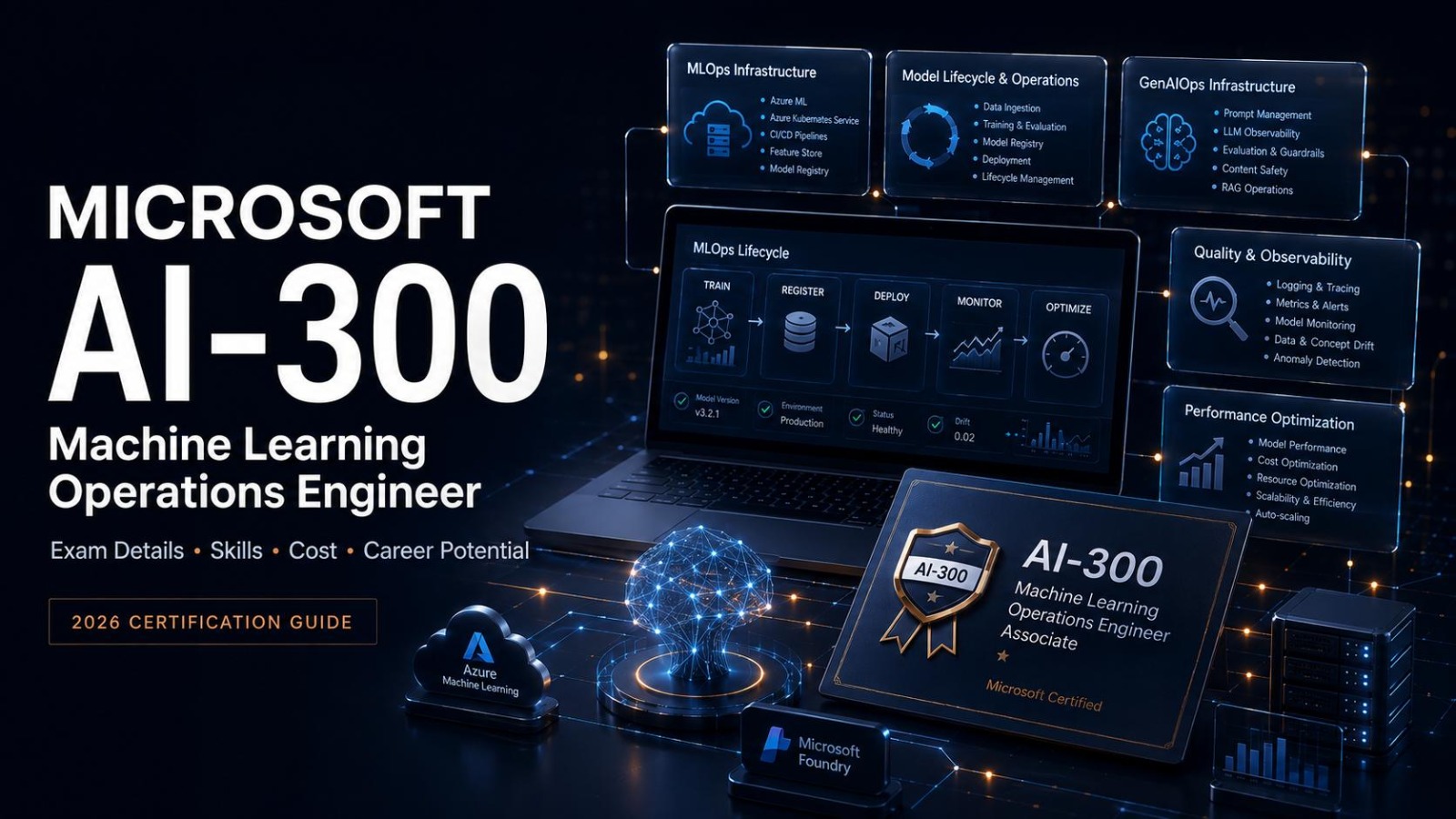
Design and implement an MLOps infrastructure 15–20%
Implement machine learning model lifecycle and operations 25–30%
Design and implement a GenAIOps infrastructure 20–25%
Implement generative AI quality assurance and observability 10–15%
Optimize generative AI systems and model performance 10–15%
These percentages come from Microsoft’s AI-300 study guide and represent the current published skills outline.
1. Design and Implement an MLOps Infrastructure
This domain focuses on the infrastructure required to support machine learning operations.
Candidates should understand how to work with Azure Machine Learning resources and assets and how infrastructure can be managed consistently across environments.
Relevant areas include:
- Azure Machine Learning workspaces
- Data and environment assets
- Compute resources
- Identity and access management
- Git integration
- Infrastructure as code
- Bicep
- Azure CLI
- GitHub Actions
- Network and security considerations
The important concept here is repeatability. Production machine learning environments should not depend entirely on manual configuration.
2. Implement Machine Learning Model Lifecycle and Operations
This is the largest section of the AI-300 skills measured, accounting for 25–30% of the exam.
Candidates should understand the complete model lifecycle, including:
- Experiment tracking with MLflow
- Model training
- Hyperparameter tuning
- Training pipelines
- Distributed training
- Model registration
- Model versioning
- Model evaluation
- Production deployment
- Real-time and batch endpoints
- Troubleshooting endpoints
- Progressive deployment
- Rollback strategies
- Production monitoring
- Data drift detection
- Performance monitoring
- Retraining and alerting
For example, imagine a company has a model that predicts customer demand. The model may perform well during initial testing, but customer behavior can change over time. An MLOps professional needs to monitor the model, identify performance or data changes, and determine when retraining or intervention is necessary.
3. Design and Implement a GenAIOps Infrastructure
The third major area focuses on building and managing infrastructure for generative workloads.
The study guide includes topics such as:
- Creating Microsoft Foundry resources
- Configuring projects and environments
- Identity and role-based access control
- Network security
- Private networking
- Deploying infrastructure with Bicep
- Using Azure CLI
- Deploying foundation models
- Selecting appropriate models
- Model versioning
- Production deployment strategies
- Managing throughput
- Versioning prompts with Git
This section makes AI-300 different from certifications that concentrate primarily on model development. The emphasis is on putting systems into an operational environment and managing them throughout their lifecycle.
4. Implement Quality Assurance and Observability
Production systems need continuous evaluation and monitoring.
This part of the exam covers:
- Creating test datasets
- Evaluating application quality
- Measuring relevance and coherence
- Evaluating safety risks
- Creating evaluation workflows
- Monitoring application performance
- Tracking latency
- Measuring throughput
- Monitoring response times
- Tracking resource consumption and costs
- Logging and tracing
- Troubleshooting production issues
The goal is to ensure that a deployed system continues to perform as expected rather than simply working during initial development.
5. Optimize Generative Systems and Model Performance
The final area focuses on performance and optimization.
Important subjects include:
- Retrieval-augmented generation (RAG)
- Retrieval optimization
- Similarity thresholds
- Retrieval strategies
- Embedding models
- Hybrid search
- Performance evaluation
- A/B testing
- Advanced fine-tuning
- Synthetic data
- Managing fine-tuned models
- Monitoring production performance
According to Microsoft’s current study guide, this area represents 10–15% of the exam.
Microsoft AI-300 Exam Format
The current Microsoft certification page states that candidates have 120 minutes to complete the assessment. The exam is proctored and may include interactive components.
The exam is currently offered in English.
Microsoft also provides an exam sandbox so candidates can become familiar with the testing environment and different question types before taking the actual assessment.
A passing score of 700 or higher is required for Microsoft certification exams, according to the AI-300 study guide.
AI-300 Exam at a Glance
Detail Information
Exam AI-300
Certification Machine Learning Operations Engineer Associate
Level Intermediate
Duration 120 minutes
Delivery Proctored
Language English
Passing score 700 or higher
Main platforms Azure Machine Learning, Microsoft Foundry
Exam provider Pearson VUE
Retake Available under Microsoft’s retake policy
What Is the AI-300 Exam Cost?
The AI-300 exam cost depends on the country or region where the exam is taken.
Microsoft currently lists the U.S. price at approximately $165 USD, while the actual amount can differ depending on the exam location. Microsoft specifically notes that certification exam pricing is based on the country or region in which the exam is proctored.
For candidates outside the United States, it is therefore better to check the price displayed during the official registration process rather than assuming that the U.S. price applies.
Additional costs may also arise if a candidate chooses paid training, books, labs, or third-party preparation resources. These are separate from the examination fee.
Who Should Take Microsoft AI-300?
AI-300 is primarily intended for professionals who already have some technical experience.
Microsoft recommends a background that includes:
- Data science fundamentals
- Python programming
- Azure Machine Learning
- Machine learning model deployment
- Basic DevOps knowledge
- GitHub Actions
- Command-line interfaces
- Bicep
- Azure CLI
- Infrastructure-as-code concepts
Candidates are also expected to understand the practical lifecycle of machine learning models, including training, optimization, deployment, and monitoring.
Suitable Professionals
The certification can be relevant to:
- MLOps engineers
- Machine learning engineers
- Data scientists moving toward production operations
- Cloud engineers working with machine learning workloads
- DevOps professionals supporting machine learning projects
- AI engineers
- Software professionals responsible for deploying machine learning systems
It is less suitable as a first technical certification for someone who has no experience with Python, Azure, machine learning, or cloud concepts.
What Skills Should You Have Before AI-300?
You do not necessarily need to master every topic before beginning your preparation, but having a solid foundation can make the learning process considerably easier.
Python
You should be comfortable reading and working with Python-based machine learning
workflows.
Azure Fundamentals
A basic understanding of Azure resources, identity, networking, and resource management is useful.
Machine Learning Concepts
You should understand concepts such as:
- Model training
- Validation
- Testing
- Model evaluation
- Overfitting
- Model deployment
- Data drift
- Model monitoring
DevOps
Basic knowledge of:
- Git
- GitHub
- CI/CD concepts
- GitHub Actions
- Command-line tools
can help with several AI-300 topics.
Infrastructure as Code
AI-300 includes Bicep and Azure CLI, so candidates should understand how infrastructure can be defined and deployed through code rather than configured entirely through a graphical interface.
How to Prepare for the Microsoft AI-300 Exam
A good preparation strategy should focus on practical understanding rather than memorizing isolated facts.
1. Start With the Official Skills Outline
Begin by reviewing the current AI-300 skills measured in Microsoft’s official study guide.
The model lifecycle and operations section accounts for 25–30%, making it the largest individual domain.
2. Build Hands-On Experience
Reading documentation alone may not be enough.
For additional exam preparation and practice, candidates can also explore the AI-300 preparation resources available on CertsGate.
Try to practice tasks such as:
- Creating an Azure Machine Learning workspace
- Managing datasets and environments
- Training a model
- Registering a model
- Deploying an endpoint
- Monitoring model performance
- Working with MLflow
- Using Azure CLI
- Creating infrastructure with Bicep
- Configuring GitHub Actions
Practical work helps connect individual concepts into a complete workflow.
3. Study Model Lifecycle Management
Because model lifecycle and operations represent the largest exam domain, spend significant preparation time on this area.
Understand what happens before, during, and after production deployment.
4. Learn Monitoring and Troubleshooting
Do not treat monitoring as an optional topic.
Understand how production systems can experience:
- Data drift
- Performance degradation
- Increased latency
- Resource issues
- Unexpected costs
- Endpoint failures
You should also know what actions can be taken when these problems occur.
5. Use the Exam Sandbox
Microsoft provides an exam sandbox that allows candidates to experience the interface and different question formats before the real assessment.
This can reduce surprises on exam day.
Microsoft AI-300 vs. DP-100
One important change in 2026 is the relationship between AI-300 and Microsoft’s former Azure Data Scientist certification.
The Azure Data Scientist Associate certification and DP-100 exam were retired on June 1, 2026, with Microsoft identifying the Machine Learning Operations Engineer Associate certification as the replacement.
However, AI-300 should not simply be viewed as a renamed DP-100.
The focus is more strongly connected to operationalizing machine learning and generative workloads. This means candidates preparing for AI-300 should study the current AI-300 skills outline rather than relying on older DP-100 preparation material.
Career Potential of Microsoft AI-300 in 2026
The career value of AI-300 largely depends on the candidate’s existing skills and professional goals.
The certification can demonstrate knowledge in areas that are important for organizations running machine learning workloads in production, including infrastructure, deployment, monitoring, lifecycle management, and optimization.
Potentially relevant job roles include:
- MLOps Engineer
- Machine Learning Engineer
- AI Engineer
- Cloud Engineer
- Data Scientist with production responsibilities
- DevOps Engineer supporting machine learning workloads
However, a certification alone does not guarantee employment or a particular salary.
Employers may also look for:
- Python proficiency
- Cloud experience
- Real project experience
- DevOps knowledge
- Machine learning fundamentals
- Problem-solving ability
- Experience with production deployments
Therefore, AI-300 is generally more valuable when combined with practical experience rather than treated as a standalone qualification.
Is Microsoft AI-300 Worth It in 2026?
For professionals interested in the operational side of machine learning on Azure, AI-300 can be a relevant certification in 2026.
It is particularly worth considering if your career path involves:
- Azure-based machine learning
- MLOps
- Model deployment
- Production monitoring
- Cloud infrastructure
- GenAIOps
- Machine learning lifecycle management
On the other hand, beginners with little experience in Python, Azure, or machine learning may find the certification challenging without first developing those foundations.
The best way to judge its value is to compare the exam objectives with your current role and career direction.
Final Thoughts
Microsoft AI-300 represents Microsoft’s current certification path for professionals focused on machine learning operations and related production workloads on Azure.
The exam goes beyond model development. Its major areas include MLOps infrastructure, model lifecycle management, GenAIOps infrastructure, quality assurance, observability, and performance optimization.
The largest exam domain is machine learning model lifecycle and operations at 25–30%, followed by GenAIOps infrastructure at 20–25%. The exam takes 120 minutes, requires a score of 700 or higher to pass, and its U.S. listed price is currently $165, although regional pricing can differ.
For experienced technical professionals, AI-300 can provide a structured way to validate production-focused Azure skills. For newcomers, building foundational Python, Azure, machine learning, and DevOps knowledge first is likely to make the certification path more manageable.
Frequently Asked Questions About Microsoft AI-300
1. What is Microsoft AI-300?
Microsoft AI-300 is the exam associated with the Microsoft Certified: Machine Learning Operations Engineer Associate certification. It focuses on MLOps and GenAIOps infrastructure, model lifecycle management, monitoring, evaluation, and optimization on Azure.
2. What is the AI-300 exam cost?
The U.S. listed price is currently $165 USD. The final fee depends on the country or region where the exam is proctored.
3. What are the AI-300 skills measured?
The exam measures five major areas: MLOps infrastructure, machine learning model lifecycle and operations, GenAIOps infrastructure, quality assurance and observability, and system and model performance optimization.
4. How long is the Microsoft AI-300 exam?
Candidates have 120 minutes to complete the assessment. The exam is proctored and may include interactive components.
5. Is AI-300 suitable for beginners?
AI-300 is classified as an intermediate certification. Microsoft recommends experience with Python, data science, Azure Machine Learning, DevOps practices, GitHub Actions, CLI tools, and infrastructure-as-code concepts. Beginners may therefore benefit from building these foundations first.