Introduction
AI and cloud computing are no longer two separate fields of technology. They now power many of the digital services that people use every day. Cloud-based AI is changing how businesses work and make decisions. It’s doing this through personalized suggestions on streaming services, smart customer service, and predictive business analytics.
As more businesses put money into cloud solutions powered by AI, more people with the right skills are needed. Professionals say that getting a cloud AI certification is now a smart move for students, developers, IT pros, data analysts, and even business leaders who want to compete in the market today.
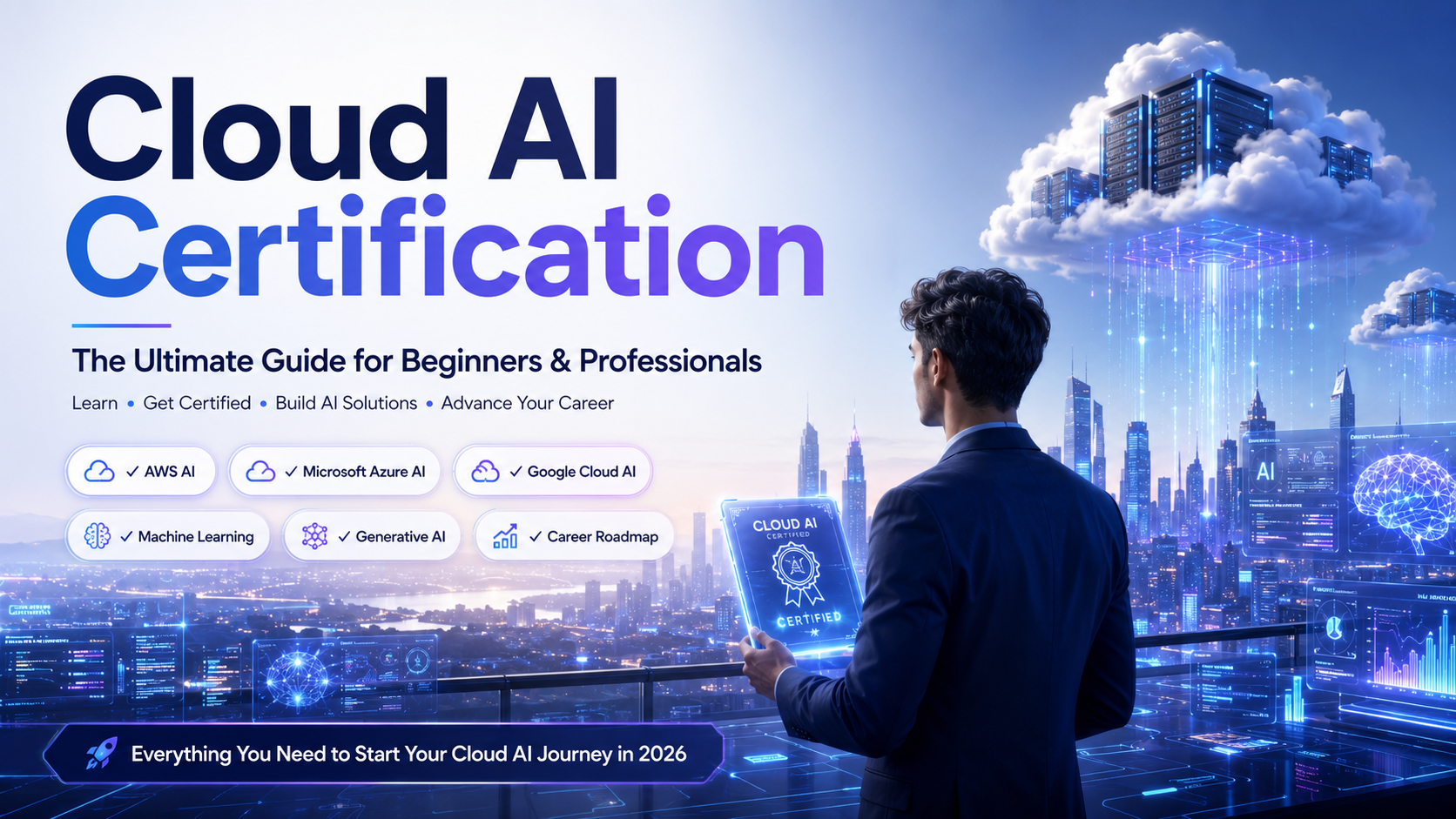
In this comprehensive guide, you’ll learn what Cloud AI certification is, why it matters, the top certifications available, how to choose the right one, career opportunities, salary expectations, preparation strategies, and the latest trends shaping the future of cloud-based artificial intelligence.
What Is Cloud AI Certification?
Cloud AI certification is a professional credential that proves you have the skills to use Artificial Intelligence (AI) technologies on cloud platforms. It shows employers that you can build, deploy, and manage AI solutions using cloud-based tools and services from leading providers such as AWS, Microsoft Azure, and Google Cloud.
Cloud AI certifications are different from regular AI courses because they focus on real-world applications instead of just programming, algorithms, and math. They teach you how to use Generative AI solutions, ready-made AI services, machine learning platforms, and data analytics tools to get business problems done quickly. This means you can make smart apps without having to build complicated machine learning models from scratch all the time.
A certified Cloud AI professional can work on projects such as:
- Creating AI-powered chatbots for customer support
- Building image and facial recognition applications
- Analyzing business data to generate useful insights
- Developing predictive analytics solutions
- Deploying Generative AI applications
- Automating repetitive tasks and business workflows
One of the major benefits of cloud platforms is that they provide everything needed to develop AI applications in one place-including computing power, secure storage, machine learning tools, and deployment services. Instead of investing in expensive hardware, businesses can access these resources on demand and scale them as their needs grow.
Why Cloud AI Certification is important
The demand for cloud-based AI solutions continues to grow across industries, including healthcare, finance, manufacturing, education, retail, and logistics.
Earning a certification offers several advantages:
- Demonstrates practical cloud AI knowledge
- Builds credibility with employers
- Improves career opportunities
- Supports career transitions into cloud technologies
- Keeps professionals updated with evolving industry practices
For beginners, certification provides structured learning. For experienced professionals, it validates existing expertise while expanding cloud-specific knowledge.
Who Should Consider Cloud AI Certification?
Cloud AI certifications are designed for different experience levels.
Beginners
Those with little or no experience can benefit from introductory certifications that cover:
- Cloud fundamentals
- Basic AI concepts
- Data fundamentals
- Simple machine learning workflows
An AI certification for beginners provides an excellent starting point before moving into advanced specializations.
Developers
Software developers learn how to integrate cloud AI services into applications using APIs, SDKs, and cloud-native tools.
Data Professionals
Data analysts and data scientists can strengthen their understanding of cloud-based machine learning pipelines and scalable analytics.
IT Professionals
System administrators and cloud engineers gain knowledge about deploying, managing, and monitoring AI workloads in cloud environments.
Top Cloud AI Certifications to Consider in 2026
Choosing the right Cloud AI certification is one of the most important decisions in your learning journey. Every certification has a different focus, target audience, and career pathway. Some are designed for beginners with little or no technical experience, while others are intended for experienced developers, machine learning engineers, or cloud architects.
Below are some of the most respected Cloud AI certifications offered by leading technology companies.
1. Microsoft Azure AI Fundamentals (AI-900)
The Microsoft Azure AI Fundamentals (AI-900) certification is widely recognized as one of the best starting points for anyone entering the world of Artificial Intelligence. It introduces learners to the basic concepts of AI, machine learning, computer vision, natural language processing (NLP), and generative AI while explaining how these technologies are implemented using Microsoft Azure.
Unlike advanced certifications, AI-900 does not require programming experience or previous knowledge of cloud computing, making it ideal for students, business professionals, and career changers.
Key Skills Covered
- Fundamentals of Artificial Intelligence
- Machine Learning concepts
- Azure AI services
- Responsible AI principles
- Computer Vision
- Conversational AI
- Natural Language Processing Best For
- Students
- Beginners
- Business professionals
- Non-technical learners
2. AWS Certified AI Practitioner
Amazon Web Services (AWS) introduced the AWS Certified AI Practitioner certification to help professionals build foundational knowledge of Artificial Intelligence and Generative AI using AWS cloud services.
The certification covers AI concepts, machine learning basics, responsible AI practices, and the practical use of AWS AI services. It is designed for individuals who want to understand AI technologies without necessarily becoming machine learning engineers.
Key Skills Covered
- AI fundamentals
- Generative AI concepts
- AWS AI services
- Responsible AI
- Business use cases
- AI implementation strategies
Best For
- Beginners
- Cloud professionals
- Project managers
- Technical consultants
3. Google Cloud Professional Machine Learning Engineer
Google Cloud has established itself as one of the leading providers of AI and Machine Learning technologies. Its Professional Machine Learning Engineer certification is intended for professionals who design, build, and manage machine learning solutions using Google Cloud.
Unlike beginner certifications, this credential requires practical experience with machine learning models, data pipelines, and cloud infrastructure.
Key Skills Covered
- Machine Learning lifecycle
- Vertex AI
- Data preparation
- Model deployment
- Model monitoring
- AI optimization
Best For
- Machine Learning Engineers
- Data Scientists
- AI Developers
- Experienced Cloud Professionals
4. IBM AI Developer Professional Certificate
IBM has long been recognized as a pioneer in enterprise Artificial Intelligence. Its AI certifications focus on helping learners develop practical AI applications using Python, machine learning, deep learning, APIs, and IBM Watson technologies.
The IBM AI Developer Professional Certificate combines theoretical concepts with hands-on projects that prepare learners for real-world AI development.
Key Skills Covered
- Python programming
- Machine Learning
- Deep Learning
- IBM Watson
- AI application development
- APIs
- Data analysis
Best For
- Developers
- AI Enthusiasts
- Data Analysts
- Software Engineers
Cloud AI Certification Roadmap
Choosing the right learning path depends on your experience. A structured cloud AI certification roadmap helps you progress efficiently.
Step 1: Learn Cloud Fundamentals
Understand:
- Cloud computing basics
- Virtual machines
- Storage
- Networking
- Security
- Identity management
Step 2: Learn AI Fundamentals
Study:
- Machine learning concepts
- Deep learning basics
- Computer vision
- Natural language processing
- Data preprocessing
Step 3: Practice Cloud AI Services
Gain practical experience with:
- Image recognition
- Text analysis
- Speech processing
- Recommendation systems
- Predictive analytics
Step 4: Choose a Certification
Select one based on:
- Career goals
- Current experience
- Preferred cloud platform
- Industry demand
Step 5: Build Hands-On Projects
Practical experience reinforces learning.
Example projects include:
- Chatbots
- Image classification
- Sentiment analysis
- Forecasting applications
- Document processing
Step 6: Continue Learning
Technology evolves rapidly.
Continue improving through:
- Advanced certifications
- Personal projects
- Industry case studies
- Community learning
Essential Skills You’ll Learn
Most cloud AI training programs cover a combination of technical and practical skills.
These commonly include:
- Cloud computing concepts
- Artificial intelligence fundamentals
- Machine learning workflows
- Data preparation
- Model deployment
- Cloud security
- API integration
- Monitoring AI services
- Responsible AI practices
Hands-on labs are often included to help learners apply concepts in realistic scenarios.
How to Prepare for a Cloud AI Certification Exam
Preparation becomes easier with a structured plan.
Build a Study Schedule
Divide topics into manageable sections over several weeks.
Practice Regularly
Hands-on experience helps reinforce theoretical knowledge.
Spend time using cloud platforms whenever possible.
Review Core Concepts
Focus on understanding:
- Machine learning lifecycle
- Cloud architecture
- Data storage
- AI services
- Security fundamentals
Take Practice Exams
Mock exams help identify knowledge gaps and improve time management.
Revise Weak Areas
Review difficult topics several times before scheduling your exam.
Career Opportunities After Cloud AI Certification
Certification can support careers in many technology fields.
Common job roles include:
- Cloud Engineer
- Machine Learning Engineer
- AI Engineer
- Data Scientist
- Cloud Solutions Architect
- Data Engineer
- Software Developer
- Cloud Consultant
- Business Intelligence Analyst
Many organizations value professionals who understand both cloud infrastructure and intelligent services.
Common Mistakes to Avoid
Many learners slow their progress by making avoidable mistakes.
Try to avoid:
- Skipping cloud fundamentals
- Memorizing instead of understanding concepts
- Ignoring practical exercises
- Choosing an advanced certification too early
- Studying without a consistent schedule
- Neglecting revision before the exam
A balanced approach combining theory and practice usually produces the best results.
Tips for Success
To maximize your learning experience:
- Start with beginner-level certifications if you’re new.
- Practice consistently instead of studying only before the exam.
- Build small projects to reinforce concepts.
- Review exam objectives before creating your study plan.
- Stay updated as cloud platforms regularly introduce new services.
- Continue learning after earning your certification.
Steady progress is more effective than trying to master everything at once.
Frequently Asked Questions (FAQs)
1. What is the best cloud AI certification for beginners?
If you are new to cloud computing and artificial intelligence, start with a foundational certification that covers cloud basics, core AI concepts, and introductory machine learning before moving to more advanced certifications.
2. Is AWS AI Certification suitable for beginners?
Some AWS certifications are designed for learners with limited experience, while others require prior knowledge of cloud services. Reviewing the recommended prerequisites can help you choose the right starting point.
3. How long does it take to prepare for a cloud AI certification?
Preparation time depends on your background. Beginners often spend several months building foundational knowledge, while experienced professionals may require only a few weeks of focused study.
4. Do I need programming experience before starting cloud AI training?
Basic programming knowledge can be helpful, but many introductory training programs begin with fundamental concepts before progressing to more technical topics.
5. Which industries value cloud AI certification?
Cloud AI skills are used across healthcare, finance, manufacturing, retail, education, telecommunications, logistics, and many other industries that rely on cloud-based data and intelligent applications.
Conclusion
A cloud AI certification is a practical way to develop skills that are increasingly relevant across today’s technology landscape. Whether you’re a student exploring new opportunities, a professional looking to expand your expertise, or an organization supporting workforce development, the right certification can provide a structured path toward understanding cloud-based artificial intelligence.
The key is to begin with a strong foundation, follow a clear cloud AI certification roadmap, gain hands-on experience through cloud AI training, and choose certifications that match your current skill level and long-term goals. With consistent learning and practical application, you can build confidence and prepare for the evolving demands of modern cloud and AI careers.