

Introduction
Just a few years ago, prompt engineering was considered one of the most valuable skills for getting better results from large language models. Countless tutorials, courses, and social media posts focused on writing the perfect prompt to generate accurate, creative, or detailed responses.
However, the landscape has changed rapidly. Instead of relying on carefully crafted prompts alone, modern systems are becoming more context-aware, goal-oriented, and capable of handling complex tasks with minimal human guidance. As a result, many people are asking the same question: Is prompt engineering coming to an end?
The short answer is not entirely.
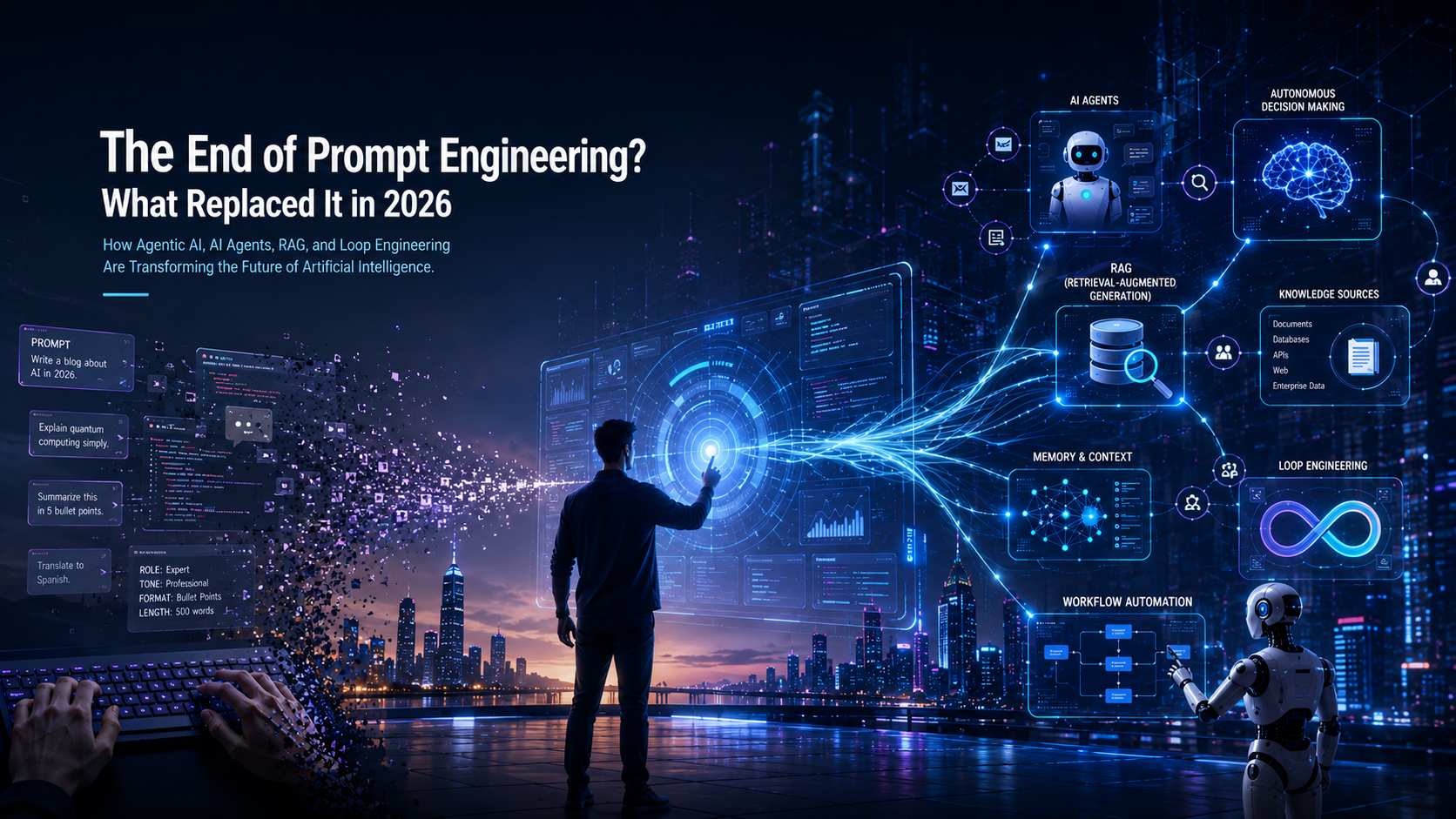
Rather than disappearing, prompt engineering is evolving into something much broader. New approaches such as Agentic AI, AI agents, RAG (Retrieval-Augmented Generation), and Loop engineering are changing how intelligent systems solve problems, access information, and complete multi-step workflows.
In this guide, you’ll learn why prompt engineering is changing, what technologies are replacing traditional prompting, and which skills are becoming more valuable in 2026 and beyond.
What Is Prompt Engineering?
Prompt engineering is the practice of designing clear instructions that guide a language model toward producing useful and accurate responses.
Instead of simply asking a question, users carefully structure prompts by providing:
- Context
- Goals
- Examples
- Formatting instructions
- Constraints
For example:
Instead of asking:
“Write a blog.”
A prompt engineer might write:
“Write a 1,500-word beginner-friendly blog about renewable energy using simple English, include FAQs, use H2 headings, and maintain a neutral tone.”
The second instruction provides far more guidance, leading to more focused results.
Why Prompt Engineering Became Popular
Prompt engineering gained popularity because early language models depended heavily on user instructions.
Small changes in wording could significantly affect:
- Accuracy
- Detail
- Creativity
- Structure
- Reliability
People discovered techniques like:
- Role prompting
- Chain-of-thought prompting
- Few-shot prompting
- Step-by-step instructions
- Persona-based prompts
These methods helped users achieve better outcomes without changing the underlying model.
Why People Say Prompt Engineering Is Ending
The phrase “the end of prompt engineering” can be misleading.
Prompt engineering is not disappearing. Instead, its role is becoming smaller as intelligent systems handle more of the planning internally.
Several developments are driving this shift.
1.Systems Understand Intent Better In the Modern language model, there is no need for a long paragraph to explain the intent. Instead of this, use short and natural wording that the actual users want. This will produce a high-quality result because the system understands what the user wants and also their intent because of their past interaction.
2. Context Is Becoming More Important Than Prompts
Older models depended mainly on the prompt itself.
Today’s systems increasingly rely on:
- External knowledge
- Previous conversation history
- Documents
- Memory
- Real-time information
As context improves, prompt wording becomes less critical.
3. Complex Tasks Need Planning, Not Better Prompts
Writing one perfect prompt is rarely enough for tasks involving:
- Research
- Multi-step reasoning
- Decision making
- Software development
- Business analysis
Instead, modern systems divide work into smaller steps and complete them sequentially.
This change has led to entirely new approaches.
What replaced it in 2026
In 2026, the “replacement” isn’t one single technique. It’s a shift toward systems that handle four things more directly:
- Reliable context (where the answer’s facts come from)
- Task decomposition (how work is broken into steps)
- Verification and iteration (how errors are caught)
- Goal-driven behavior (how outcomes are pursued over time)
The most common building blocks are RAG (Retrieval-Augmented Generation), Loop engineering, and goal-driven workflows grouped under Agentic AI and AI agents.
RAG (Retrieval-Augmented Generation): replacing “ask harder” with “bring the right context”
RAG (Retrieval-Augmented Generation) is a technique that connects a system to external knowledge so it can draw from relevant material when forming an answer.
Instead of trying to force better results through longer prompts, RAG changes the workflow:
- Find relevant documents or passages
- Use that retrieved text as the basis for the response
- Produce an output grounded in the retrieved material
Real-world example
A company has an internal policy library. In older workflows, someone might ask for “the policy about refunds” and then tweak prompts until the output matched what they expected.
With RAG, the system first retrieves the refund policy excerpts, then generates the explanation using those excerpts. The prompt still matters, but the main accuracy driver becomes whether the correct material was retrieved.
Why does it reduce the need for prompt engineering
When the facts come from a targeted retrieval step, the prompt no longer has to “remember” everything. It can focus on:
- Requested format
- Tone and structure
- How to summarize the retrieved text
Loop engineering: replacing one-shot responses with structured iteration
Many tasks aren’t solved in a single pass. Loop engineering focuses on repeating steps with a clear rule for when to stop, such as:
- Draft → check → revise
- Plan → execute → review
- Extract → verify → finalize
Instead of relying on one carefully crafted prompt to produce the final output immediately, loop-based designs create intermediate checkpoints.
Real-world example
Suppose you need a project update that includes:
- Key accomplishments
- Risks
- Next steps
- A consistent format
A one-shot prompt might miss a section or produce vague bullet points. With loop engineering, the process can look like:
- Create a draft
- Check for missing required sections
- Revise the draft to fill gaps
- Stop once requirements are satisfied
This approach shifts effort away from “getting it perfect the first time” and toward “improving over a controlled sequence.”
Agentic AI and AI agents: replacing single prompts with goal-driven workflows
Agentic AI and AI agents describe workflows where the system behaves more like a task operator than a simple prompt responder. Rather than treating each question as an independent request, the workflow can:
- Break work into steps
- Decide what to do next
- Use tools or data sources as needed
- Continue until the goal is met (or a limit is reached)
Real-world example
Imagine you’re handling a recurring support process:
- Identify the issue type
- Collect relevant details
- Propose troubleshooting steps
- Summarize the resolution
An agent-style workflow can follow a structured progression. The instructions you provide are less about micromanaging phrasing and more about defining:
- The goal
- Constraints (what to include or avoid)
- Stopping conditions (when the response is “done”)
Why can this “replace” heavy prompt work
If a workflow already knows how to plan and refine, prompts don’t need to include every nuance. The system can handle routine decisions, while your prompt guides intent and boundaries.
Does Prompt Engineering Still Matter?
Absolutely.
Prompt engineering remains valuable for tasks requiring precision, creativity, or structured outputs.
Examples include:
- Creating reports
- Summarizing documents
- Data extraction
- Brainstorming ideas
- Educational content
- Programming assistance
However, instead of being the primary skill, it has become one part of a broader workflow.
The Future of Prompt Engineering
Prompt engineering is entering a new phase rather than disappearing.
In the future, prompts are likely to become:
- Shorter
- More conversational
- Focused on goals rather than detailed instructions
Meanwhile, systems will increasingly rely on planning, retrieval, memory, and iterative improvement to deliver better results.
The emphasis is moving from crafting perfect prompts to designing effective workflows that combine multiple techniques.
Conclusion
The idea that prompt engineering has ended is an oversimplification. While it is no longer the only skill needed to work effectively with modern language models, it remains an important foundation.
What has changed is the broader ecosystem around it. Technologies such as Agentic AI, AI agents, RAG (Retrieval-Augmented Generation), and Loop engineering are reducing the need for lengthy, highly specific prompts by enabling systems to plan tasks, retrieve relevant information, and refine results over multiple steps.
Rather than replacing prompt engineering completely, these developments are expanding how intelligent systems are designed and used. For professionals and businesses alike, understanding this shift is becoming just as important as knowing how to write an effective prompt.
Frequently Asked Questions (FAQs)
1. Is prompt engineering still relevant in 2026?
Yes. Prompt engineering remains useful for tasks that require clear instructions, structured outputs, and precise control. However, it is now often combined with newer approaches such as retrieval systems and workflow-based planning.
2. What is replacing traditional prompt engineering?
There is no single replacement. Instead, technologies like Agentic AI, AI agents, RAG (Retrieval-Augmented Generation), and Loop engineering work together to reduce dependence on long, manually crafted prompts.
3.What is the difference between prompt engineering and AI agents?
Prompt engineering focuses on creating effective instructions for a single interaction, while AI agents are designed to complete multi-step tasks by planning, executing, and adapting as needed.
4. Why is RAG important?
RAG (Retrieval-Augmented Generation) helps systems retrieve relevant information from trusted documents or databases before generating a response, making answers more relevant and context-aware.
5. Should beginners still learn prompt engineering?
Yes. Understanding prompt engineering provides a strong foundation for working with modern language models. It also makes it easier to understand newer concepts such as AI agents, retrieval systems, and workflow design as they continue to evolve.