
Introduction
Building reliable, scalable, and secure enterprise solutions requires more than technical knowledge-it demands a strong understanding of architecture, governance, integration, and best practices. As organizations increasingly adopt advanced technologies across business operations, the demand for professionals who can design robust enterprise architectures continues to grow.
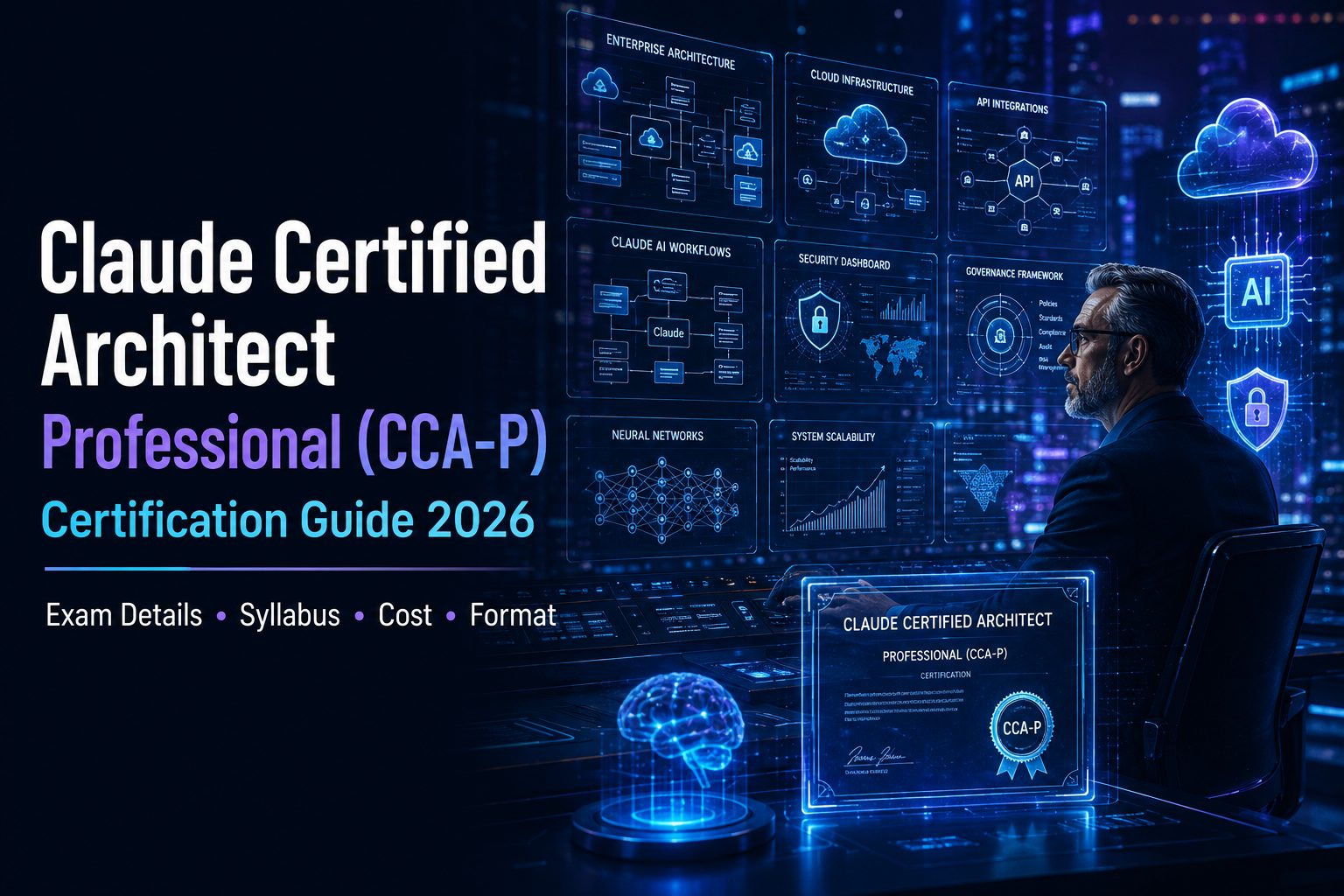
The Claude Certified Architect – Professional (CCA-P) certification is designed for experienced professionals who want to validate their expertise in designing, implementing, and managing enterprise-scale architectural solutions. Whether you are a solutions architect, technical consultant, enterprise architect, or senior developer moving into architecture, this certification demonstrates your ability to make informed architectural decisions in complex business environments.
This Claude Certified Architect CCA-P Certification Guide 2026 covers everything you need to know before taking the exam, including the CCA-P exam syllabus, CCA-P exam format, CCA-P certification cost, eligibility, preparation strategies, and frequently asked questions.
What Is the Claude Certified Architect – Professional (CCA-P) Certification?
The Claude Certified Architect – Professional (CCA-P) certification validates advanced architectural knowledge and practical skills required to design enterprise-grade solutions. Unlike entry-level certifications that focus primarily on foundational concepts, the professional-level certification evaluates your ability to apply architectural principles in real-world scenarios.
Professionals earning this certification are expected to demonstrate expertise in:
- Enterprise architecture design
- Solution planning and implementation
- Security and governance
- System scalability
- Integration strategies
- Performance optimization
- Risk management
- Architecture documentation
The certification is intended for experienced professionals responsible for making technical and architectural decisions within medium to large organizations.
Who Should Take the CCA-P Certification?
The CCA-P certification is best suited for professionals who already possess practical experience in designing enterprise systems.
Ideal candidates include:
- Enterprise Architects
- Solution Architects
- Technical Architects
- Cloud Architects
- Senior Software Engineers
- Infrastructure Architects
- Technology Consultants
- IT Managers involved in solution design
Candidates typically benefit from several years of experience working on enterprise-scale projects before attempting this professional-level certification.
Why Earn the CCA-P Certification?
As organizations continue investing in generative AI, certified professionals can distinguish themselves by validating practical architecture skills.
Some of the key benefits include:
Industry Recognition
The certification demonstrates your ability to design enterprise-grade Claude implementations using industry best practices.
Stronger Career Opportunities
Companies adopting Claude-based solutions increasingly seek professionals capable of planning, deploying, and maintaining production AI systems.
Improved Technical Skills
Preparing for the exam deepens your understanding of:
- AI system architecture
- Claude APIs
- Agentic workflows
- Context engineering
- Security principles
- Governance frameworks
- Scalable AI design
Greater Professional Credibility
Holding an advanced certification can strengthen your professional profile when applying for senior technical or consulting roles.
Claude Certified Architect CCA-P Exam Details
Although Anthropic has announced the Professional certification, some administrative details may evolve as the program expands. The current published blueprint indicates that the Professional exam targets experienced architects responsible for delivering production-grade Claude solutions.
Expected exam overview:
Feature Details
Certification Claude Certified Architect – Professional (CCA-P)
Level Professional
Target Audience Experienced AI Architects & Technical Leaders
Questions Approximately 63
Duration 120 Minutes
Question Type Scenario-based Multiple Choice
Delivery Online Proctored / Test Center (where available)
Focus Enterprise AI Architecture
Certification Provide Anthropic
The exam emphasizes practical decision-making through realistic scenarios rather than memorization of documentation.
CCA-P Exam Format
Understanding the exam format is an important step in preparing effectively.
The Professional certification is expected to include:
Scenario-Based Questions
Most questions present real-world business situations where candidates must determine the most appropriate architectural solution.
Architecture Design Problems
You may be asked to evaluate:
- AI system designs
- Integration approaches
- Scalability considerations
- Security requirements
- Performance optimization strategies
Time Management
With approximately 63 questions in 120 minutes, candidates should be comfortable making architectural decisions efficiently.
CCA-P Certification Cost
One of the most common questions candidates ask is:
How much does the Claude Certified Architect Professional certification cost?
At the time of writing, public sources indicate the Professional exam is expected to be priced around USD $175, though pricing may vary as Anthropic updates its certification program or offers promotional discounts. Always verify the latest fee before registering.
Additional costs to consider include:
- Optional training courses
- Practice exams
- Learning resources
- Retake fees (if applicable)
Investing in quality preparation can significantly improve your chances of passing on the first attempt.
CCA-P Exam Syllabus (Exam Domains & Weightage)
The Claude Certified Architect – Professional (CCA-P) exam is divided into seven competency domains, each covering a specific area of enterprise AI architecture. Understanding the weight of each domain can help you prioritize your study plan and spend more time on the topics that carry the greatest percentage of the exam.
Exam Domain Weight
Solution Design & Architecture 17%
Integration 19%
Claude Models, Prompting & Context Engineering 13%
Evaluation, Testing & Optimization 16%
Governance, Safety & Risk Management 14%
Stakeholder Communication & Lifecycle Management 14%
Developer Productivity & Operational Enablement 7%
The percentage allocation above reflects the current published blueprint for the Professional certification. As Anthropic updates its certification program, candidates should always review the latest exam guide before scheduling their exam.
1. Solution Design & Architecture (17%)
This domain focuses on your ability to translate business requirements into practical AI solutions using Claude. You’ll be expected to evaluate architectural options, choose appropriate design patterns, and create scalable systems that meet performance, security, and cost objectives.
Key topics include:
- Enterprise AI solution design
- End-to-end architecture planning
- Multi-agent system design
- Workflow selection
- Business requirement analysis
- Scalability and reliability
- Performance optimization
- Cost-efficient architecture
2. Integration (19%)
This is the largest section of the exam, emphasizing the integration of Claude into enterprise applications and existing technology ecosystems.
Topics covered include:
- Claude API integration
- Model Context Protocol (MCP)
- Tool integration
- Authentication and authorization
- External system connectivity
- RAG implementation
- API security
- Observability and monitoring
3. Claude Models, Prompting & Context Engineering (13%)
This section measures your understanding of selecting the right Claude model and designing prompts that produce reliable, consistent, and high-quality outputs.
Important concepts include:
- Claude model selection
- Prompt engineering strategies
- System prompts
- Context window management
- Token optimization
- Prompt templates
- Structured outputs
- Response consistency
4. Evaluation, Testing & Optimization (16%)
Professional architects must know how to evaluate AI systems before deploying them into production. This domain covers testing methodologies and continuous optimization.
You’ll need to understand:
- Evaluation metrics
- Benchmarking
- A/B testing
- Performance monitoring
- Error analysis
- Latency optimization
- Output quality assessment
- Continuous improvement
5. Governance, Safety & Risk Management (14%)
Enterprise AI solutions must comply with security, governance, and responsible AI principles. This domain focuses on building safe and trustworthy AI systems.
Topics include:
- AI governance
- Risk management
- Data privacy
- Security best practices
- Compliance requirements
- Responsible AI
- Access controls
- Audit and monitoring
6. Stakeholder Communication & Lifecycle Management (14%)
Beyond technical expertise, solution architects must effectively communicate with stakeholders and manage AI projects throughout their lifecycle.
Key topics include:
- Requirements gathering
- Technical documentation
- Architecture presentations
- Project planning
- AI adoption strategy
- Cross-functional collaboration
- Change management
- Production lifecycle management
7. Developer Productivity & Operational Enablement (7%)
The final domain focuses on improving developer workflows and maintaining AI applications in production environments.
Key areas include:
- Claude Code workflows
- Development best practices
- Debugging
- CI/CD integration
- Operational support
- Monitoring
- Incident response
- Team productivity
CCA-P Exam Preparation Tips
1. Understand the Exam Objectives
Before diving into your study plan, review the official exam objectives and identify the knowledge areas covered in the certification. Focus on understanding concepts rather than memorizing documentation.
Pay particular attention to:
- Enterprise AI architecture
- Claude API integration
- Prompt engineering
- Model Context Protocol (MCP)
- Claude Code workflows
- AI security and governance
- Production deployment
- Cost optimization
Building a strong conceptual foundation will help you answer scenario-based questions more effectively.
2. Gain Hands-On Experience
The Professional certification emphasizes practical skills. Reading alone is unlikely to be enough.
If possible, spend time building real projects, such as:
- AI customer support assistants
- Document summarization tools
- Knowledge-base chatbots
- Internal enterprise assistants
- Workflow automation applications
- AI-powered coding assistants
Working on real implementations helps you understand architectural trade-offs and prepares you for real-world scenarios presented in the exam.
3. Learn the Claude API Thoroughly
A professional architect should understand how Claude integrates with applications.
Practice:
- Sending API requests
- Handling structured outputs
- Streaming responses
- Managing long contexts
- Error handling
- Optimizing token usage
Rather than memorizing endpoints, focus on choosing the right integration approach for different business needs.
4. Study AI Architecture Patterns
Many exam questions are expected to evaluate architectural decision-making.
Become familiar with concepts such as:
- Microservices
- Event-driven architecture
- API gateways
- Queue-based systems
- Serverless architecture
- Distributed applications
- High availability
- Fault tolerance
Understanding these patterns will help you design scalable Claude-powered solutions.
5. Practice Scenario-Based Thinking
Professional certification exams rarely ask straightforward factual questions.
Instead, you may encounter scenarios like:
“A financial organization needs an AI assistant that processes sensitive customer information while meeting strict compliance requirements. Which architecture best satisfies security, scalability, and governance needs?”
Approach each question by identifying:
- Business requirements
- Technical constraints
- Security considerations
- Cost implications
- Scalability requirements
- User experience
6. Stay Updated
The Claude ecosystem evolves quickly, with new features and capabilities introduced regularly.
Keep an eye on updates related to:
- Claude models
- Claude Code
- Model Context Protocol (MCP)
- API improvements
- Enterprise security
- Best practices
Regularly reviewing official announcements and documentation will help ensure your knowledge remains current.
Best Learning Resources
A combination of official documentation and hands-on practice is the best preparation strategy.
Recommended resources include:
- Anthropic Documentation: Learn about Claude APIs, prompt engineering, and platform capabilities.
- Claude Certification Learning Materials: Review any official study guides or training resources released for the certification program.
- Model Context Protocol (MCP) Documentation: Understand how MCP enables secure communication between AI models and external tools.
- Claude Code Documentation: Explore development workflows, code assistance, and project integration.
- Hands-On Projects: Build practical AI applications to reinforce theoretical knowledge.
Supplementing documentation with real-world experimentation will significantly improve your understanding.
30-Day CCA-P Study Plan
Week 1: Build the Foundation
Focus on:
- Claude fundamentals
- AI architecture concepts
- Claude API basics
- Prompt engineering
- Context management
Goal: Understand the core technologies and architecture principles.
Week 2: Deep Dive into Advanced Topics
Study:
- Model Context Protocol (MCP)
- Claude Code
- Security and governance
- Enterprise integrations
- Agentic workflows
Goal: Develop a solid understanding of enterprise AI systems.
Week 3: Practical Application
Spend most of your time building projects.
Suggested ideas:
- AI document assistant
- Internal knowledge chatbot
- Customer support assistant
- Workflow automation tool
Goal: Apply architectural concepts in realistic scenarios.
Week 4: Review and Practice
During the final week:
- Review all exam domains.
- Revisit weak areas.
- Practice scenario-based questions.
- Study architecture case studies.
- Refine your time management.
Goal: Build confidence before exam day.
Career Opportunities After CCA-P Certification
Earning the Claude Certified Architect – Professional (CCA-P) certification can strengthen your profile for roles involving enterprise AI design and implementation.
Potential career paths include:
- AI Solutions Architect
- Enterprise Architect
- Senior AI Engineer
- Cloud Solutions Architect
- Technical Consultant
- Platform Engineer
- AI Integration Specialist
- AI Engineering Manager
- Generative AI Consultant
As organizations continue adopting generative AI, professionals with architecture expertise are likely to remain in demand.
Final Thoughts
The Claude Certified Architect CCA-P Certification Guide 2026 provides a comprehensive overview of what candidates can expect before pursuing this professional certification. From understanding the CCA-P exam syllabus and CCA-P exam format to reviewing the CCA-P certification cost and practical CCA-P exam preparation tips, a structured preparation approach can significantly improve your readiness.
Because professional-level certifications emphasize practical architectural thinking, candidates should focus on developing real-world problem-solving skills alongside a strong understanding of architectural principles. Consistent study, regular practice, and experience with enterprise design concepts can help build the confidence needed for the examination.
Frequently Asked Questions (FAQs)
1. What is the Claude Certified Architect – Professional (CCA-P) certification?
It is a professional-level certification designed to validate advanced knowledge of enterprise architecture, solution design, governance, scalability, security, and system integration.
2. What topics are included in the CCA-P exam syllabus?
The CCA-P exam syllabus generally includes enterprise architecture, solution design, security, governance, scalability, integration, reliability, monitoring, and architecture documentation.
3. What is the CCA-P exam format?
The CCA-P exam format primarily focuses on scenario-based and practical questions that assess architectural decision-making and real-world problem-solving abilities.
4. How much does the CCA-P certification cost?
The CCA-P certification cost varies depending on current pricing, regional policies, and any optional preparation resources. Candidates should verify the latest fee before registering.
5. How should I prepare for the CCA-P certification exam?
A good preparation strategy includes studying the exam objectives, strengthening architecture fundamentals, practicing scenario-based questions, reviewing security and governance concepts, creating architecture diagrams, taking practice exams, and following a structured revision plan.
.