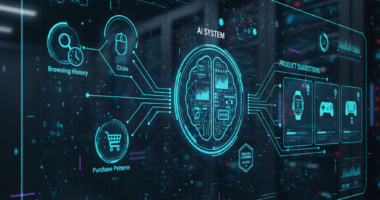

Introduction
Technology is moving away from systems that simply respond to commands. Today, a new concept is gaining attention called agentic AI. This is because it focuses on systems that can make decisions, plan activities, and achieve tasks with minimum human participation.
Unlike traditional models that mainly create replies, agentic artificial intelligence aims to execute multi-step tasks, adjust to changing settings, and interact with digital environments more independently. Industries such as healthcare, finance, customer assistance, logistics, education and software development are being affected by this transition.
The article describes what agentic AI is, how it works, its essential features, its real-world applications and obstacles, and why many experts believe that it is a crucial step towards more capable intelligent systems.
What Is Agentic AI?
Agentic AI refers to intelligent systems that can behave autonomously to some extent to achieve specific goals. These systems can instead of waiting for continual instruction:
- Analyze situations
- Make decisions
- Plan sequences of actions
- Learn from feedback
- Adjust behavior when conditions change
The term is strongly associated with autonomous AI agents that conduct activities on their own within specified rules or goals.
For instance, a typical chatbot may answer queries. But an agentic system could handle the entire workflow, including scheduling meetings, organising data, generating reports, and automatically responding to updates.
Core components of autonomous AI agents
These building blocks are typically part of these agentic systems:
- Environment interface: consumes data from sensors, logs, or APIs.
- State and memory: contain the context, past actions, and goals.
- Planner/decision engine: assesses alternatives and sequences steps.
- Executors perform actions alone or invoke external services.
- Learning/feedback loop – adapts strategy depending on successes and failures.
These parts collectively enable continuing cycles of sense → plan → act → learn.
How Agentic Artificial Intelligence Works
Agentic AI combines multiple capabilities into a coordinated system, with these features essential to its decision-making and autonomous actions, helping readers understand
how it operates more like a digital decision-maker than just a reaction engine.
Goal-Driven Planning
The system has a purpose. It then breaks the objective down into smaller steps and considers the best way to fulfil them.
For example:
- Receive a task
- Analyze available information
- Create an action plan
- Execute actions
- Monitor results
- Adjust if needed
Memory and Context Management
Agentic systems tend to remember context across interactions. This enables them to recall past activities, user preferences, or current workflows.
Decision-Making Capacity
The system doesn’t follow a single set path; it considers choices and decides what to do based on changing conditions.
Ongoing Feedback Loop
Many autonomous AI agents learn to perform better by analyzing the results and adjusting their actions accordingly.
Autonomous AI Agents: Key Features
- Independent Task Executions:These systems can perform tasks without step-by-step human instruction.
- Multi-Step Reasoning :These can accommodate complex workflows with many phases and decision points.
- Flexibility: Agentic systems respond to the unanticipated shift and adjust methods accordingly.
- Interaction with System and Tools: Some AI agent frameworks are built to hook into external platforms, databases, or apps to get things done more efficiently.
- Cooperative Agents: In more complex contexts, several agents can collaborate to solve larger issues.
AI agent frameworks: What they offer
Frameworks package common features, so teams don’t have to build everything from scratch. Features are typical of:
- Modular components for planners, state storage, and executors.
- Policy libraries provide pre-built strategies for typical tasks.
- Connections to other services and data sources.
- Testing and simulation environments for safe validation.
A framework speeds up development, supports best practices, and reduces integration problems.
Real-World Applications of Agentic AI
Some concrete instances of how agentic systems might offer value:
- Customer support routing: An agent can triage requests, run diagnostics, address simple issues, and escalate to a person when thresholds are met.
- Study assistant: Agent gathers papers, extracts summaries, compares results, and recommends next steps in the study.
- Workflow orchestration: An agent orchestrates data transfer, initiates processing jobs, and retries failing stages until completion.
- Manufacturing monitor: An agent detects irregularities, takes corrective actions, and alerts the operators when human intervention is needed.
- Software Development :Some AI agent frameworks handle repetitive technical procedures, aiding debugging, testing, and project collaboration.
- Learning & Education Systems: Education systems can tailor learning pathways and adjust what’s suggested for study based on student achievement.
Benefits of Autonomous Task Automation
Improved Efficiency:
Systems can do repetitive or time-consuming activities faster.
Faster Decision-Making
Agentic systems can process vast volumes of data instantaneously.
Reduced Human Effort
The routine can be automated, allowing teams to focus on higher-level functions.
Scaleability
Organisations can handle more workflows without the corresponding increase in staff or resources.
Continuous Operation
Conventional work methods do not limit them and can work continuously with few interruptions.
Concerns and Challenges
While there are substantial benefits of agentic AI, there are also several obstacles.
Accuracy and dependability
Making the right decisions in autonomous systems is critical, particularly in high-risk businesses.
Security Risks
Systems that can access a wide range of tools and data need effective security measures.
Ethical Issues
But questions persist about accountability, transparency, and the limits of decision-making.
Human Supervision
Many experts still believe humans should oversee key processes.
Implementation Complexity
Building trustworthy autonomous AI agents involves a generally complex infrastructure and careful system architecture.
Is Agentic AI the Future?
Many technology experts see agentic AI as the next evolution in intelligent systems, moving beyond simple responses to more independent action. Future systems are likely to manage complex workflows more efficiently and flexibly, underscoring their potential significance.
Many technology experts see agentic AI as the next step for intelligent systems, since it goes beyond simply responding to acting independently.
As AI agent frameworks continue to evolve, systems are likely to be better equipped to manage complex workflows more efficiently and flexibly.
But widespread acceptance will probably hinge on:
- Improved safety procedures
- Clear rules
- Enhanced reliability
- Best Practice Implementation
Agentic AI is more likely to complement people, assisting with decision-making and organised activities, rather than replace human involvement totally.
The Future of Autonomous AI Agents
Future developments in autonomous AI agents may include:
- More complex coordination between agents
- Improved reasoning and long-term memory
- More personalisation
- Better workflow coordination
- Extended enterprise applications
Industries are already exploring how autonomous task automation might enhance productivity, eliminate delays, and streamline operations.
As technology evolves, agentic AI might become a critical aspect of how digital systems handle tasks, analyse information, and underpin everyday operations.
Conclusion
Agentic AI represents a paradigm shift in how intelligent systems operate. These systems are designed to plan, adapt, and act towards specified goals with more autonomy, rather than just responding to requests.
Autonomous AI agents are increasingly impacting how organisations manage complex workflows and repetitive operations across industries such as healthcare, finance, logistics, and education.
Questions of reliability, ethics, and accountability remain. Still, the increasing development of AI agent frameworks and autonomous job automation suggests that the future of intelligent digital systems will be increasingly agentic artificial intelligence.
FAQs
Q: What’s the difference between agentic AI and plain scripted automation?
A: Agentic systems will plan and adapt over numerous steps to achieve goals, while scripts will execute fixed, pre-defined commands.
Q: Are autonomous AI agents safe for vital tasks?
- They can be, but safety requires clear goals, testing, monitoring, and human control before deployment.
Q: When should a team adopt an AI agent framework?
A: Use a framework to reduce development time and errors in projects that require planning, state management, or various integrations.
Q: How do agentic systems learn from the results?
A: Via feedback loops that modulate internal models or policies based on success indicators and observable outcomes.
Q: What’s the quickest way to test an agentic solution?
A: The fastest approach to test an agentic solution is to deploy it and see how it acts in the real world.