Technology transformation is no longer only a technical responsibility. Organizations increasingly need leaders who can connect business goals, organizational change, governance, workforce readiness, and emerging technology initiatives into one practical strategy.
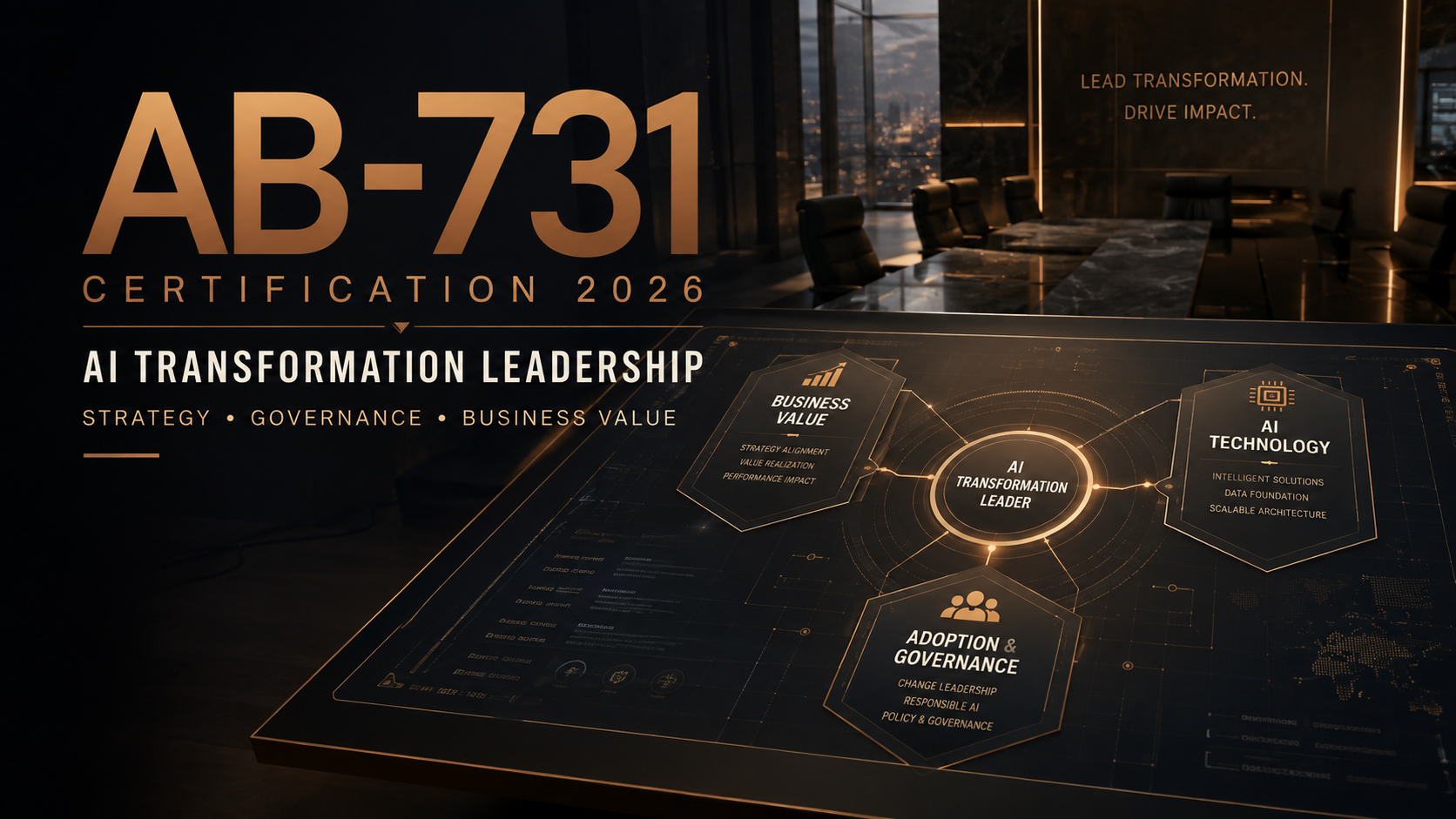
The AB-731 Certification 2026 is relevant to professionals interested in developing the strategic knowledge associated with transformation leadership. Microsoft officially offers this credential as the AI Transformation Leader certification, designed for business decision-makers guiding AI transformation and innovation.
This guide explains what candidates should understand about the AB-731 exam, the role of an AI Transformation Leader, important areas to study, practical preparation strategies, and ways to approach scenario-based questions effectively.
What Is the AB-731 Certification?
The AB-731 certification focuses on the leadership and business strategy involved in organizational transformation.
An AI Transformation Leader is expected to understand how technology initiatives connect with measurable business outcomes. This can involve identifying suitable opportunities, evaluating organizational readiness, managing stakeholder expectations, establishing governance principles, and supporting responsible adoption.
The certification is therefore particularly relevant to professionals whose responsibilities extend beyond individual systems or applications.
Potential candidates may include:
- Business and technology leaders
- Transformation managers
- Digital strategy professionals
- Consultants
- Program managers
- Solution leaders
- Innovation managers
- Department heads involved in technology initiatives
The key idea is that successful transformation requires more than
choosing technology. Organizations also need clear objectives, leadership support, governance, employee participation, and measurable results.
Who Should Consider the AB-731 Exam?
The AB-731 exam is designed for business decision-makers at different organizational levels.
Typical candidates may include:
- Business managers
- Department heads
- Directors
- Senior managers
- Executives
- Business owners
- Transformation leaders
- Strategy professionals
- Consultants
- Technology decision-makers
Microsoft describes the credential as suitable for people responsible for guiding transformation and innovation who need strategic understanding but are not expected to write code.
Is AB-731 a Technical Certification?
AB-731 requires technology awareness, but it is not primarily a technical implementation exam.
Candidates should understand concepts such as models, grounding, retrieval-augmented generation, data quality, security, Microsoft Copilot, Foundry Tools, and machine learning. However, the emphasis is generally on understanding when and why these capabilities should be used rather than writing applications.
For example, a technical engineer may be responsible for building a solution. An AI
Transformation Leader may instead decide:
- Whether the solution addresses an important business problem
- Whether the organization has suitable data
- Which approach offers an acceptable return on investment
- What governance controls should exist
- Which employees need training
- How adoption should be measured
This business-centered perspective is important throughout the AB-731 study guide.
AB-731 Exam Domains for 2026
The exam objectives effective from July 22, 2026 are organized into three major skill areas. Candidates should review Microsoft’s official AB-731 study guide to confirm the latest skills measured and exam objectives before beginning their preparation.
- Identify the business value of generative AI solutions (35–40%)
- Identify benefits, capabilities, and opportunities for Microsoft’s AI apps and services (35–40%)
- Identify an implementation and adoption strategy for Microsoft’s AI apps and services (20–25%)
Understanding these percentages can help candidates allocate their study time effectively.
Domain 1: Identify the Business Value of Generative AI Solutions
This domain represents approximately 35–40% of the AB-731 exam, making it one of the most important sections.
The objective is not simply to understand terminology. Candidates need to recognize where modern intelligent solutions can produce useful business outcomes.
Understand Foundational Concepts
Candidates should understand the difference between generative systems and other forms of machine learning.
You should also be comfortable evaluating different types of models, including:
- Pretrained models
- Fine-tuned models
- Models selected for specialized business requirements
Understanding model selection is important because organizations should not automatically choose the largest or most advanced option. The appropriate model depends on factors such as performance requirements, cost, security, accuracy, and the complexity of the task.
Understand Business Value
A strong AB-731 exam preparation strategy should focus on business outcomes.
Imagine a customer service organization receiving thousands of similar questions every week. Leadership might evaluate whether a conversational solution could help employees find information faster.
The important questions include:
- What problem is being solved?
- How much employee time could be saved?
- What information would the solution require?
- How reliable must responses be?
- What risks could incorrect responses create?
- How will success be measured?
This type of scenario reflects the strategic thinking expected from an AI Transformation Leader.
Cost and Return on Investment
Candidates should understand that implementation decisions have financial consequences.
Important considerations include:
- Usage volume
- Model consumption
- Licensing
- Infrastructure
- Data preparation
- Security
- Employee training
- Maintenance
- Expected productivity improvements
A solution that appears innovative may still be a poor business decision if implementation costs exceed the expected value.
Leaders therefore need to compare expected benefits with total cost rather than focusing only on technical capability.
Understand Reliability and Bias
Modern intelligent systems can produce incorrect or misleading outputs. Leaders must understand limitations such as:
- Fabricated information
- Inconsistent responses
- Bias
- Poor data quality
- Lack of appropriate context
These risks do not necessarily prevent adoption. Instead, they affect how a solution should be designed, governed, reviewed, and monitored.
Prompting, Grounding, and RAG
The exam also expects familiarity with prompting and grounding concepts.
Candidates should understand how clear instructions can influence system outputs and why adding reliable organizational information can improve relevance.
Retrieval-augmented generation, commonly called RAG, is another important concept within the current exam objectives.
For example, imagine an employee asking questions about an organization’s internal HR policies.
A general-purpose model may not know the company’s latest policies. A grounded system can first retrieve information from approved internal documents and then use that information when preparing its response.
From a leadership perspective, the important issue is understanding why grounding is needed and what business problem it solves.
Domain 2: Microsoft AI Apps and Services
The second major domain also represents approximately 35–40%
of the AB-731 exam.
Candidates should understand where Microsoft’s different services fit within business scenarios.
Microsoft 365 Copilot
Microsoft 365 Copilot can support work across familiar productivity applications.
For exam purposes, candidates should focus on matching capabilities with business requirements rather than memorizing product descriptions.
Possible business scenarios include:
- Summarizing meetings
- Reviewing documents
- Preparing presentations
- Analyzing information
- Supporting communication
- Finding organizational knowledge
- Improving employee productivity
An important leadership question is whether a process should be improved using an existing product capability, extended using additional functionality, or addressed through a custom solution.
Microsoft Copilot Studio
Candidates should also understand the purpose of Microsoft Copilot Studio.
From a business leadership perspective, Copilot Studio becomes relevant when an organization wants more customized conversational experiences, workflows, or agents connected to organizational processes and information.
A leader does not necessarily need to know how to configure every component. Instead, the exam may expect candidates to recognize situations where customization creates business value.
Microsoft Graph
Microsoft Graph provides access to organizational information and relationships across Microsoft services.
For transformation leaders, understanding Graph is useful because organizational context can significantly improve the relevance of workplace solutions.
For example, a solution might need awareness of documents, meetings, users, messages, or other business information while still respecting security and access
permissions.
Microsoft Foundry and Foundry Tools
The current AB-731 study guide also expects candidates to understand Microsoft Foundry and Foundry Tools.
Important capabilities include areas such as:
- Model selection
- Azure AI Search
- Vision-related capabilities
- Enterprise solution development
- Security
- Scalability
Candidates should focus on matching business requirements to appropriate capabilities rather than studying the platform only from an engineering perspective.
Build, Buy, or Extend
One important strategic decision is whether an organization should:
- Use an existing product
- Extend an existing solution
- Build something more customized
Consider a company that needs employees to summarize Microsoft Teams meetings. An existing Microsoft 365 capability may already address the requirement.
However, if the company wants a specialized assistant connected to proprietary databases, internal procedures, and unique approval workflows, extending or building a customized solution may be more appropriate.
The correct decision depends on business requirements, cost, security, complexity, maintenance, and expected value.
Domain 3: Implementation and Adoption Strategy
The third domain accounts for approximately 20–25% of the current exam and focuses heavily on leadership responsibilities.
A successful technology initiative requires more than selecting the right product. Employees must understand it, trust it, and use it appropriately.
Responsible AI and Governance
Candidates should understand responsible use principles and why governance is necessary.
Important areas include:
- Fairness
- Reliability
- Safety
- Privacy
- Security
- Inclusiveness
- Transparency
- Accountability
These principles help organizations introduce new capabilities while managing operational, ethical, security, and compliance risks.
Establishing Governance Principles
Organizations should define clear rules covering areas such as:
- Approved use cases
- Data handling
- Security responsibilities
- Human review
- Risk assessment
- Employee responsibilities
- Monitoring
- Escalation procedures
Without clear governance, different teams may introduce tools independently, creating unnecessary security and compliance risks.
The Role of an AI Council
The updated exam objectives include understanding the role of an AI council in strategy, oversight, and cross-functional alignment.
A council might include representatives from:
- Leadership
- IT
- Security
- Legal
- Compliance
- Finance
- Human resources
- Business departments
Its purpose is not necessarily to approve every individual use case. Instead, it can establish organizational direction, governance principles, priorities, and accountability.
Planning Organizational Adoption
Strong technology with weak adoption creates limited value.
For this reason, candidates should understand how organizations can prepare employees for change.
Create an Adoption Team
An adoption team can coordinate implementation across departments.
Responsibilities might include:
- Identifying suitable use cases
- Communicating benefits
- Providing employee training
- Collecting feedback
- Measuring adoption
- Resolving implementation barriers
Identify Adoption Barriers
Common challenges may include:
- Employee uncertainty
- Lack of leadership support
- Poor data quality
- Security concerns
- Unclear business value
- Limited training
- Cost concerns
- Resistance to changing established workflows
Candidates should understand how leadership actions can reduce these barriers.
AI Champions Programs
The current exam objectives also include establishing an AI champions program.
Champions are employees who develop stronger knowledge of available capabilities and help colleagues use them effectively.
For example, instead of relying only on a central technology department, an organization could nominate representatives from finance, sales, HR, marketing, and operations.
These employees can identify department-specific opportunities and help teams adopt new working practices.
AB-731 Exam Preparation Strategy
Effective AB-731 exam preparation should combine conceptual learning with practical business scenarios.
For candidates looking for additional AB-731 exam preparation resources, CertsGate can provide supplementary study and practice materials to support preparation for the certification exam.
Step 1: Review the Official Exam Objectives
Begin by studying the current skills measured for AB-731. This gives you a clear picture of the areas that can appear on the exam.
The objectives were updated on July 22, 2026, so candidates preparing with older material should check that their study resources reflect the current version.
Step 2: Understand the Business Scenario First
Instead of memorizing isolated definitions, ask questions such as:
- What business problem is being addressed?
- What outcome does the organization want?
- Which Microsoft capability could support that outcome?
- What data would be required?
- What security or privacy concerns could arise?
- How would employees adopt the solution?
- How could the organization measure success?
This approach helps develop the decision-making perspective expected from a transformation leader.
Step 3: Learn Product Capabilities at a Practical Level
Create simple notes for each major Microsoft service.
For each one, record:
- What it does
- Who typically uses it
- What business problem it addresses
- What its major capabilities are
- What limitations or considerations should be evaluated
This is generally more useful than trying to memorize long lists of features.
Step 4: Practice Scenario-Based Questions
The AB-731 exam is closely connected to business decision-making. Practice questions should therefore be approached as scenarios rather than simple memorization exercises.
Candidates who want additional AB-731 practice questions and study resources can use CertsGate to reinforce key concepts and practice applying them to exam-style scenarios.
For every question, identify:
- The business requirement
- The desired outcome
- The relevant product or capability
- The organizational constraint
- The most appropriate strategic response
When two answers appear reasonable, focus on the option that best addresses the stated business requirement while considering adoption, security, privacy, and cost.
Step 5: Use Hands-On Learning Where Appropriate
Although AB-731 does not require programming, practical exposure can make the concepts easier to understand.
Microsoft recommends training and hands-on experience before taking the exam. Its AB-731 training course, Drive AI transformation in your organization, is listed as a one-day course and is specifically associated with the AI Transformation Leader certification.
Common AB-731 Preparation Mistakes
Memorizing Without Understanding
Knowing product names is not enough.
Candidates should understand why one option may be more suitable than another in a particular business situation.
Ignoring Business Value
AB-731 is a leadership-focused certification.
Always connect technology decisions with:
- Business goals
- Productivity
- Revenue
- Cost reduction
- Employee experience
- Customer outcomes
- Risk
Studying Too Technically
Technical knowledge is useful, but candidates do not need to approach AB-731 like a developer certification.
Spend more time understanding strategy, use cases, adoption, governance, and decision-making.
Ignoring Change Management
A technically successful implementation can still fail if employees do not use it.
Adoption strategy is therefore a meaningful part of the certification.
Using an Outdated Study Plan
The English AB-731 exam objectives were updated on July 22, 2026, so candidates preparing in 2026 should ensure their materials reflect the current objectives.
How AB-731 Skills Apply in the Real World
Consider a manufacturing company exploring intelligent tools across several departments.
The finance department wants faster financial analysis. HR wants employees to find policy information more easily. Customer service wants faster access to product documentation.
An AI Transformation Leader would not immediately introduce the same solution everywhere.
Instead, the leader could:
- Identify each department’s business problem.
- Estimate potential business value.
- Review available organizational data.
- Evaluate suitable Microsoft services.
- Assess security and privacy requirements.
- Decide whether to use, extend, or build a solution.
- Establish governance controls.
- Select pilot groups.
- Train employees.
- Measure business outcomes.
- Expand successful initiatives.
This example demonstrates why AB-731 is primarily about strategic transformation rather than technology alone.
Is the AB-731 Certification Worth Considering in 2026?
The value of any professional certification depends on a person’s responsibilities and career direction.
AB-731 may be especially relevant for professionals who participate in digital strategy, organizational transformation, technology investment, business process improvement, or Microsoft-focused initiatives.
It can also provide a structured learning path for managers who need to communicate effectively with technical teams without becoming developers themselves.
However, professionals seeking deep engineering skills, model development expertise, or software architecture knowledge may need a more technically focused certification alongside or instead of AB-731.
The strongest reason to pursue the credential is therefore alignment with the role you perform or want to perform.
Final Thoughts
The AB-731 Certification 2026 reflects an important shift in technology leadership. Successful transformation requires more than understanding what modern tools can do. Leaders must know where they create business value, how to choose appropriate solutions, how to manage organizational risk, and how to help employees adopt new ways of working.
Effective AB-731 exam preparation should therefore combine product knowledge with strategic thinking.
Candidates should understand Microsoft 365 Copilot, Copilot Studio, Microsoft Foundry, Foundry Tools, business value, grounding, data, governance, security, responsible use, organizational adoption, and change management.
Most importantly, approach the AB-731 exam from the perspective of an AI Transformation Leader: identify the business problem first, evaluate the available options, consider risk and cost, and select the strategy that creates sustainable organizational value.
Frequently Asked Questions
What is the AB-731 Certification 2026?
AB-731 is the exam associated with the Microsoft Certified: AI Transformation Leader certification. It focuses on business value, Microsoft intelligent services, governance, implementation strategy, and organizational adoption.
Who should take the AB-731 exam?
The exam is most suitable for business managers, decision-makers, directors, executives, consultants, transformation professionals, and aspiring leaders responsible for technology adoption or business innovation.
Does AB-731 require coding skills?
No. Microsoft states that candidates are not expected to write code. The certification focuses mainly on business strategy, opportunities, adoption, governance, and informed decision-making.
What should an AB-731 study guide cover?
A useful AB-731 study guide should cover business value, generative concepts, prompting, grounding, RAG, data considerations, Microsoft 365 Copilot, Copilot Studio, Microsoft Graph, Microsoft Foundry, Foundry Tools, responsible use, governance, security, adoption, and change management.
How should I approach AB-731 exam preparation?
Start with the current exam objectives, study each domain according to its weighting, understand Microsoft services through business scenarios, review governance and adoption concepts, and use scenario-based practice to strengthen decision-making skills.