Business applications are becoming more connected, intelligent, and capable of handling increasingly complex tasks. As organizations look for better ways to improve customer service, streamline operations, analyze information, and support decision-making, the role of the solution architect is also changing.
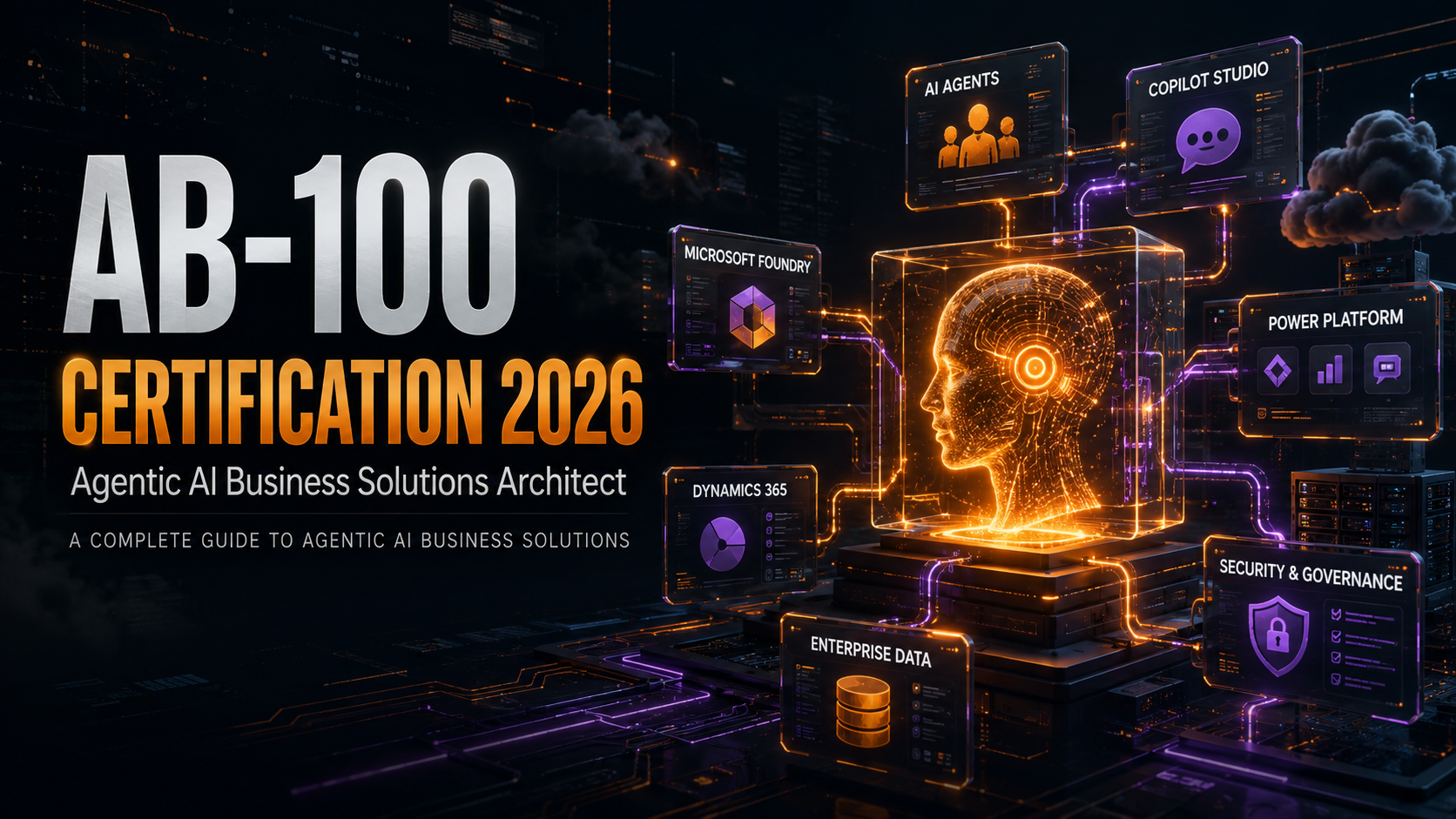
The AB-100 Certification 2026 is designed for experienced professionals who can architect business solutions using Microsoft technologies. The credential is officially known as Microsoft Certified: Agentic AI Business Solutions Architect.
The certification focuses less on individual features and more on how these technologies can be combined into secure, scalable, and business-focused solutions.
This guide explains what the AB-100 exam covers, who should consider it, the current skills measured, certification requirements, and practical approaches for AB-100 exam preparation. It also provides an AB-100 study guide structure to help candidates organize their learning around the areas that carry the greatest weight.
What Is AB-100 Certification?
AB-100 is the exam associated with the Microsoft Certified: Agentic AI Business Solutions Architect certification. The role is aimed at experienced solution architects who design and guide business solutions across Microsoft platforms.
The certification expects candidates to understand how to:
- Analyze business and technical requirements
- Plan intelligent business solutions
- Design agent-based and multi-agent architectures
- Work with Microsoft Copilot Studio and Microsoft Foundry
- Integrate Dynamics 365 and Power Platform capabilities
- Design secure and scalable solutions
- Monitor solution performance
- Establish testing and application lifecycle management processes
- Apply governance, compliance, and responsible-use principles
- Evaluate costs, benefits, and expected business outcomes
In other words, the AB-100 exam tests architectural judgment rather than simple product knowledge.
A candidate may know how a particular Microsoft service works, but AB-100 goes further by asking whether that service is the right choice for a particular business requirement and how it should fit into the overall architecture.
AB-100 Exam vs. AB-100 Certification
One important point candidates should understand is that AB-100 is an exam, while Agentic AI Business Solutions Architect is the certification.
Passing AB-100 alone does not necessarily complete the Expert-level certification path.
Microsoft currently requires candidates to pass AB-100 and hold one qualifying Associate-level Microsoft certification. Eligible credentials currently include certifications connected with Power Platform, Dynamics 365, and Microsoft’s newer intelligent application and agent development tracks.
Examples include:
- Power Platform Functional Consultant Associate
- Power Platform Developer Associate
- Dynamics 365 Customer Experience Analyst Associate
- Dynamics 365 Customer Service Functional Consultant Associate
- Dynamics 365 Finance Functional Consultant Associate
- Dynamics 365 Supply Chain Management Functional Consultant Associate
- Dynamics 365 Business Central Functional Consultant Associate
- Machine Learning Operations Engineer Associate
- Azure AI Apps and Agents Developer Associate
- AI Agent Builder Associate
- Intelligent Applications Builder Associate
Candidates should therefore check their certification profile before assuming that passing AB-100 will immediately result in the Expert credential.
For the latest prerequisite requirements, candidates should verify the requirements on Microsoft’s Agentic AI Business Solutions Architect certification page before scheduling their certification path.
AB-100 Exam Details for 2026
The current AB-100 exam is delivered as a proctored Microsoft certification assessment.
Important details include:
Exam Detail Information
Exam code AB-100
Exam name Agentic AI Business Solutions Architect
Certification level Expert
Primary role Solution Architect
Exam duration 100 minutes
Passing score 700 or higher
Current exam language English
Main skill areas Plan, Design, and Deploy business solutions
Certification requirement AB-100 plus an eligible Associate certification
Microsoft notes that certification exams can include interactive components, so candidates should prepare for scenario-based tasks as well as traditional questions.
AB-100 Exam Skills Measured in 2026
The AB-100 skills outline was updated for the English exam on July 22, 2026.
Microsoft’s official AB-100 study guide provides the current skills measured and should be treated as the primary reference when planning your preparation.
The current exam is divided into three major areas:
- Plan AI-powered business solutions (25–30%)
- Design AI-powered business solutions (25–30%)
- Deploy AI-powered business solutions (40–45%)
The percentages are important when building an AB-100 exam preparation strategy. Deployment, governance, monitoring, testing, and lifecycle management together represent the largest portion of the assessment.
1. Plan Business Solutions (25–30%)
The planning domain examines whether a candidate can understand a business problem before choosing technologies.
Analyze Business Requirements
Candidates should be able to determine where agents can provide practical value.
This includes evaluating their use for:
- Task execution
- Business process support
- Data analysis
- Decision support
- Employee experiences
- Customer interactions
Data readiness is also important.
Before enterprise information can reliably support an intelligent solution, an architect should evaluate its:
- Accuracy
- Relevance
- Timeliness
- Availability
- Cleanliness
- Accessibility
Consider a customer service organization that wants an agent to answer questions about warranties.
Simply connecting the agent to a document repository would not be enough. The architect should first determine whether those documents are current, whether employees have permission to access them, whether duplicate policies exist, and which source represents the official version.
That type of architectural reasoning is relevant to AB-100.
Design the Overall Strategy
Candidates should understand how to develop an enterprise-wide strategy rather than designing each feature independently.
Topics include:
- Agent-first architecture
- Multi-agent solutions
- Microsoft 365 Copilot
- Copilot Studio
- Microsoft Foundry
- Prebuilt agents
- Custom agents
- Custom models
- Knowledge sources
- Prompt libraries
- Small language models
- Dynamics 365 integration
- Microsoft Cloud Adoption Framework principles
The exam can present scenarios where several technical approaches appear possible.
The architect must choose the option that best satisfies the business requirement while
considering security, maintainability, cost, scalability, and existing Microsoft investments.
Evaluate Cost, Value, and ROI
Architecture decisions also have financial consequences.
Candidates should understand concepts including:
- Return on investment
- Total cost of ownership
- Build-versus-buy decisions
- Extending an existing solution
- Creating a custom component
- Selecting different models for different workloads
For example, using the most capable model for every request may be technically possible but financially inefficient.
An architect could instead route routine requests toward a smaller or lower-cost model while reserving more capable models for complex tasks.
AB-100 therefore evaluates business judgment alongside technical knowledge.
2. Design Business Solutions (25–30%)
The design section moves from strategy into specific architecture choices.
Designing Agents for Business Scenarios
Candidates should understand different types of agents and where each approach fits.
The current AB-100 study guide includes areas such as:
- Task agents
- Autonomous agents
- Prompt-and-response agents
- Copilot Studio agents
- Agent flows
- Dynamics 365 integrations
- Contact center scenarios
- Grounding strategies
- Topics and fallback behavior
- Prompt actions
- Custom models
The important skill is not simply knowing what these features are.
Candidates must understand when to use them.
For example, a support assistant that responds only when an employee asks a question has very different requirements from an autonomous agent that reviews cases and initiates actions without waiting for a request.
The second design requires stronger controls around permissions, monitoring, failure handling, approvals, and auditing.
Understand Grounding and Enterprise Data
Business solutions frequently require models to work with information that is not part of their original training.
Grounding allows the system to use approved organizational data when responding or making decisions.
Candidates should understand:
- Selecting knowledge sources
- Preparing enterprise data
- Access permissions
- Data processing
- Retrieval quality
- Data residency
- Knowledge freshness
- Security boundaries
An architecture should ensure that access to grounded information follows the same business security rules that apply to the underlying data.
An employee should not gain access to restricted financial, HR, or customer information simply because an agent can retrieve it.
Copilot Studio Architecture
Copilot Studio is an important technology within the AB-100 scope.
Candidates should understand architectural decisions involving:
- Topics
- Fallback behavior
- Agent flows
- Prompt actions
- Reasoning behavior
- Voice experiences
- Knowledge sources
- Extensibility
- Connectors
- Computer Use
- Model Context Protocol
The exam can test whether a proposed Copilot Studio design appropriately matches a business requirement.
Model Context Protocol
Model Context Protocol, commonly called MCP, provides a standardized approach for connecting models and agents with external tools, services, and contextual information.
For AB-100 candidates, the important issue is architectural use rather than protocol implementation details.
Candidates should understand why an organization might use standardized interfaces instead of building separate custom integrations for every agent and service.
Microsoft also identifies Agent2Agent, or A2A, among the open standards relevant to the certification role.
Design Multi-Agent Solutions
Some enterprise processes involve several specialized responsibilities.
Instead of creating one large agent, an organization might use separate agents for:
- Customer interaction
- Document retrieval
- Order processing
- Compliance checks
- Escalation to employees
The architect must determine how these components communicate and which component owns each responsibility.
A well-designed multi-agent solution should consider:
- Agent responsibilities
- Orchestration
- Context sharing
- Authentication
- Data boundaries
- Error handling
- Human approval
- Monitoring
- Security
- Cost
Expect this architectural thinking to be important for the Agentic AI Business Solutions Architect role.
Designing Across Dynamics 365 and Microsoft 365
AB-100 is intentionally cross-platform.
Candidates should understand how intelligent capabilities can be applied to applications including:
- Dynamics 365 Sales
- Dynamics 365 Customer Service
- Dynamics 365 Contact Center
- Dynamics 365 Finance
- Dynamics 365 Supply Chain Management
- Microsoft Teams
- SharePoint
- Microsoft 365 Copilot
- Power Apps
Candidates do not necessarily need to be the deepest technical specialist in every product.
However, an architect must understand enough about each platform to determine where a business requirement should be implemented and how different services can work together.
3. Deploy Business Solutions (40–45%)
Deployment is currently the largest AB-100 exam domain.
It covers much more than moving a solution into production.
Candidates must think about what happens throughout the complete operational lifecycle.
Monitor and Tune Solutions
Once agents are deployed, organizations need visibility into how they perform.
Architects should understand how to:
- Define useful performance metrics
- Monitor agent behavior
- Interpret telemetry
- Analyze user feedback
- Review usage patterns
- Identify performance problems
- Improve model behavior
- Track reliability
A solution that works correctly during a demonstration may behave differently when thousands of employees begin using it with unpredictable inputs.
Monitoring is therefore part of architecture, not an optional post-deployment activity.
Testing Strategy
Candidates should know how to design testing processes for intelligent business solutions.
Relevant areas include:
- Agent testing
- Model validation
- Prompt validation
- End-to-end testing
- Multi-application scenarios
- Test metrics
- Business acceptance criteria
For example, testing a customer support agent should go beyond verifying whether it produces grammatically correct responses.
Testing could evaluate:
- Factual accuracy
- Correct use of organizational data
- Response relevance
- Access permissions
- Unsupported requests
- Escalation behavior
- Prompt manipulation attempts
- Unexpected inputs
Scenario-based thinking is particularly useful during AB-100 exam preparation.
Application Lifecycle Management
Application lifecycle management, or ALM, is another important topic.
Candidates should understand lifecycle strategies for:
- Copilot Studio agents
- Agent actions
- Connectors
- Enterprise data
- Custom models
- Microsoft Foundry Agent Service
- Dynamics 365 capabilities
- Development, testing, and production environments
A mature organization generally should not modify production agents directly whenever a new requirement appears.
Changes should move through controlled environments with appropriate testing, approvals, version tracking, and rollback processes.
Security, Governance, and Compliance
Security is one of the most important areas in AB-100.
Candidates should understand architecture decisions involving:
- Agent security
- Model security
- Access controls
- Data protection
- Data residency
- Governance
- Audit trails
- Risk management
- Vulnerability mitigation
- Prompt manipulation
- Responsible-use principles
A technically impressive solution can still be unsuitable for enterprise deployment if it exposes sensitive data or allows unauthorized actions.
Security should therefore be part of the architecture from the beginning rather than added shortly before deployment.
Who Should Take the AB-100 Exam?
AB-100 is most suitable for experienced professionals working in roles such as:
- Solution Architect
- Enterprise Architect
- Power Platform Architect
- Dynamics 365 Architect
- Technical Architect
- Senior Functional Consultant
- Business Applications Architect
- Intelligent Applications Architect
- Technology Consultant
It is particularly relevant to professionals responsible for connecting several Microsoft platforms into one enterprise solution.
The exam is unlikely to be the best starting point for someone completely new to Microsoft Power Platform, Dynamics 365, Copilot Studio, or enterprise solution architecture.
Skills You Should Have Before Starting AB-100 Preparation
A strong candidate should ideally have practical experience in several areas.
Microsoft Power Platform
Understand the purpose and architecture of:
- Power Apps
- Power Automate
- Dataverse
- Connectors
- Environment management
- Security
- Solution lifecycle management
Microsoft Copilot Studio
Study:
- Agents
- Topics
- Knowledge sources
- Actions
- Agent flows
- Generative orchestration
- Extensibility
- Authentication
- Governance
Dynamics 365
Understand the business purpose of major Dynamics 365 applications and how their capabilities can participate in broader enterprise solutions.
Microsoft Foundry
Be familiar with concepts involving:
- Models
- Model selection
- Agents
- Custom models
- Evaluation
- Grounding
- Monitoring
Enterprise Architecture
AB-100 candidates should also be comfortable discussing:
- Scalability
- Integration
- Identity
- Security
- Governance
- Data architecture
- ALM
- Cost management
- Monitoring
- Business requirements
- ROI
AB-100 Exam Preparation Strategy
A successful AB-100 exam preparation plan should combine conceptual study with architecture practice.
Candidates looking for additional AB-100 exam preparation resources can also use CertsGate to reinforce their knowledge with structured practice and revision materials.
Step 1: Start With the Official Skills Outline
Use the three exam domains as the structure for your preparation:
- Plan
- Design
- Deploy
Avoid studying individual Microsoft products without connecting them to these architecture objectives.
Step 2: Focus More Time on Deployment
Because deployment represents 40–45% of the current exam, allocate significant preparation time to:
- Governance
- Security
- Monitoring
- Testing
- ALM
- Model validation
- Data controls
Do not spend all your preparation time creating agents.
Step 3: Build Scenario-Based Knowledge
For each technology you study, ask questions such as:
- When should I use this?
- When should I avoid it?
- What is the simpler alternative?
- What data does it require?
- How is access controlled?
- How would I monitor it?
- How would I deploy changes?
- What happens when it fails?
- What does it cost?
These questions develop the decision-making skills expected from an architect.
Step 4: Practice Cross-Platform Architecture
Create sample business requirements and map them to appropriate services.
For example:
Requirement: A company wants sales employees to ask questions about customers, retrieve approved SharePoint documentation, summarize recent CRM activities, and create follow-up tasks.
Your architecture might involve:
- Dynamics 365 Sales
- Microsoft 365 Copilot
- SharePoint
- Copilot Studio
- Dataverse
- Appropriate identity and access controls
The important exercise is explaining why each component belongs in the solution.
Step 5: Study Security Alongside Every Feature
Do not treat security as one isolated chapter.
Whenever you study a feature, consider:
- Authentication
- Authorization
- Data access
- Data residency
- Logging
- Auditing
- Prompt manipulation
- Compliance
- Governance
This better reflects real enterprise architecture.
Step 6: Use AB-100 Practice Questions Correctly
Practice questions are useful when they help identify weak areas.
After answering each scenario, explain:
- Why the correct architecture meets the requirement.
- Why the alternative options are weaker.
- Which requirement eliminates the incorrect choices.
This approach is more valuable than simply memorizing answers.
Example Six-Week AB-100 Study Plan
Week 1: Architecture Fundamentals
Focus on:
- AB-100 exam objectives
- Business requirements
- Architecture patterns
- Cloud Adoption Framework
- ROI and total cost of ownership
- Build-versus-buy decisions
Week 2: Copilot Studio and Agents
Study:
- Agent types
- Topics
- Actions
- Knowledge
- Agent flows
- Orchestration
- Extensibility
Week 3: Dynamics 365 and Microsoft 365
Review intelligent capabilities across:
- Sales
- Customer Service
- Contact Center
- Finance
- Supply Chain
- Teams
- SharePoint
- Microsoft 365 Copilot
Week 4: Data, Models, and Integration
Study:
- Grounding
- Model selection
- Microsoft Foundry
- Custom models
- MCP
- Multi-agent architecture
- Enterprise data
Week 5: Deployment and Governance
Prioritize:
- Security
- ALM
- Monitoring
- Testing
- Governance
- Responsible use
- Data residency
- Audit trails
Week 6: Review and Scenario Practice
Complete:
- Practice assessments
- Architecture scenarios
- Weak-domain review
- Timed question sessions
- Exam environment familiarization
Adjust the schedule based on your existing experience rather than following it rigidly.
Common AB-100 Preparation Mistakes
Memorizing Product Features
AB-100 evaluates architecture decisions.
Knowing that a feature exists is less useful than understanding when that feature is appropriate.
Ignoring Business Requirements
The technically most advanced option is not always the correct architecture.
Cost, maintainability, security, existing infrastructure, and business value all matter.
Studying Only Copilot Studio
Copilot Studio is important, but AB-100 spans a much wider Microsoft business application ecosystem.
Ignoring Governance
Security, compliance, testing, monitoring, and ALM represent major responsibilities for an enterprise architect.
Using Practice Questions as the Entire Study Plan
Practice questions can measure readiness, but they should not replace documentation, hands-on experience, architecture exercises, and conceptual understanding.
How Difficult Is the AB-100 Exam?
AB-100 should generally be viewed as an advanced certification exam.
Its difficulty comes from its breadth.
A candidate may need to evaluate a scenario involving business requirements, Dynamics 365, Copilot Studio, Microsoft 365, enterprise data, agents, security, governance, and lifecycle management within the same architectural decision.
Experienced Power Platform or Dynamics 365 professionals may already understand parts of the exam, but they may need additional preparation around multi-agent architecture, Microsoft Foundry, model management, monitoring, and intelligent solution governance.
Similarly, professionals with strong model-development knowledge may need deeper familiarity with Microsoft business applications and enterprise architecture.
Is AB-100 Certification Worth Pursuing in 2026?
The value of AB-100 depends largely on a professional’s role and career direction.
It is most relevant for professionals responsible for designing enterprise solutions across Microsoft business platforms rather than implementing one isolated application.
The certification aligns particularly well with roles where responsibilities include:
- Enterprise solution planning
- Business process architecture
- Microsoft platform integration
- Agent architecture
- Governance
- Security
- Technical leadership
- Technology selection
Professionals focused only on entry-level development or a single Microsoft product may benefit more from building foundational or Associate-level knowledge before pursuing AB-100.
Final Thoughts
The AB-100 Certification 2026 path reflects a broader change in solution architecture.
Modern architects increasingly need to connect business applications, enterprise information, models, agents, security controls, governance processes, and measurable business outcomes into one coherent architecture.
For the AB-100 exam, candidates should therefore avoid approaching preparation as a simple memorization exercise.
A strong AB-100 study guide should concentrate on three questions throughout the preparation process:
What should the organization build? How should it be designed? And how can it be deployed securely and reliably at enterprise scale?
Candidates who can answer those questions across Microsoft Copilot Studio, Microsoft Foundry, Power Platform, Dynamics 365, Microsoft 365, enterprise data, security, and governance will be addressing the central skills expected from an Agentic AI Business Solutions Architect.
Frequently Asked Questions
What is the AB-100 exam?
AB-100 is the Microsoft exam for the Agentic AI Business Solutions Architect certification path. It evaluates the ability to plan, design, deploy, secure, govern, test, and monitor intelligent business solutions across Microsoft platforms.
What is the best way to prepare for the AB-100 exam?
Begin with the official skills outline, study each exam domain, gain hands-on experience with Copilot Studio and related Microsoft platforms, practice architecture scenarios, and spend significant time on deployment, security, governance, testing, and ALM.
Is AB-100 an Expert-level exam?
Yes. The Agentic AI Business Solutions Architect credential is positioned at the Expert level and is intended primarily for experienced solution architects.
What score is required to pass AB-100?
Microsoft’s current certification study guide states that candidates need a score of 700 or greater to pass the exam.
Do I receive the certification after passing AB-100?
Not necessarily. AB-100 is the required exam, but Microsoft currently also requires an eligible Associate certification to earn the complete Agentic AI Business Solutions Architect credential. Candidates should verify the current qualifying certifications before scheduling their certification path.