
Cloud development is changing quickly, and developers are increasingly expected to do more than connect applications to simple APIs. Modern Azure projects can involve intelligent search, language processing, document extraction, computer vision, generative applications, and agent-based workflows.
Microsoft AI-103 is designed around these newer development responsibilities.
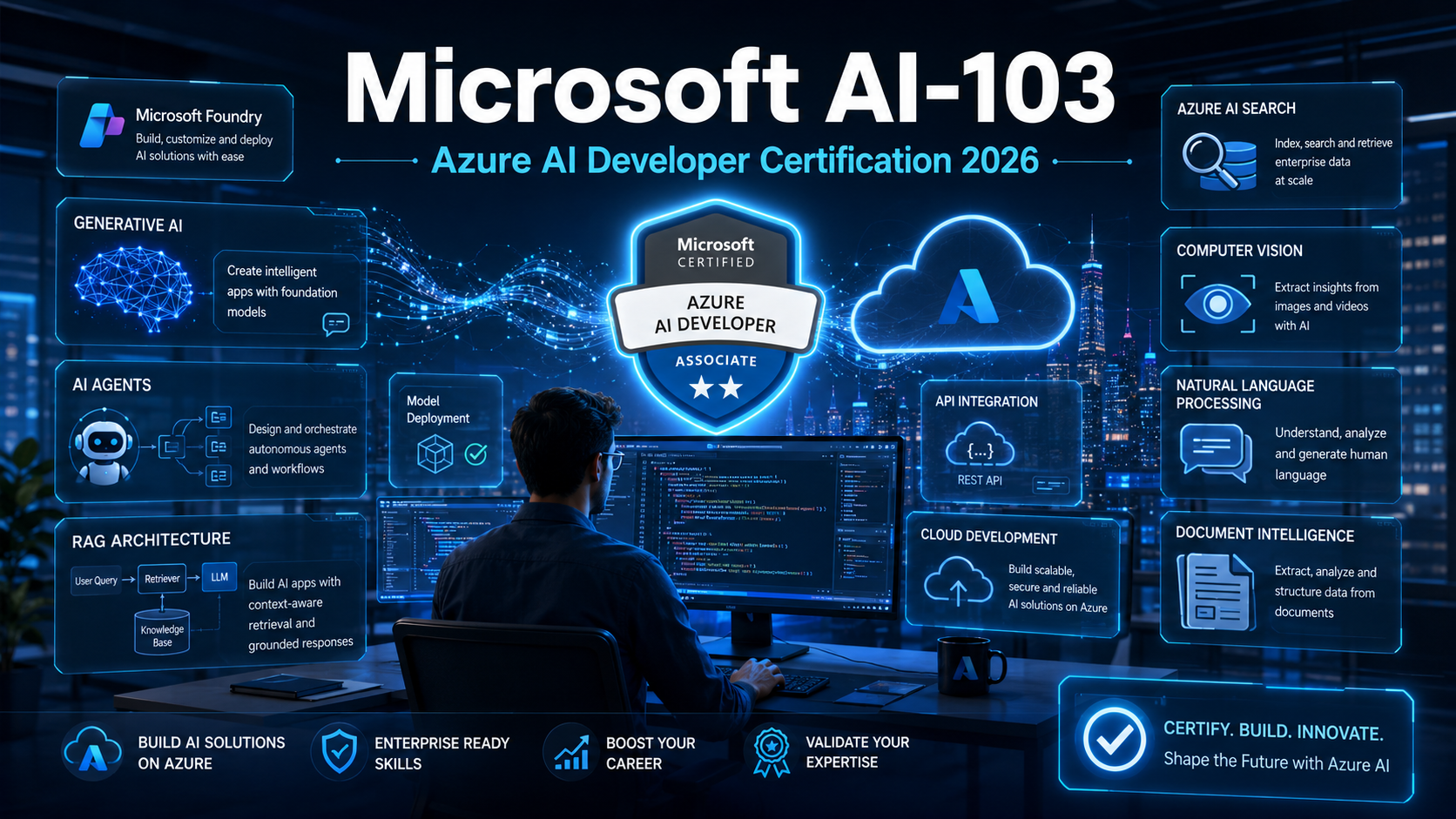
In 2026, candidates searching for the Microsoft AI-103 Azure AI Developer Associate certification should know that its official name is Microsoft Certified: Azure AI Apps and Agents Developer Associate. The AI-103 exam is titled Developing AI Apps and Agents on Azure and focuses heavily on building practical solutions with Python, Microsoft Foundry, Azure services, retrieval systems, agents, language processing, vision, and information extraction.
This guide explains what AI-103 covers, the skills you should develop, an effective Azure AI developer learning path, important Azure services, how to approach AI-103 exam questions, and how to use an AI-103 practice test effectively before attempting the certification.
What Is the Microsoft AI-103 Certification?
AI-103 is an intermediate-level Microsoft certification exam aimed at developers and engineers who design, build, deploy, and maintain intelligent applications on Azure.
The certification focuses on practical development rather than simply testing whether you can recognize Azure product names.
Candidates are expected to understand how different Azure capabilities fit together inside a working application.
For example, imagine a company receives thousands of contracts every month. A developer might build a system that:
- extracts information from uploaded documents
- indexes important content
- allows users to search the documents
- generates answers based on retrieved information
- applies security and content controls
- monitors application quality and performance
AI-103 examines many of the skills needed to create systems like this.
Microsoft recommends that candidates already have experience developing applications with Python and understand general AI concepts, generative systems, and Azure services.
Why AI-103 Matters in 2026
Microsoft’s certification path changed significantly in 2026.
The previous AI-102: Designing and Implementing a Microsoft Azure AI Solution exam was retired on June 30, 2026. AI-103 represents the newer direction of Microsoft’s Azure development certification path, with much stronger attention given to Microsoft Foundry, generative applications, retrieval-augmented generation, agents, multimodal systems, and modern information-processing workloads.
This makes the certification particularly relevant to professionals working with:
- Azure application development
- intelligent cloud applications
- enterprise search
- document processing
- conversational applications
- agent-based systems
- computer vision
- natural language processing
- retrieval systems
- multimodal applications
The exam is not limited to understanding individual services. Candidates need to understand how services work together when designing a complete solution.
AI-103 Exam Skills You Need to Understand
Microsoft currently divides the AI-103 exam into five major skill areas.Candidates should also review the official AI-103 study guide before starting their preparation.
1. Plan and Manage an Azure AI Solution (25-30%)
This section evaluates whether you can choose, configure, secure, deploy, and manage the right Azure components for a solution.
Candidates should understand topics such as:
- selecting appropriate models for different tasks
- choosing Microsoft Foundry services
- selecting retrieval and indexing approaches
- planning infrastructure
- configuring deployments
- integrating projects with CI/CD processes
- managing quotas and scaling
- monitoring application performance
- controlling costs
- configuring identities and permissions
- implementing safety controls
A typical scenario may describe an application with specific security, performance, or scalability requirements and ask you to identify the most suitable architecture.
This means memorizing definitions alone is unlikely to be enough.
You should understand why one technical choice would be more appropriate than another.
2. Implement Generative AI and Agentic Solutions ( 30-35%)
This is currently the largest area of the exam.
It covers the development of generative applications and agent-based systems using Microsoft Foundry.
Important areas include:
- deploying and consuming models
- connecting applications to Foundry projects
- retrieval-augmented generation
- grounding responses with external information
- implementing tools and functions
- managing conversation context
- building agent workflows
- connecting APIs and knowledge sources
- evaluating outputs
- implementing tracing and monitoring
- managing model behavior
- creating multi-step workflows
Consider a customer-support application.
Instead of allowing the application to answer from general knowledge, the developer may connect it to product documentation stored inside a searchable knowledge system. Relevant information is retrieved first and then used to produce a grounded response.
Understanding this complete flow is much more useful for AI-103 preparation than simply memorizing what RAG stands for.
3. Implement Computer Vision Solutions (10-15%)
Computer vision remains an important part of the certification.
The current AI-103 objectives include both understanding visual information and working with image or video capabilities.
You may need to understand how to:
- analyze images
- process video
- identify objects or regions
- generate image descriptions
- work with multimodal models
- extract visual characteristics
- apply content-safety controls
- handle visual information within applications
A practical example could be an insurance system where customers upload photographs of damaged property.
The application might analyze the image, identify important visual details, generate structured information, and send the results into another business process.
4. Implement Text Analysis Solutions (10-15%)
Text processing is another major part of Azure application development.
Candidates should be familiar with tasks such as:
- extracting entities
- identifying topics
- generating summaries
- detecting sentiment
- translating text
- identifying sensitive information
- producing structured output
- speech-to-text
- text-to-speech
- speech translation
Microsoft’s current objectives also include integrating language and speech capabilities into broader application workflows.
For example, a multinational support department might receive customer messages in several languages. An Azure-based application could detect or translate the content, extract important information, classify the issue, and prepare structured data for the support team.
5. Implement Information Extraction Solutions (10-15%)
Information extraction becomes especially important when applications work with large collections of documents or mixed content.
Candidates should understand:
- document ingestion
- OCR
- semantic search
- vector search
- hybrid search
- indexing
- enrichment
- retrieval pipelines
- structured information extraction
- Microsoft Content Understanding
- grounding applications with retrieved information
The AI-103 objectives include building retrieval pipelines capable of processing documents, images, audio, and video.
A good real-world example is invoice processing.
An organization may receive invoices as PDFs and scanned images. The application needs to recognize the text, identify fields such as supplier name and invoice amount, structure the extracted information, and make the data available to another business application.
Azure AI Services Overview for AI-103
A useful Azure AI services overview should focus on what each capability helps developers accomplish rather than trying to memorize every product feature.
Microsoft Foundry
Microsoft Foundry is central to the AI-103 learning path.
Candidates should understand how Foundry can support model deployment, application development, agents, evaluation, monitoring, and connections to other services.
Azure AI Search
Search becomes especially important for applications that need information from private or organizational data.
Key concepts include:
- indexes
- vector search
- semantic search
- hybrid search
- retrieval
- grounding
- data ingestion
Azure AI Search commonly appears in architectures involving retrieval-augmented generation.
Azure OpenAI
Developers should understand how models can be deployed and consumed securely inside Azure applications.
The exam is more likely to test how models fit into an application architecture than require simple memorization of model names.
Azure AI Language and Translator
Language-related services can help applications analyze, classify, extract, translate, and understand text.
Azure AI Speech
Speech capabilities support scenarios such as:
- speech recognition
- speech generation
- voice-enabled applications
- speech translation
Azure AI Vision
Vision-related capabilities can help applications interpret images and visual information.
Azure AI Document Intelligence and Content Understanding
Document and content processing is particularly relevant to information-extraction scenarios.
Microsoft’s AI-103 study objectives include OCR, layout analysis, structured extraction, and creating grounded representations that retrieval systems or agents can later use.
A Practical Azure AI Developer Learning Path
A structured Azure AI developer learning path is usually more effective than studying exam objectives randomly.For additional AI-103 preparation resources, practice materials, and certification guidance, visit: https://certsgate.com/
Step 1: Strengthen Your Python Skills
You do not need to become an advanced Python specialist before preparing for AI-103, but you should be comfortable with:
- functions
- classes
- dictionaries
- JSON
- environment variables
- HTTP requests
- REST APIs
- SDKs
- exception handling
- authentication concepts
Most importantly, you should be able to read a short code sample and understand what it is doing.
Step 2: Understand Core Azure Concepts
Before going deeply into AI-103, understand basic Azure concepts such as:
- subscriptions
- resource groups
- Azure resources
- regions
- identities
- roles and permissions
- endpoints
- keys and credentials
These concepts appear throughout real Azure development.
Step 3: Learn Microsoft Foundry
Spend time creating projects and understanding the development workflow.
Learn how applications connect to models, tools, external knowledge, and other Azure services.
Step 4: Build a Small Generative Application
Create something simple before attempting more complex agent architectures.
For example:
- Create a Foundry project.
- Deploy an appropriate model.
- Connect through Python.
- Send requests.
- Process the returned output.
- Add error handling.
- Add logging.
The goal is to understand the complete application flow.
Step 5: Build a Retrieval-Based Application
Next, build an application that answers questions from your own documents.
Learn the relationship between:
- documents
- chunking
- embeddings
- indexes
- vector search
- retrieval
- grounding
- response generation
This gives you practical knowledge that can help with many scenario-based AI-103 exam questions.
Step 6: Explore Agents and Tools
Once you understand normal application flows, study agents.
Focus on:
- agent instructions
- tool definitions
- function calling
- conversation memory
- external APIs
- retrieval
- safeguards
- approval controls
- monitoring
Try building an agent that must call a function instead of answering every request directly.
Step 7: Practice Vision, Language and Document Scenarios
Do not spend all your preparation time on generative solutions.
The other exam sections collectively represent a significant part of the assessment.
Build at least one small example involving:
- image analysis
- language analysis
- speech processing
- document extraction
- search
How to Approach AI-103 Exam Questions
Strong preparation means learning how to interpret scenarios rather than searching for memorized keywords.
When reading AI-103 exam questions, first identify what the problem is actually asking.
Look for requirements related to:
- security
- cost
- performance
- scalability
- search quality
- grounding
- permissions
- document processing
- model selection
- monitoring
For example, imagine a question describing an internal knowledge assistant that must answer only from company documents.
Important clues would include:
- private organizational content
- document ingestion
- retrieval
- grounding
- access control
Those clues immediately point toward a retrieval architecture rather than a standalone model response.
How to Use an AI-103 Practice Test Effectively
An AI-103 practice test should be treated as a learning tool, not simply a score generator.
When you answer a practice question incorrectly, identify why.
Ask yourself:
- Did I misunderstand the Azure service?
- Did I miss an important requirement?
- Did I confuse two similar services?
- Do I understand the architecture behind the scenario?
- Could I implement this solution myself?
Keep a simple list of weak areas.
For example:
Topic Confidence
Foundry projects High
RAG architecture Medium
Agent tools Medium
Vision Low
Content Understanding Low
Security and managed identity Medium
Then spend more study time on the low-confidence topics.
At the time of writing, Microsoft states that its official Practice Assessment for AI-103 is not yet available, although candidates can use the Microsoft exam sandbox to become familiar with the testing interface.
This makes hands-on labs, scenario questions, self-testing, and carefully selected practice material even more useful during preparation.
Common AI-103 Preparation Mistakes
Studying Only Definitions
Knowing what a service does is useful, but certification questions often require you to choose the right service for a particular situation.
Learn through scenarios.
Ignoring Hands-On Practice
Reading documentation without building anything can leave large gaps in understanding.
Even small projects can make concepts much easier to remember.
Focusing Only on Generative Applications
Generative and agentic solutions carry the largest weighting, but vision, text processing, information extraction, security, deployment, and management still matter.
Memorizing Practice Questions
Memorizing answers may improve a practice score without improving your understanding.
Instead, learn the reasoning behind each answer.
Ignoring Security
Modern Azure solutions need secure identity, controlled access, protected networking, monitoring, and appropriate permissions.
Security should be part of your architecture from the beginning.
A Simple 6-Week AI-103 Study Roadmap
A balanced preparation schedule could look like this:
Week 1: Azure and Python Foundations
Review Azure resources, authentication, SDK usage, API calls, and Python development.
Week 2: Microsoft Foundry
Study projects, model deployments, application connections, security, monitoring, and evaluation.
Week 3: Generative Applications and RAG
Build a basic application and then add document retrieval, indexing, vector search, and grounding.
Week 4: Agents
Learn tools, function calling, memory, orchestration, safeguards, and agent monitoring.
Week 5: Vision, Language and Information Extraction
Work through smaller projects involving images, speech, text analysis, document processing, and search.
Week 6: Review and Practice
Use AI-103 practice test questions, review weak areas, revisit labs, and practice interpreting architecture scenarios.
The exact preparation time will vary depending on your existing Azure and Python experience.
Final Thoughts
The Microsoft AI-103 Azure AI Developer Associate path represents a broader type of cloud development than earlier Azure certification exams.
Candidates are expected to understand not only individual services but also how models, search systems, agents, language tools, vision services, document processing, security, monitoring, and application code work together.
The best preparation strategy is therefore practical.
Follow a structured Azure AI developer learning path, understand the major services, build small Azure projects, study the official exam domains, review realistic AI-103 exam questions, and use an AI-103 practice test to identify weaknesses rather than simply memorizing answers.
If you can look at a business problem and explain which Azure components should be used, how they connect, how the application should be secured, and how the solution should be monitored, you are developing the understanding AI-103 is designed to evaluate.
Frequently Asked Questions About Microsoft AI-103
What is the Microsoft AI-103 exam?
Microsoft AI-103 is the exam for the Microsoft Certified: Azure AI Apps and Agents Developer Associate certification. It focuses on designing and developing Azure applications involving Microsoft Foundry, generative solutions, agents, computer vision, text analysis, and information extraction.
Is AI-103 replacing AI-102?
AI-102 was retired on June 30, 2026. AI-103 represents Microsoft’s newer certification path for developers building modern Azure AI applications and agent-based solutions.
Which programming language should I know for AI-103?
Microsoft recommends experience developing applications with Python for the AI-103 certification. Candidates should also be comfortable working with APIs, SDKs, authentication, and Azure services.
Are AI-103 exam questions practical or theoretical?
Candidates should prepare for both conceptual knowledge and scenario-based problem solving. Microsoft states that the assessment may also contain interactive components, so understanding how Azure solutions are actually built is important.
What is the best way to prepare for the AI-103 exam?
Start with Python and Azure fundamentals, learn Microsoft Foundry, build generative and retrieval-based applications, practice agent development, study vision and information extraction, and finish with scenario-based review and practice questions. Hands-on experience should be a central part of the preparation process.