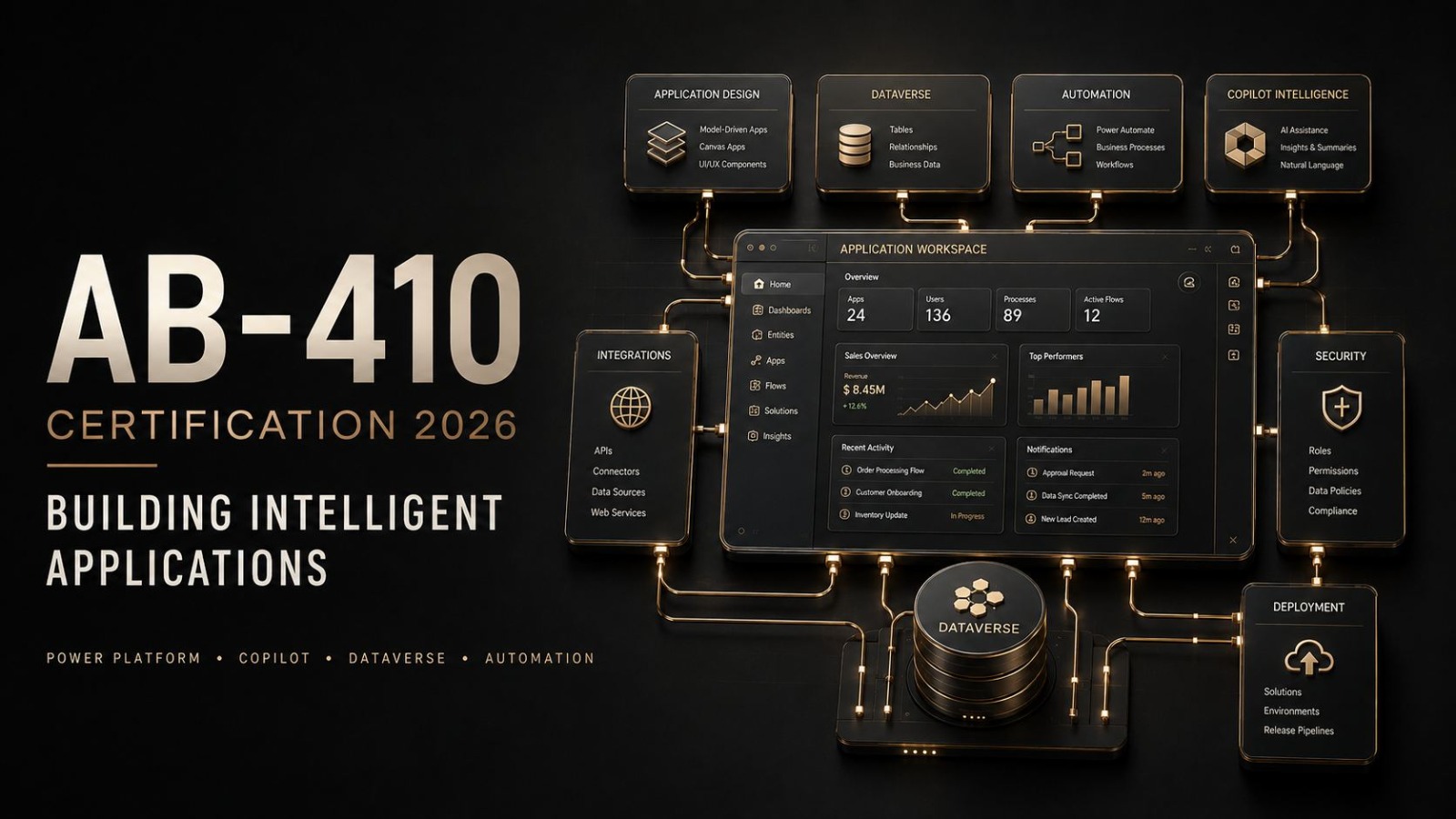

Business applications are moving beyond traditional forms, workflows, and dashboards. Modern application builders are increasingly expected to connect business data, intelligent capabilities, apps, and processes into solutions that can respond to real business requirements.
That is the focus of the AB-410 certification 2026. The Microsoft Certified: Intelligent Applications Builder Associate certification is designed for professionals who build intelligent business applications with Microsoft Power Platform, Microsoft Copilot, Dataverse, Power Apps, Power Automate, Power Pages, and related capabilities.
The associated AB-410: Building Intelligent Applications exam evaluates practical skills rather than focusing on a single product. Candidates are expected to understand how different Power Platform components work together to create complete business solutions.
This guide explains the AB-410 certification, exam structure, skills measured, preparation strategy, recommended study approach, and career relevance.
What Is the AB-410 Certification?
The AB-410 certification is the exam-based credential associated with the Microsoft Certified: Intelligent Applications Builder Associate certification.
It is aimed at professionals who create business applications using Microsoft Power Platform and incorporate Copilot, natural-language capabilities, data models, business logic, and intelligent features into those applications.
The certification is positioned at the intermediate level and is associated with application development. Its primary Power Platform products include:
- Power Apps
- Power Automate
- Power Pages
- Microsoft Power Platform
- Dataverse
- Copilot Studio
- AI Hub and related prompting capabilities
Microsoft currently lists AB-410 as the certification exam for the Intelligent Applications Builder Associate credential.
Who Should Consider the AB-410 Certification?
The certification is particularly relevant to professionals who build or maintain business applications using Microsoft Power Platform.
Potential candidates include:
- Power Apps developers
- Power Platform developers
- Business application builders
- Low-code application developers
- Power Automate professionals
- Application consultants
- Business analysts working closely with Power Platform teams
- Professionals moving into intelligent application development
It can also be useful for experienced Microsoft business-application professionals who want to expand their Power Platform skills into newer intelligent application capabilities.
Understanding the Microsoft Intelligent Applications Builder Certification
The Microsoft Intelligent Applications Builder certification represents a broader shift in how business applications are designed.
Traditional applications normally respond directly to predefined user actions. Modern business applications can provide more contextual assistance, connect information from multiple sources, and help users complete complex tasks more efficiently.
For certification candidates, this means understanding the complete application rather than studying individual Microsoft products separately.
A business solution might involve:
- Capturing information through Power Apps.
- Storing structured business information in Dataverse.
- Connecting external services through connectors or APIs.
- Using Power Automate for business processes.
- Providing conversational functionality through Copilot Studio.
- Applying appropriate permissions and governance.
- Monitoring and improving the finished solution.
Exam preparation should therefore focus on relationships between services as much as individual product features.
What Does the AB-410 Exam Cover?
The AB-410 exam focuses on three major skill areas. Understanding their weighting is important when creating an AB-410 study guide because the sections do not carry equal importance.
1. Create a Foundation for Intelligent Applications (25–30%)
This section focuses on the foundation required to build reliable Power Platform applications.
Candidates should understand topics such as:
- Dataverse tables and relationships
- Data modeling
- Columns and data types
- Choices and business data structures
- Solutions
- Environment considerations
- Security concepts
- Application lifecycle considerations
- Connecting business requirements with Power Platform components
A strong data foundation is important because applications, flows, and other capabilities depend on properly structured business information.
2. Create Intelligent Applications (25–30%)
This area focuses on developing applications with Power Apps and incorporating intelligent capabilities.
Important topics include:
Model-driven apps
Candidates should know how to:
- Configure forms
- Configure views
- Create generative pages using natural language
- Compose model-driven applications
- Configure access to forms and views
- Configure application access
- Create charts and dashboards
Canvas apps
The exam also evaluates the ability to:
- Create canvas apps using data
- Design accessible and responsive applications
- Improve application performance and usability
- Automate processes from canvas apps
- Work with variables and collections
- Create reusable components
- Use named formulas and user-defined functions
- Implement error handling
- Test canvas applications
- Use Monitor for troubleshooting
- Create a Copilot Studio agent from a canvas app
The emphasis is not simply on creating an application. Candidates need to understand how application design decisions affect usability, maintainability, and business requirements.
3. Build Business Application Logic and Automation (40–45%)
This is the largest section of the AB-410 exam, making it an especially important area for AB-410 exam preparation.
It covers business logic, cloud flows, prompts, models, and process implementation.
Create cloud flows
Candidates should be familiar with:
- Selecting appropriate triggers
- Evaluating connectors
- Configuring actions
- Managing approvals
- Conditions
- Loops
- Flow control
- Testing
- Troubleshooting
For example, a business might need a process in which a new customer request is submitted, reviewed, approved, and then recorded in a business application. Understanding how to design that process is part of the practical knowledge tested by AB-410.
Create prompts and models in AI Hub
Candidates should also understand how to:
- Build prompts from templates
- Create prompts from scratch
- Use prompts in applications
- Use prompts in cloud flows
- Add knowledge to prompts
- Configure prompt settings
- Work with model selections
- Add appropriate inputs to prompts
The important skill is understanding when and how these capabilities should be incorporated into a business solution.
Implement business and process logic
This section includes:
- Business rules
- Business process flows
- Calculated columns
- Rollup columns
- Formula columns
- Evaluating appropriate business-logic use cases
Because this section represents the largest percentage of the exam, candidates should give it significant attention during preparation.
What Skills Should You Have Before Taking AB-410?
The exam is designed around practical Power Platform development knowledge. Candidates should be comfortable with several foundational concepts before beginning serious preparation.
Useful experience includes:
Dataverse
You should understand how to structure business data, create relationships, configure columns, and use Dataverse as an application data platform.
Power Apps
You should have practical knowledge of both model-driven and canvas applications, including configuration, design, testing, and usability.
Power Automate
You should understand cloud flows, triggers, actions, connectors, conditions, loops, approvals, and troubleshooting.
Copilot and intelligent capabilities
You should understand how Copilot-related capabilities can be incorporated into applications and how prompts and models can support business requirements.
Power Pages
Basic familiarity with Power Pages and how it can be used as part of a broader business solution is also relevant.
The goal is not to memorize isolated product features. You should understand how these components work together.
Application Lifecycle and Solution Management
Building the first version of an application is only one stage of application development.
Organizations normally maintain separate development, testing, and production environments.
Candidates should understand how Microsoft Power Platform solutions can help move components between environments.
A simplified application lifecycle might look like this:
- Develop the solution.
- Test individual features.
- Validate the complete application.
- Package solution components.
- Move the solution into a testing environment.
- Perform user acceptance testing.
- Deploy the approved version.
- Monitor the production application.
- Release future improvements.
Understanding this lifecycle helps candidates connect technical development with real organizational practices.
AB-410 Exam Format and Passing Score
Microsoft currently lists 700 or greater as the passing score for AB-410. The exam is currently offered in English and is delivered through Pearson VUE. Microsoft lists a 120-minute assessment time on the certification page. Exam details, pricing, and availability can vary by location and may change, so candidates should verify the latest information on Microsoft’s official certification page before scheduling.
A Practical AB-410 Study Guide
A structured AB-410 study guide can make preparation more manageable. Microsoft’s official study guide outlines the skills measured in the exam and provides recommended learning resources.
Step 1: Understand the Exam Scope
Start by identifying the major areas that the AB-410 exam expects candidates to understand.
Create separate study sections for major technologies such as:
- Power Apps
- Dataverse
- Copilot Studio
- Integrations
- Security
- Solution management
- Application design
This makes it easier to identify gaps.
Step 2: Strengthen Power Platform Foundations
Candidates who are new to Power Platform should avoid jumping immediately into advanced scenarios.
First become comfortable with basic concepts such as tables, apps, connectors, environments, permissions, and solutions.
These concepts appear repeatedly when building larger applications.
Step 3: Build Small Practice Solutions
Hands-on experience is particularly valuable for AB-410.
Instead of building one large application, create several small projects.
For example:
Project 1: Customer Request App
Create a basic application in which employees can:
- Add a customer request
- Select a request category
- Assign a priority
- Update its status
- Review existing requests
Project 2: Employee Information App
Build an application that:
- Uses Dataverse
- Includes related tables
- Applies different permissions
- Provides searchable employee information
Project 3: Business Support Copilot
Configure a conversational experience that helps users locate common business information and complete predefined actions.
Small projects make individual concepts easier to understand.
How to Approach AB-410 Exam Preparation
Effective AB-410 exam preparation should combine conceptual study with scenario practice.
Candidates who want additional practice resources can also explore AB-410 exam preparation materials from CertsGate as a supplementary resource alongside Microsoft’s official learning content.
Week 1: Power Platform and Dataverse
Focus on:
- Power Platform fundamentals
- Dataverse
- Tables
- Relationships
- Columns
- Solutions
- Security concepts
Week 2: Model-Driven Apps
Study:
- Forms
- Views
- Dashboards
- Charts
- Generative pages
- App configuration
- Access management
Build at least one small model-driven application.
Week 3: Canvas Apps
Practice:
- Data connections
- Variables
- Collections
- Components
- Named formulas
- User-defined functions
- Error handling
- Accessibility
- Performance
- Monitor
Week 4: Power Automate
Focus heavily on:
- Triggers
- Actions
- Connectors
- Conditions
- Loops
- Approvals
- Testing
- Troubleshooting
Build several flows rather than studying the concepts only theoretically.
Week 5: Prompts and Business Logic
Study:
- AI Hub
- Prompt creation
- Prompt inputs
- Knowledge
- Model settings
- Business rules
- Business process flows
- Calculated columns
- Rollup columns
- Formula columns
Week 6: Revision and Scenario Practice
Use the final week to:
- Review weak areas
- Revisit the skills measured
- Complete practical exercises
- Test applications
- Practice scenario-based questions
- Review common configuration mistakes
- Take timed practice assessments when available
Avoid spending the entire final week learning new topics. Concentrate on identifying and fixing knowledge gaps.
How Difficult Is the AB-410 Exam?
The difficulty of AB-410 depends heavily on your practical experience.
Someone who has worked with Dataverse, Power Apps, Power Automate, and related Power Platform services may find the exam more approachable than someone who has only studied the concepts.
The exam covers multiple technologies, so one common challenge is switching between different types of scenarios.
A question may require you to think about:
- Data structure
- Application design
- Business logic
- Cloud flows
- Prompts
- Security
- Testing
For this reason, studying individual features separately is not enough. You should practice designing complete solutions.
AB-410 vs. Traditional Power Platform Skills
AB-410 builds on familiar Power Platform development concepts but places greater emphasis on intelligent application experiences.
Traditional application development may focus primarily on:
- Data
- Forms
- Views
- Workflows
- Business rules
- User interfaces
AB-410 expands this approach by requiring candidates to understand how applications can incorporate:
- Copilot capabilities
- Natural-language interactions
- Prompts
- Agents
- Intelligent data experiences
- Integrated business processes
This makes the certification particularly relevant to professionals adapting their Power Platform skills to newer application-development approaches.
Common AB-410 Preparation Mistakes
Memorizing Without Practicing
Reading documentation alone may provide familiarity with terminology, but application-building skills improve through direct experience.
Build and modify applications during preparation.
Studying Every Microsoft Product Equally
Not every Microsoft service deserves the same amount of preparation time.
Prioritize technologies directly related to the certification scope.
Ignoring Dataverse
Dataverse plays an important role across Microsoft business applications.
Candidates should understand data modeling, relationships, permissions, and solution components.
Overlooking Security
A technically working application is not necessarily a properly designed application.
Always consider authentication, authorization, data protection, and environment security.
Memorizing Practice Questions
Exam questions can present familiar concepts using completely different business scenarios.
Understanding the principle behind an answer is therefore more valuable than remembering a specific question.
Real-World Example of an Intelligent Power Platform Solution
Consider a company that manages equipment maintenance for business customers.
Technicians currently receive service requests through email. Customer details exist in one system, equipment information exists somewhere else, and managers manually track open requests.
A Power Platform solution could provide a more structured experience.
A technician-facing application could display:
- Assigned service requests
- Customer details
- Equipment history
- Maintenance notes
- Required parts
- Job status
Dataverse could store the core service records and relationships.
Connectors could retrieve information from additional business systems.
Copilot capabilities could help employees locate relevant information through natural-language interactions.
Permissions could restrict sensitive information based on employee roles.
Managers could then use the same platform to review service activity and maintain consistent business records.
This example demonstrates why AB-410 preparation involves several technologies rather than a single application-development product.
Skills You Can Develop Through AB-410 Preparation
Studying for the AB-410 certification 2026 can strengthen practical knowledge in several areas.
These include:
- Designing business applications
- Creating Power Apps solutions
- Modeling information in Dataverse
- Working with Microsoft Copilot Studio
- Integrating multiple services
- Applying role-based security
- Managing Power Platform environments
- Troubleshooting business solutions
- Planning application deployment
- Translating business requirements into technical solutions
These skills can apply to organizations already using Microsoft 365, Dynamics 365, Power Platform, and related cloud services.
Career Roles Related to AB-410 Skills
The certification may be relevant to several career paths, depending on previous experience.
Possible roles include:
- Power Platform Developer
- Power Platform Consultant
- Business Applications Developer
- Application Developer
- Microsoft 365 Developer
- Technical Consultant
- Solution Consultant
- Copilot Studio Developer
- Business Systems Analyst
- Low-Code Developer
Certification alone does not guarantee a particular role. Employers may also consider practical experience, development knowledge, project history, problem-solving ability, and familiarity with business processes.
Building a small portfolio of working applications can therefore complement certification preparation.
Final Thoughts
The AB-410 certification 2026 focuses on an increasingly important area of Microsoft application development: creating connected, intelligent business solutions using Power Platform, Copilot, business data, and Microsoft cloud services.
Successful preparation requires understanding how technologies work together.
Candidates should be comfortable designing applications, structuring information in Dataverse, connecting business services, configuring conversational experiences, applying security, and managing solutions throughout their lifecycle.
A strong AB-410 study guide should combine structured learning with hands-on projects and scenario-based practice. Rather than memorizing individual product features, focus on understanding which technology should be used for a particular business requirement and why.
That approach can make AB-410 exam preparation more useful both for the certification exam and for practical Microsoft business application development.
Frequently Asked Questions
1. What is the AB-410 certification?
AB-410 is the exam associated with the Microsoft Certified: Intelligent Applications Builder Associate certification. It evaluates skills related to building intelligent business applications using Microsoft Power Platform, including Power Apps, Dataverse, Power Automate, Copilot-related capabilities, and business logic.
2. What does the AB-410 exam test?
The exam covers three main areas: creating a foundation for intelligent applications, creating intelligent applications, and building business application logic and automation. Cloud flows and business application logic represent the largest portion of the exam.
3. Is prior Power Platform experience required for AB-410?
Microsoft positions the certification at an intermediate level. Practical familiarity with Dataverse, Power Apps, Power Automate, Power Pages, and Power Platform capabilities is highly useful when preparing for the exam.
4. What is the passing score for AB-410?
Microsoft lists 700 as the passing score for the exam.
5. What is the best way to prepare for AB-410?
Start with the official exam objectives, then combine structured study with hands-on practice. Give particular attention to Dataverse, Power Apps, cloud flows, business logic, prompts, testing, and troubleshooting. Practice complete business scenarios rather than studying individual features in isolation.