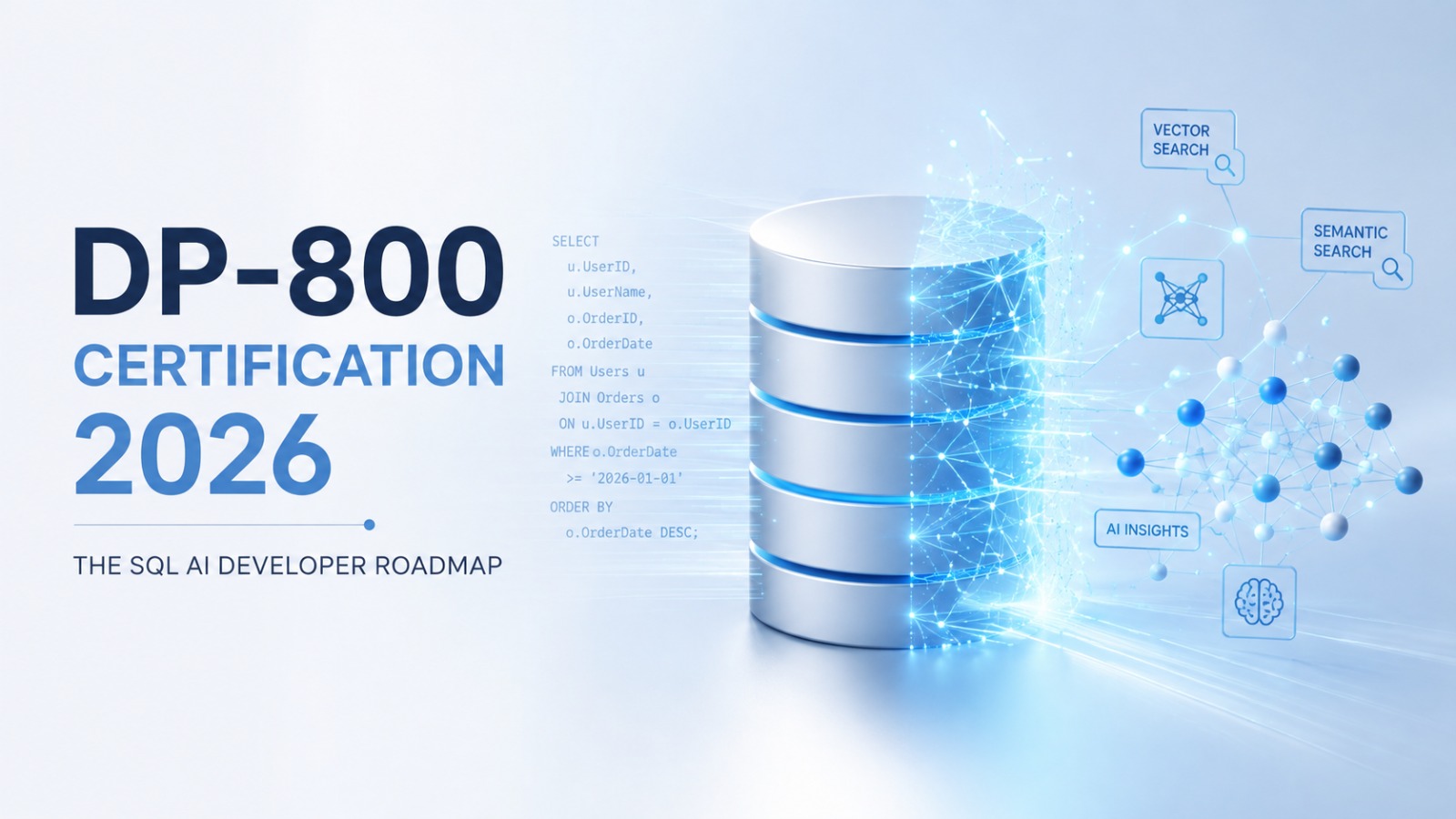

Modern database development is changing rapidly. SQL professionals are no longer expected to focus only on tables, queries, indexes, and stored procedures. They also need to understand newer approaches to intelligent search, vector data, secure application integration, database deployment, and modern development workflows.
The DP-800 Certification 2026 reflects this broader role. Officially associated with the Microsoft Certified: SQL AI Developer Associate credential, the DP-800 exam focuses on designing, developing, securing, optimizing, and deploying modern database solutions across Microsoft SQL platforms. Candidates are expected to work with SQL Server, Azure SQL, and SQL databases in Microsoft Fabric.
This guide explains the DP-800 Exam, the major skills candidates should develop, a practical DP-800 Study Guide, and a structured approach to DP-800 Exam Preparation in 2026.
What Is the DP-800 Certification?
The DP-800 Certification is designed for database developers and data professionals working with Microsoft’s SQL technologies.
It is considered an intermediate-level credential and focuses on practical database development rather than basic SQL knowledge. Candidates should already be comfortable writing T-SQL and working with relational database concepts before beginning serious preparation.
The certification covers several Microsoft database environments, including:
- Microsoft SQL Server
- Azure SQL
- SQL databases in Microsoft Fabric
- SQL Database Projects
- Azure-connected database services
- REST and GraphQL database access
- Vector and semantic search
- Secure database development
- Database performance optimization
- CI/CD practices
The overall objective is to demonstrate that a candidate can build database solutions that are secure, scalable, maintainable, and suitable for modern applications.
Who Should Consider the DP-800 Exam?
The DP-800 Exam is most relevant to professionals who already work with databases or application development.
Typical candidates may include:
- SQL developers
- Database developers
- Data engineers
- Backend developers
- Database administrators moving toward development
- Cloud database professionals
- Developers working with Azure SQL
- Microsoft Fabric data professionals
DP-800 is not primarily an introduction to databases. Someone who is completely new to SQL may benefit from developing foundational knowledge before attempting the certification.
A candidate should ideally understand SELECT statements, joins, indexes, database objects, transactions, permissions, and basic performance concepts before moving into the more advanced objectives.
DP-800 Exam Overview for 2026
Microsoft currently groups the DP-800 Exam objectives into three major skill areas. Candidates should review the official DP-800 skills measured before beginning the preparation.
1. Design and Develop Database Solutions (35–40%)
This is one of the largest sections of the exam.
Candidates need to understand how to design and implement database objects correctly. Topics include:
- Tables and appropriate data types
- Indexes and columnstore indexes
- Primary and foreign keys
- UNIQUE and CHECK constraints
- Default constraints
- Sequences
- Table and index partitioning
- Temporal tables
- Ledger tables
- Graph tables
- External tables
- JSON data
Candidates must also understand common programmability objects such as:
- Views
- Stored procedures
- Triggers
- Scalar functions
- Table-valued functions
Advanced T-SQL is another important part of this domain. Microsoft lists areas including common table expressions, window functions, correlated queries, JSON functions, regular expressions, fuzzy string matching, graph queries, and error handling.
2. Secure, Optimize, and Deploy Database Solutions (35–40%)
The second major section tests whether candidates can move beyond simply creating a working database.
A production database must also be secure, efficient, observable, and deployable.
Security topics include:
- Always Encrypted
- Column-level encryption
- Dynamic Data Masking
- Row-Level Security
- Object-level permissions
- Passwordless database access
- Auditing
- Managed identities
- Endpoint security
Performance is another major area.
Candidates should know how to investigate database performance using tools and concepts such as:
- Query execution plans
- Dynamic management views
- Query Store
- Query Performance Insight
- Transaction isolation levels
- Concurrency control
- Blocking
- Deadlocks
The exam also covers database development workflows using SQL Database Projects, source control, testing, branching, pull requests, schema drift detection, deployment pipelines, and secrets management.
3. Implement Intelligent Capabilities in SQL Solutions (25–30%)
The final domain represents a significant part of the modern SQL developer role.
Candidates should understand concepts such as:
- Embeddings
- Vector data
- Vector indexes
- Semantic search
- Full-text search
- Hybrid search
- Approximate nearest-neighbor search
- Exact nearest-neighbor search
- Retrieval-augmented generation
- External models
- Structured and semi-structured data
For example, consider an online store containing thousands of product descriptions.
Traditional keyword search may return products containing an exact search term. Semantic vector search can instead help applications identify products based on similarity in meaning, even when the wording is different.
Candidates should therefore understand both the database structures required for this type of search and the situations where different search approaches are appropriate.
DP-800 Study Guide: What to Learn First
A good DP-800 Study Guide should follow a logical order instead of simply following the exam objectives from top to bottom.
Start With Strong T-SQL Fundamentals
Before studying specialized features, make sure you can confidently work with:
- Joins
- Subqueries
- CTEs
- Aggregate functions
- Window functions
- Transactions
- Error handling
- Stored procedures
- Functios
- Views
- nIndexes
The exam contains advanced database topics, and weak SQL fundamentals can make these sections unnecessarily difficult.
Learn Database Design
Next, study how database structures affect performance, maintainability, and data integrity.
Understand why you would choose:
- A clustered versus nonclustered index
- A regular versus temporal table
- Relational versus JSON storage
- Partitioned versus non-partitioned tables
- Different constraint types
Focus on understanding the reason behind a design choice rather than memorizing definitions.
Study SQL Security
Security questions often require candidates to select the most appropriate control for a scenario.
For example:
If users should only see rows belonging to their own department, Row-Level Security may be appropriate.
If sensitive values should appear partially hidden to certain users, Dynamic Data Masking may be relevant.
If sensitive information needs protection from database operators under specific architectures, encryption technologies may need to be considered.
Understanding the purpose of each feature is more valuable than memorizing its name.
Candidates who want additional structured resources can also explore CertsGate’s DP-800 exam preparation to supplement their self-study and practical work.
Build Practical Performance-Tuning Skills
Database optimization deserves significant attention during DP-800 Exam Preparation because performance forms part of one of the exam’s largest domains.
Candidates should practice investigating:
- Slow queries
- Missing or ineffective indexes
- Expensive operations
- Table scans
- Blocking sessions
- Deadlocks
- Poor execution plans
Suppose an application normally retrieves customer orders in 200 milliseconds but suddenly takes several seconds.
A database developer should know how to investigate the execution plan, review relevant indexes, examine Query Store information, and determine whether blocking or
a query-plan change is contributing to the problem.
That type of troubleshooting mindset is useful both for DP-800 and real database development.
Learn Modern SQL Application Integration
Modern databases rarely operate independently. They normally support applications, services, reporting platforms, or APIs.
The DP-800 objectives therefore include integration concepts such as Data API Builder and exposing database functionality through REST or GraphQL endpoints. Candidates should understand configuration, entities, filtering, searching, pagination, relationships, deployment, and security.
You should also become familiar with change-related technologies such as:
- Change Data Capture
- Change Tracking
- Change event streaming
- Azure Functions SQL trigger bindings
- Azure Logic Apps
The goal is not simply to memorize these technologies but to understand when each approach may be appropriate.
Understand SQL Database CI/CD
Database deployment is another important DP-800 topic.
Traditional environments sometimes rely on developers making database changes manually. Modern development teams increasingly manage database schemas through version-controlled projects and deployment pipelines.
For the exam, understand:
- SQL Database Projects
- Source control
- Branching strategies
- Pull requests
- Build validation
- Database testing
- Schema changes
- Schema drift
- Secrets management
- Deployment controls
A useful practice exercise is to create a small database project, store it in Git, change the schema through a branch, validate the project, merge the change, and deploy it to a test database.
This turns abstract CI/CD terminology into practical experience.
A Six-Week DP-800 Exam Preparation Roadmap
Candidates can adjust this roadmap depending on their existing SQL experience.
Week 1: SQL and Database Objects
Focus on:
- Tables
- Constraints
- Indexes
- Views
- Functions
- Stored procedures
- Triggers
- CTEs
- Window functions
Build a small database rather than only reading about each feature.
Week 2: Advanced SQL Development
Practice:
- JSON storage and queries
- Regular expressions
- Fuzzy matching
- Graph queries
- Correlated queries
- Error handling
- Specialized table types
Create short exercises for each area.
Week 3: Security and Performance
Study:
- Encryption
- Data masking
- Row-Level Security
- Permissions
- Auditing
- Managed identity
- Execution plans
- Query Store
- DMVs
- Blocking
- Deadlocks
Spend extra time troubleshooting deliberately inefficient queries.
Week 4: Development and Deployment
Focus on:
- SQL Database Projects
- Git
- Branching
- Pull requests
- Testing
- Schema drift
- Deployment pipelines
- Secrets management
Candidates with little DevOps experience may need additional time here.
Week 5: Vector and Intelligent Search
Study:
- Embeddings
- Vector columns
- Vector indexes
- Similarity calculations
- Full-text search
- Semantic search
- Hybrid search
- ANN versus ENN
- Retrieval patterns
Try building a simple search scenario using sample data.
Week 6: Review and Practice
During the final week:
- Review the official skills outline.
- Identify your weakest domain.
- Repeat practical exercises.
- Complete practice assessments.
- Review incorrect answers carefully.
- Practice working within exam time limits.
- Avoid trying to learn completely new topics immediately before the exam.
Microsoft currently provides 120 minutes for the DP-800 assessment, and a score of 700 or higher is required to pass Microsoft certification exams using this scoring model.
Hands-On Practice Is Important for DP-800
Reading alone is unlikely to provide complete preparation for a technical database certification.
Candidates should create a small practice environment and perform actual tasks.
Useful exercises include:
- Create normalized SQL tables.
- Add indexes and compare query plans.
- Create stored procedures and functions.
- Implement Row-Level Security.
- Configure Dynamic Data Masking.
- Use JSON data inside SQL.
- Create a SQL Database Project.
- Place database code under source control.
- Experiment with vector data.
- Compare traditional and semantic search approaches.
- Investigate blocking and deadlocks.
- Build a basic database-backed API.
These exercises help connect individual DP-800 objectives into complete database solutions.
After completing the practical exercises, candidates can use CertsGate for DP-800 practice questions to assess their understanding and identify areas that need further review.
Common DP-800 Preparation Mistakes
Memorizing Without Practicing
Knowing what a feature does is different from knowing when to use it.
Scenario-based questions may present several technically possible choices. Practical experience makes it easier to identify the most appropriate one.
Ignoring Traditional SQL Topics
Candidates may spend too much time on newer database capabilities and overlook indexing, security, transactions, or T-SQL.
However, traditional database design, optimization, and deployment together make up most of the exam objectives.
Skipping Performance Tuning
Execution plans, Query Store, blocking, concurrency, and indexing deserve serious attention.
These concepts are also highly transferable to real SQL development work.
Studying Every Topic Equally
Use the official exam weightings to prioritize your preparation.
Two domains currently account for 35-40% each, while the third represents 25-30%.
Spend more study time where both the exam weighting and your personal knowledge gaps are greatest.
Is the DP-800 Certification Worth Pursuing in 2026?
The value of the DP-800 Certification 2026 depends largely on your career direction.
It may be particularly relevant if you work with Microsoft SQL technologies and want to demonstrate skills extending beyond traditional database development.
DP-800 combines database design, advanced T-SQL, security, performance, deployment practices, cloud integration, and modern search technologies under one certification.
However, certification should complement practical experience rather than replace it.
A candidate who earns the credential while also building real SQL projects will generally have a stronger technical foundation than someone who prepares only by memorizing exam material.
Final DP-800 Exam Preparation Checklist
Before scheduling the DP-800 Exam, make sure you can confidently:
- Design tables, indexes, constraints, and specialized database objects
- Write advanced T-SQL queries
- Create stored procedures, views, functions, and triggers
- Work with JSON data
- Implement database security controls
- Analyze execution plans
- Troubleshoot blocking and deadlocks
- Use Query Store and relevant monitoring tools
- Work with SQL Database Projects
- Understand source control and deployment workflows
- Configure database-backed REST and GraphQL access
- Understand vectors, embeddings, and semantic search
- Compare full-text, vector, and hybrid search approaches
- Apply retrieval patterns to SQL-based applications
If several items remain unfamiliar, continue practical preparation before attempting the exam.
Frequently Asked Questions
What is the DP-800 Certification?
The DP-800 Certification exam is associated with the Microsoft Certified: SQL AI Developer Associate credential. It evaluates skills in database development, security, optimization, deployment, modern search, and related SQL capabilities across Microsoft’s database platforms.
Is the DP-800 Exam difficult?
The difficulty depends on your experience. Candidates who already work with T-SQL, SQL Server, Azure SQL, database security, performance tuning, and development workflows may find preparation easier. Those new to professional database development may need more hands-on practice.
How long should DP-800 Exam Preparation take?
There is no single study period that suits everyone. An experienced SQL developer may require several weeks, while someone unfamiliar with Azure SQL, Microsoft Fabric, deployment pipelines, or vector search may need considerably longer.
What should a DP-800 Study Guide focus on?
A strong DP-800 Study Guide should cover database design, advanced T-SQL, security, performance optimization, SQL Database Projects, deployment workflows, Azure integration, vectors, semantic search, and retrieval patterns.
What certification do you receive after passing DP-800?
DP-800 is the qualifying exam for the Microsoft Certified: SQL AI Developer Associate credential. Microsoft categorizes the certification at the intermediate level and associates it with the developer role and data management subject area.
Conclusion
The DP-800 Certification 2026 represents a broader view of SQL development than traditional database certifications. Candidates need to understand database architecture and T-SQL, but they must also be comfortable with security, performance, source-controlled development, deployment practices, application integration, vector data, and modern search.
Successful DP-800 Exam Preparation should therefore combine structured study with repeated hands-on practice.
Instead of trying to memorize every individual feature, focus on understanding how database technologies work together to solve real development problems. That approach can improve exam readiness while also building skills that remain useful well beyond the DP-800 Exam.