
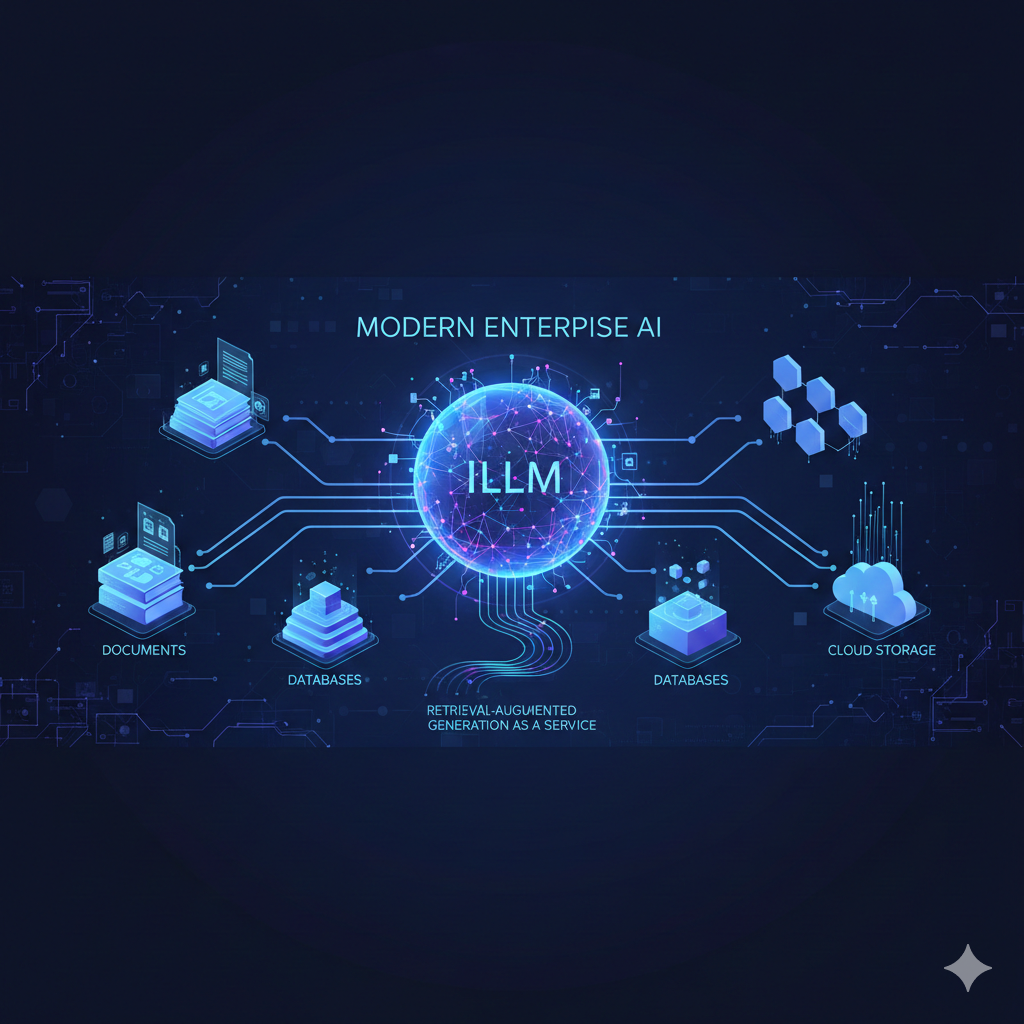

Artificial Intelligence has changed the way businesses work, communicate, and make decisions. However, traditional AI models have one major limitation: they only know what they were trained on. They cannot automatically access a company’s private documents, databases, or real-time information.
This is where Retrieval-Augmented Generation (RAG) comes in.
Today, many companies are not just using RAG—they are adopting RAG as a Service, a scalable and managed solution that brings accurate, up-to-date, and business-specific intelligence to AI systems.
In this blog, we will explain:
- What RAG is
- What RAG as a Service means
- How it works
- Why businesses are adopting it
- Use cases, benefits, and future trends
All explained in simple words.
What Is Retrieval-Augmented Generation (RAG)?
Retrieval-Augmented Generation (RAG) is an AI technique that combines:
- Information retrieval (searching relevant data)
- Text generation (AI creating responses)
Instead of relying only on pre-trained knowledge, RAG systems first retrieve relevant information from external sources and then use that information to generate accurate answers.
Simple Definition
RAG allows AI to “look up information first” before answering.
Why Traditional AI Is Not Enough
Traditional AI models:
- Cannot access private company data
- May give outdated information
- Sometimes hallucinate answers
- Cannot verify facts in real time
For businesses, this can be risky.
RAG solves this problem by grounding AI responses in real, trusted data.
What Is “RAG as a Service”?
RAG as a Service means providing RAG capabilities as a fully managed cloud service instead of building everything from scratch.
In simple words:
RAG as a Service lets businesses use RAG without handling complex infrastructure, data pipelines, or AI tuning.
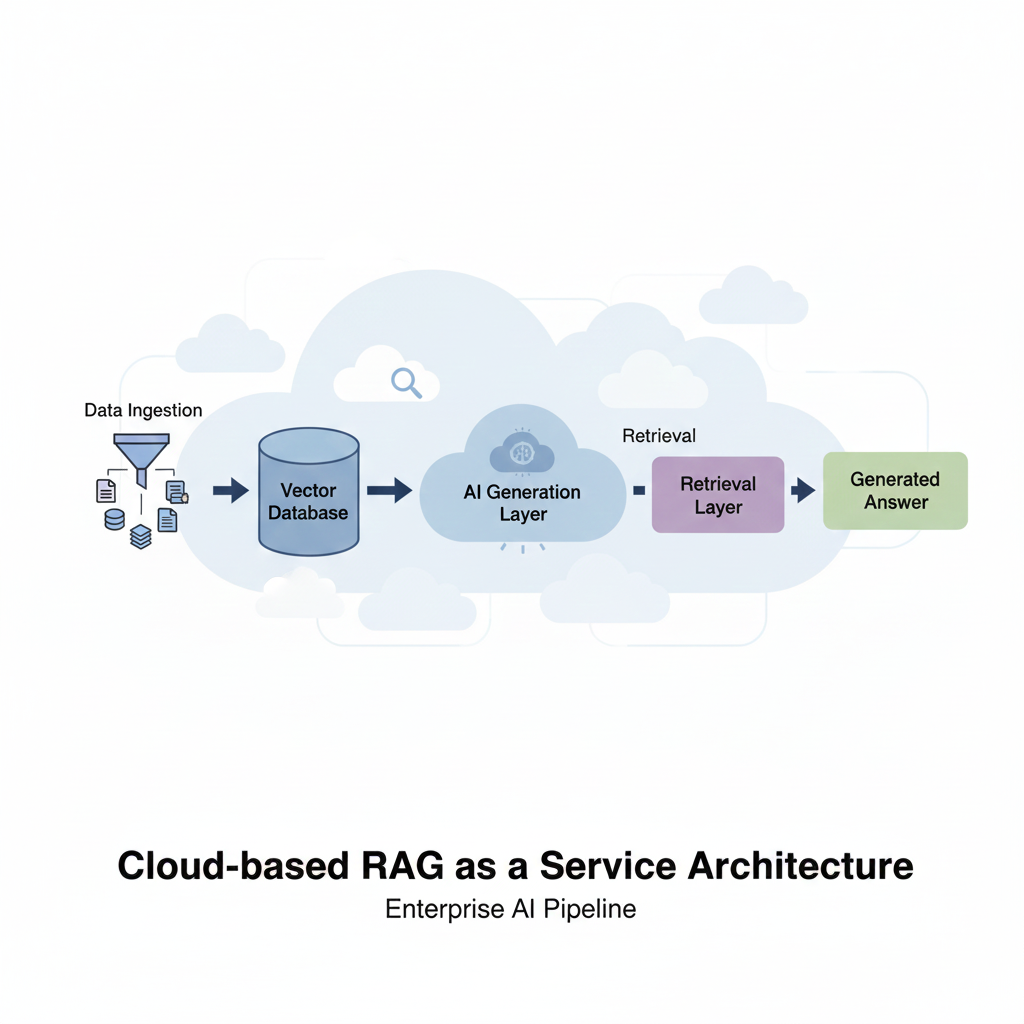
The service provider handles:
- Data ingestion
- Indexing and vector databases
- Retrieval pipelines
- AI model integration
- Security and scaling
Businesses just plug in their data and use AI.
How RAG as a Service Works (Step by Step)
Let’s break it down simply.
Step 1: Data Ingestion
Business documents are uploaded:
- PDFs
- Word files
- Knowledge bases
- Databases
- Websites
Step 2: Data Processing
The system:
- Cleans the data
- Breaks it into chunks
- Converts it into embeddings
- Stores it in a vector database
Step 3: User Query
A user asks a question, for example:
“What is our company’s refund policy?”
Step 4: Retrieval
The system searches the most relevant documents related to the question.
Step 5: Generation
The AI model uses the retrieved information to generate an accurate, context-aware answer.
Step 6: Response
The user receives a fact-based, company-specific response.
Key Components of RAG as a Service
A typical RAG service includes:
- Vector databases
- Embedding models
- Large language models (LLMs)
- Retrieval pipelines
- API access
- Monitoring and logging
- Security and access control
All of this is managed by the service provider.
Why Businesses Prefer RAG as a Service
1. Faster Deployment
Companies don’t need months of development. RAG services can be deployed quickly.
2. Lower Technical Complexity
No need to manage:
- AI infrastructure
- Model updates
- Scaling issues
3. Cost Efficiency
Pay only for usage instead of building expensive systems internally.
4. Better Accuracy
Responses are based on verified internal data, not guesses.
5. Scalability
The system grows as business data and users increase.
Common Use Cases of RAG as a Service
1. Customer Support Chatbots
AI answers customer questions using:
- FAQs
- Help documents
- Policies
This reduces support workload and improves response accuracy.
2. Internal Knowledge Assistants
Employees can ask questions like:
- “How do I submit expenses?”
- “What is the HR leave policy?”
AI responds using internal documents.
3. Legal and Compliance
RAG systems help:
- Search legal documents
- Answer compliance questions
- Reduce research time
4. Healthcare Information Systems
Doctors and staff can retrieve accurate information from:
- Medical guidelines
- Patient records
- Research papers
5. Financial and Enterprise Search
AI helps analyze:
- Reports
- Financial statements
- Audit documents
RAG as a Service vs Traditional Search
| Feature | Traditional Search | RAG as a Service |
| Results | List of documents | Direct answers |
| Context | Limited | High |
| Accuracy | Medium | Very High |
| User Effort | High | Low |
| AI Integration | No | Yes |
RAG doesn’t just find information—it understands and explains it.
Security and Privacy in RAG as a Service
Modern RAG services focus heavily on:
- Data encryption
- Role-based access
- Secure APIs
- Compliance with regulations
This makes them suitable for enterprise and regulated industries.
Popular Technologies Behind RAG Services
Many RAG services are built using:
- Vector databases (Pinecone, FAISS, Chroma)
- AI frameworks (LangChain, LlamaIndex)
- Cloud infrastructure
- Advanced LLMs
However, users don’t need to manage these tools directly.
Challenges of RAG (and How Services Solve Them)
Common Challenges:
- Data quality issues
- Retrieval accuracy
- Latency
- Maintenance
How RAG as a Service Helps:
- Automated optimization
- Continuous improvements
- Monitoring tools
- Expert-managed pipelines
Future of RAG as a Service (2026 and Beyond)
RAG as a Service is expected to grow rapidly due to:
- Enterprise AI adoption
- Need for accurate AI
- Agent-based systems
- Regulatory requirements
Future RAG systems will include:
- Multi-agent workflows
- Real-time data retrieval
- Smarter reasoning
- Deeper integrations with business tools
Who Should Use RAG as a Service?
RAG as a Service is ideal for:
- Enterprises
- SaaS companies
- Startups with large data
- Customer support teams
- Knowledge-heavy organizations
It is especially valuable when accuracy matters more than creativity.
Final Thoughts
Retrieval-Augmented Generation as a Service is transforming how businesses use AI. Instead of relying on generic answers, companies can now deploy AI systems that are accurate, secure, and deeply connected to their own data.
By offering scalability, reliability, and ease of use, RAG as a Service is becoming a core part of modern AI infrastructure.