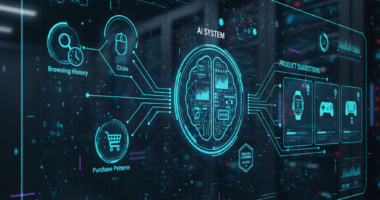


Agentic AI is one of the most important shifts in artificial intelligence today.
It goes beyond chatbots and simple automation.
Agentic AI systems can plan, decide, act, and improve on their own.
They don’t just respond. They execute goals.
In 2025, businesses are using agentic AI to run workflows, manage tasks, and make decisions with minimal human input.
This blog explains what agentic AI is, why it matters now, and how it is reshaping industries.
What Is Agentic AI?
Agentic AI refers to autonomous AI agents that can take initiative to achieve goals.
Unlike traditional AI, agentic systems:
- understand objectives
- break goals into steps
- take actions independently
- monitor results
- adapt based on feedback
Simple Example
An AI agent that manages customer support tickets:
It reads requests, prioritizes them, assigns responses, follows up, and reports results—without human control.
Why Beginners Should Care
Agentic AI is becoming the backbone of modern automation and digital workforces.
Why Agentic AI Is Trending in 2025
1. Advanced Large Language Models
LLMs now reason, plan, and remember context.
2. Business Automation Demand
Companies want systems that do work, not just assist.
3. Tool Integration
AI agents can use APIs, databases, browsers, and software tools.
4. Cost and Speed Pressure
One AI agent can replace multiple repetitive roles.
5. Scalable Decision-Making
Agents work 24/7 without burnout.
How Agentic AI Works
Agentic AI follows a cycle:
- Goal Understanding
Receives a clear objective. - Planning
Breaks the goal into smaller tasks. - Execution
Uses tools, APIs, or actions to complete tasks. - Observation
Evaluates outcomes and errors. - Adaptation
Adjusts strategy automatically.
This loop continues until the goal is achieved.
Key Capabilities of Agentic AI
- Autonomous decision-making
- Task prioritization
- Tool usage (emails, databases, browsers)
- Long-term memory
- Multi-step reasoning
- Self-correction
These features make agentic AI far more powerful than chatbots.
Real-World Use Cases
Customer Support
AI agents resolve tickets end-to-end.
E-commerce
Agents manage inventory, pricing, and recommendations.
Marketing
Campaign planning, content scheduling, and performance analysis.
Software Development
Code generation, testing, bug fixing, deployment.
Operations
Workflow automation and reporting.
Benefits of Agentic AI
- True automation
Not just assistance. - Massive productivity gains
Tasks complete faster. - Lower operational costs
Fewer human interventions. - Scalable intelligence
Agents can be duplicated easily. - Continuous improvement
Agents learn from results.
Popular Agentic AI Tools (2025)
- AutoGPT – multi-step task automation
- LangGraph / LangChain Agents – structured agent workflows
- CrewAI – multi-agent collaboration
- OpenAI Assistants API – tool-using AI agents
- Microsoft Copilot Agents – enterprise workflows
Each tool serves different levels of autonomy and control.
Common Mistakes to Avoid
- Giving vague goals
- Skipping safety constraints
- Over-trusting autonomous decisions
- Ignoring monitoring and logs
- Using agents without human oversight
Solution
Always define limits, permissions, and review points.
Challenges and Risks
- Unpredictable behavior
- Security and data risks
- Ethical decision-making
- Over-automation
- Dependence on AI systems
Responsible deployment is essential.
Future of Agentic AI
What’s Coming Next
- Multi-agent teams working together
- AI agents managing entire departments
- Real-time learning from live data
- Stronger AI governance frameworks
- Hybrid human–AI workplaces
Agentic AI will act more like a digital employee than a tool.
Conclusion
Agentic AI represents a major leap in artificial intelligence.
It shifts AI from assistant to actor.
Those who learn how to design, control, and collaborate with AI agents will lead the next wave of innovation.